A Shopify Retention Strategy That Actually Works
/
Most advice on Shopify retention strategy is still too tactical to be useful. It turns retention into a pile of disconnected tasks: send a thank-you email, add points, launch SMS, offer a discount, ask for a review. That approach creates activity, not control.
A real retention system starts somewhere less exciting. It starts with customer behavior by cohort, then builds the operating layers that make a second and third purchase more likely. That matters because replacing customers is expensive. Acquiring a new customer costs 5–7 times more than retaining an existing one, repeat customers spend 67% more per order than first-time buyers, and a good ecommerce retention rate is framed at 30–40% over 12 months according to EasyAppsEcom's retention statistics guide.
For serious operators, retention isn't an email problem. It's a system design problem. The right question isn't “what flows should be turned on?” It's “what sequence of investments will improve repeat purchase behavior without bloating the stack or training customers to wait for discounts?”
Table of Contents
The Retention Strategy Framework
Why tactic lists fail
The operating model behind retention
Stage 1 Get the Metrics Right
Measure cohorts before campaigns
Build a retention dashboard that changes decisions
Stage 2 The Post-Purchase Experience
Trust is built after checkout
Where operators usually create churn by accident
Stage 3 Lifecycle Email and SMS
Lifecycle messaging should follow customer state
Stack quality is the main constraint
Stage 4 Loyalty and Program Design
Points versus tiers
What strong programs actually reward
Stage 5 Subscription and Replenishment Where It Fits
When subscription belongs in the strategy
What reduces subscriber churn
Sequencing What to Invest In First
A practical order of operations
Category changes the sequence
The Retention Strategy Framework
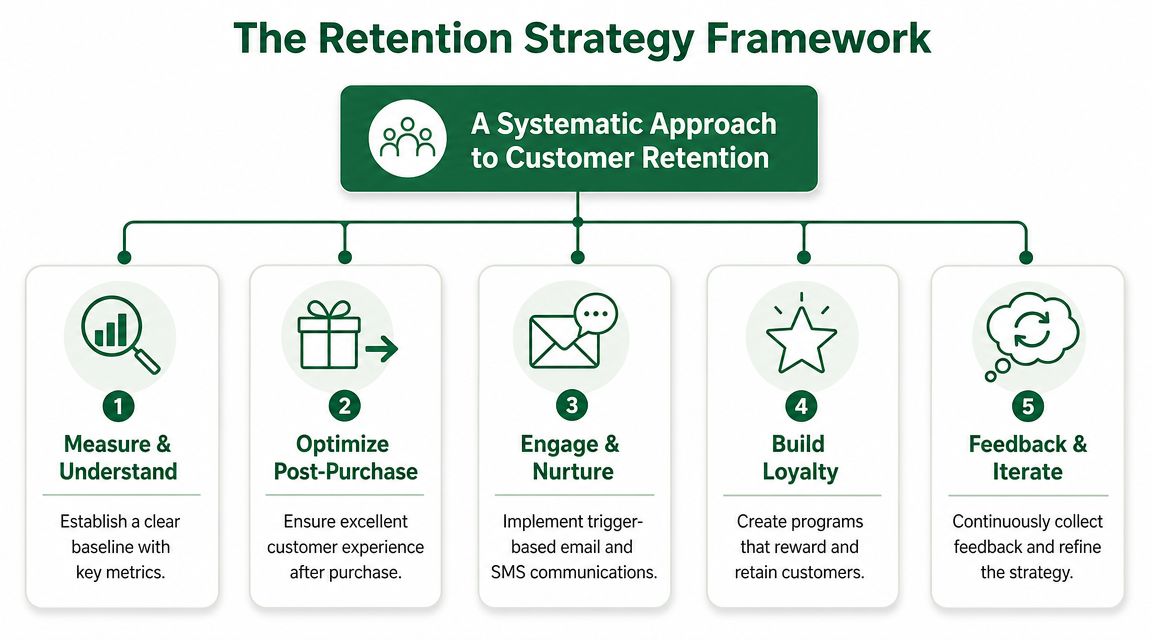
Retention usually breaks because teams buy tactics before they choose a sequence. The result is familiar. More apps, more sends, more reporting, and no clear lift in second-order rate or payback.
Why tactic lists fail
A retention strategy has to match the economics of the business. Skincare can justify replenishment and subscription testing early. Fashion often gets more from post-purchase trust, drop cadence, and win-back timing. Hard goods may have long reorder windows, which means heavy investment in loyalty or SMS too early can produce a weak return.
That is why retention works better as a staged system than a grab bag of ideas. Start with measurement, because bad baselines create bad decisions. Fix the post-purchase experience next, because customers who regret the first order rarely respond well to more messaging. Add lifecycle email and SMS after that, once the brand knows which customer states matter. Layer in loyalty when repeat behavior already exists and the program can reinforce it. Add subscription only when the product, margin profile, and reorder pattern support it.
Treat retention like capital allocation. Each tool, campaign, and program should justify its cost by improving repeat purchase behavior, contribution margin, or time to second order.
That's also the cleaner path to boosting LTV and profitability. LTV goes up when the business removes friction from reorder, support, returns, and product fit. It rarely goes up because a team added another generic flow.
The operating model behind retention
The strongest retention programs run on sequence and restraint. They define the behavior that matters, segment customers by likely next action, test the lowest-cost intervention that fits the problem, and keep funding what changes outcomes. Everything else is noise.
That operating model matters because stage determines priority. An early-stage store with inconsistent first-order experience should not spend like a mature brand with healthy repeat demand. A brand with strong reorder intent but weak reminder coverage should usually fix lifecycle execution before launching a points program. A brand with high repeat rate and stable margins may have room to formalize loyalty or subscription. Same channel options, different order of operations.
Retention becomes strategic when it is tied back to unit economics instead of engagement screenshots. This perspective on Shopify customer LTV for operators who build to last is useful for that reason. It frames retention around customer value, margin, and payback, which is the standard operators should use when deciding what to build first.
Stage 1 Get the Metrics Right
If the retention baseline is wrong, every downstream decision gets worse. Teams over-credit flows, under-credit support, and keep tools that don't meaningfully change customer behavior.
Measure cohorts before campaigns
Shopify's own guidance advises merchants to use the Customer Cohort Analysis report, and the repeat-customer-rate formula is total customers buying more than once ÷ total customers. The same guidance, cited by LoyaltyLion, also notes that 49% of customers are more likely to become repeat buyers after a personalized shopping experience, which is why segmentation matters before campaign volume does in LoyaltyLion's Shopify retention coverage.
Cohorts answer a question aggregate metrics hide. Are newer customers behaving better or worse than older ones? If paid social brought in a large month of buyers, repeat purchase rate at the store level may look fine while that specific acquisition month underperforms badly.
A clean dashboard usually includes these views:
Metric | Why it matters | Where to use it |
|---|---|---|
Cohort retention | Shows whether first-time buyers from the same period return over time | Channel quality, merchandising fit, offer quality |
Repeat customer rate | Shows how much of the customer base purchases more than once | Executive baseline, monthly operating review |
Customers over time | Separates new and returning demand | Budget planning and acquisition mix |
Time-to-second-order patterns | Shows whether the reorder window is predictable | Lifecycle timing and replenishment logic |
Build a retention dashboard that changes decisions
The point of reporting isn't visibility. It's intervention. If one cohort falls off faster, the team should ask whether the product, channel, offer, landing page promise, or post-purchase experience created the drop.
That's where purpose-built analytics tools help. Tresl's cohort analytics example shows the practical difference between looking at customer behavior as a retention system versus reading campaign outputs in isolation.
A strong Shopify retention strategy begins when the team can say which first-purchase cohorts became valuable, which didn't, and why.
For many brands, that changes channel thinking. A source that looks efficient on first-order revenue can still be poor for retention if those buyers never come back. The opposite also happens. Some channels bring in lower first-order efficiency but produce stronger repeat behavior and better long-term economics.
Stage 2 The Post-Purchase Experience
Retention starts after payment, not before. The first order creates hope. The next two weeks test whether the brand deserves a second order.
Trust is built after checkout
The post-purchase window should reduce anxiety, answer obvious questions, and make support easy. Operators often spend too much time optimizing pre-purchase persuasion while leaving order confirmation, tracking, packaging, and returns to default settings.
The basics still matter. Confirmation pages should reassure. Shipping updates should be proactive. If there's a delay, silence is worse than bad news. Packaging should help the customer use the product correctly and know what to do if something goes wrong.
Shopify highlights customer accounts and complaint resolution as core retention levers, while recent industry guidance also ties retention to richer customer experience, improved returns, and faster support in Enchant Agency's Shopify retention analysis.
Where operators usually create churn by accident
The first failure mode is over-selling too early. A customer who hasn't received the order yet doesn't need a cross-sell sequence. That customer needs clarity, tracking, and confidence.
The second failure mode is fragmented ownership. Marketing owns flows, CX owns tickets, ops owns fulfillment, and nobody owns the total post-purchase experience. Retention gets blamed on channel performance when the actual problem was confusion, damaged trust, or a slow resolution path.
A better operating approach looks like this:
Order communication first. Make order status obvious without forcing support contact.
Delay handling second. Write the playbook before delays happen.
Returns and exchanges third. Reduce friction, because a painful resolution process teaches customers not to come back.
Education fourth. If the product needs setup, fit guidance, or usage instructions, send them before frustration appears.
Support quality often determines whether lifecycle marketing works later. If the first order creates friction, every later email feels like pressure.
This is also where retention becomes a vendor decision. If support, returns, subscriptions, or tracking are weak because the stack is weak, the brand can't message its way out of the problem.
Stage 3 Lifecycle Email and SMS
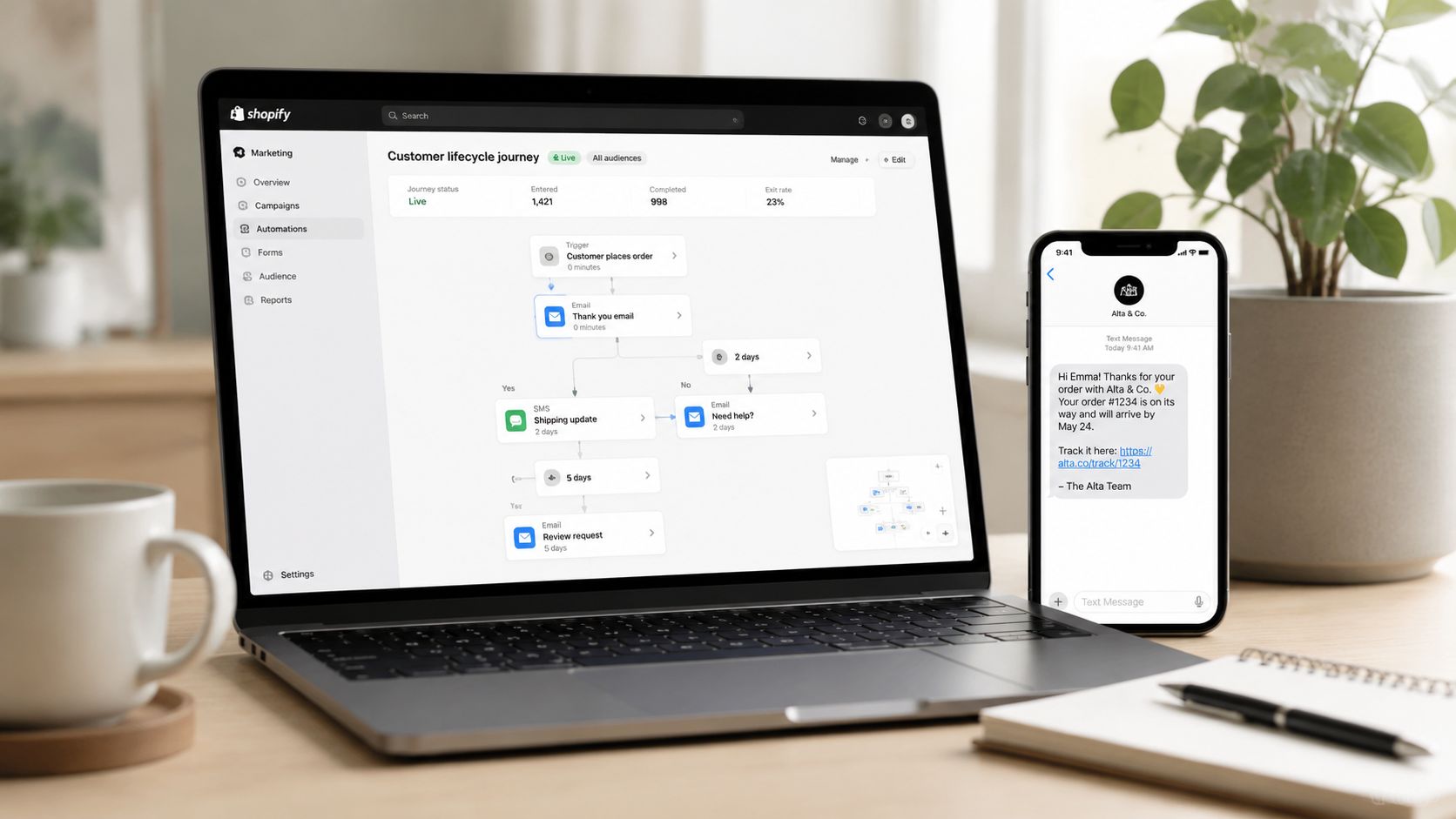
Lifecycle messaging should run off customer state and expected next action, not the campaign calendar. Brands that treat retention as a send-volume problem usually create unsubscribes, discount dependence, and noisy attribution.
Lifecycle messaging should follow customer state
The job of Stage 3 is simple. Move customers from first-order uncertainty to second-order confidence, then to repeat purchase behavior. That requires timing, segmentation, and channel discipline.
The highest-value flows are usually predictable, but their logic should change by category. A consumables brand needs reorder timing and usage-based reminders. A fashion brand needs fit follow-up, review capture, and browse or cart reactivation. A high-consideration product often needs education before any cross-sell attempt.
A practical split looks like this:
Flow type | Best use | Common mistake |
|---|---|---|
Post-purchase check-in | Confirm product satisfaction and surface issues early | Asking for a review before the product has been used |
Replenishment reminder | Prompt reorder near the expected consumption window | Using the same send date for every SKU |
Win-back | Re-engage lapsed buyers based on value, category, and last order gap | Sending the same offer to one-time buyers and high-LTV customers |
Loyalty update | Reinforce progress, status, or earned benefits | Treating it like another promotion |
The strategic question is not how many flows to build. It is which flows deserve automation at your current stage. Early on, a store often gets more from three well-tuned flows than from ten shallow ones. I usually prioritize based on revenue sensitivity first. Post-purchase and replenishment tend to pay back faster than elaborate nurture trees because they sit closer to purchase intent.
Stack quality is the main constraint
Execution breaks when event data is incomplete, channel ownership is split, or the team picks tools before defining the decision logic. The sequence matters. Define triggers, decide who owns outcomes, confirm events pass correctly, then build.
That is why lifecycle work should be reviewed as an operating system, not just a creative project. If SMS consent capture is weak, if product-level reorder logic is missing, or if customer support events never reach your ESP, the program drifts toward batch sends with better branding. Teams comparing vendors should start with use case fit, not feature sprawl. A practical place to compare options is this review of SMS marketing apps for Shopify.
Deliverability sits in the same bucket. If your core flows miss the inbox, performance reports will blame copy or offer when the actual problem is reach. Review how to stop email from going to spam in Gmail before rewriting every flow.
One more trade-off matters here. SMS is powerful for urgency, short buying cycles, and mobile-heavy audiences, but it gets expensive and irritating fast if the brand has not earned the right to interrupt. Email usually carries more education and more margin tolerance. Use SMS where speed matters. Use email where context matters.
One useful option for stack evaluation is app store research, a platform that connects Shopify merchants with paid product research interviews with app developers and UX teams. For operators trying to pressure-test retention vendors, request features, or compare tools without getting buried in outbound sales noise, direct conversations can be more useful than a standard demo cycle.
Stage 4 Loyalty and Program Design
Loyalty should formalize an existing pattern, not compensate for the absence of one. If customers don't yet have a good reason to buy again, adding points rarely fixes the underlying issue.
Points versus tiers
Points-based programs are simple to explain. They fit brands with broad audiences, steady purchase behavior, and enough order frequency to keep the program visible. Their weakness is predictability. Customers often translate them into a basic discount mechanic.
Tiered programs work better when the brand wants to reward identity and status, not just spend. They're stronger for brands with VIP behavior, drops, exclusivity, or perks that matter beyond price.
Model | Best fit | Risk |
|---|---|---|
Points | Broad base, frequent transactions, simple value exchange | Becomes just another discount layer |
Tiered VIP | Strong brand affinity, differentiated perks, higher-value buyers | Too complex if benefits are weak |
A loyalty program should match margin structure and brand posture. If margins are tight, don't build a scheme that teaches customers to extract value only through discounts.
What strong programs actually reward
The best program designs reward behaviors that deepen the relationship. That can include referrals, reviews, content contribution, or early engagement with new launches. The structure should tell customers what the brand values.
A narrow transaction-only program tends to become expensive. A broader program can reinforce participation and identity. That's one reason many operators now compare loyalty tools based on flexibility, not just widget design. This review of Shopify loyalty apps is useful because program design depends on what the tool can support.
Loyalty works when the customer feels recognized, not when the customer feels managed.
For many brands, the strongest perks aren't coupons. They're access, convenience, priority support, early product availability, or other benefits that competitors can't easily copy.
Stage 5 Subscription and Replenishment Where It Fits
Subscription is not a universal retention layer. It fits specific product economics and specific customer jobs.
When subscription belongs in the strategy
Consumables, routine-use products, and categories with predictable reorder cycles are the obvious fit. Supplements, skincare, household consumables, pet products, and similar categories can often support replenishment logic well. Fashion, gifting, and infrequent hard-goods replacement usually can't force subscription into relevance.
The decision should come from customer behavior, not software capability. If customers already reorder on a recognizable cadence and value convenience, subscription may reduce friction. If reorder timing is irregular or preference changes often, forced continuity usually creates churn and support load.
What reduces subscriber churn
Three features matter more than flashy acquisition offers:
Flexibility. Let subscribers skip, pause, swap, or adjust timing without friction.
Recovery logic. Handle failed payments cleanly so involuntary churn doesn't become avoidable revenue loss.
Ongoing value. Give customers a reason to stay beyond a standing discount.
A good ecommerce retention plan treats subscription as one branch of retention architecture, not the final stage every brand must reach.
Sequencing What to Invest In First
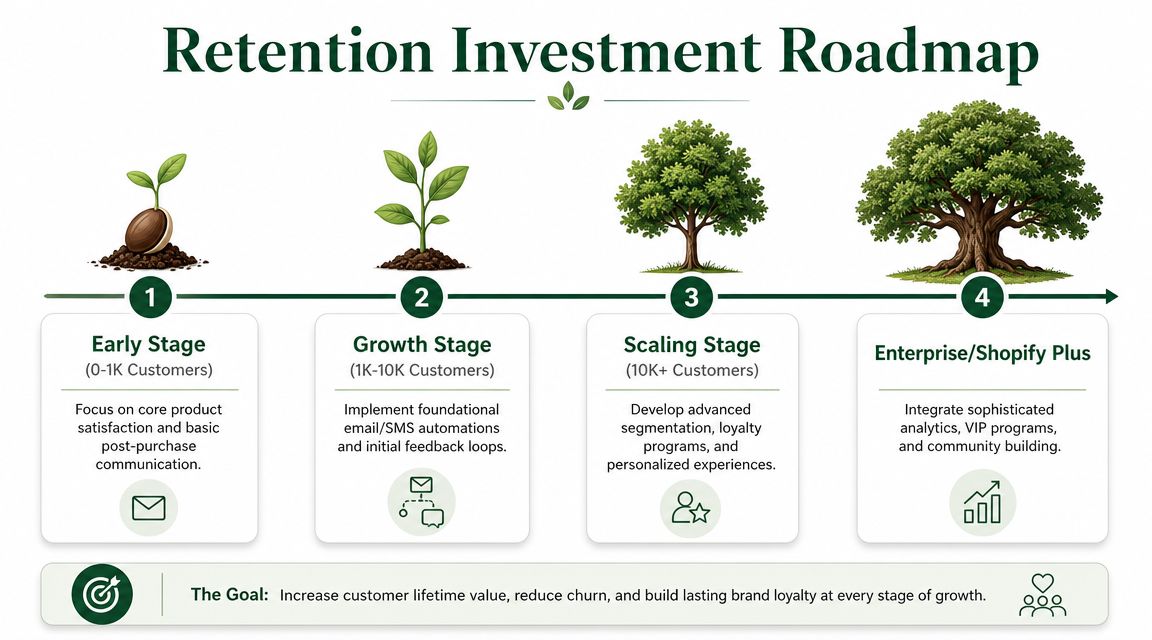
Retention investment should follow business stage and product model. That sounds obvious, but many brands still buy like enterprise operators while running early-stage economics.
A practical order of operations
The correct sequence is usually less glamorous than the app market suggests.
Business stage | First investment | Second investment | Third investment |
|---|---|---|---|
Early customer base | Product satisfaction and post-purchase clarity | Basic cohort reporting | Core lifecycle flows |
Growing brand | Segmentation and repeat-purchase analysis | Post-purchase feedback loop | Replenishment or win-back automation |
Scaling operator | Loyalty structure and higher-value segmentation | Deeper vendor evaluation | Category-specific retention layers |
Shopify Plus complexity | Cross-system analytics and CX orchestration | VIP program design | Advanced stack rationalization |
That sequence prevents a common mistake. Brands often launch loyalty before they've fixed fulfillment communication, or add SMS before support and return experiences are stable. Those investments don't compound well when the foundation is weak.
Category changes the sequence
Category should shape the plan.
Fashion usually benefits from stronger segmentation, drop strategy, and VIP logic before subscription enters the conversation.
CPG and consumables should spend more time on reorder timing, replenishment messaging, and subscription flexibility.
Hard goods need post-purchase education, support quality, accessories, and service experience more than frequent promotional messaging.
Vendor selection sits inside all of this. Rising app costs and a crowded ecosystem mean operators need better ways to evaluate what's worth adding, replacing, or removing. The best teams don't rely only on demos and outbound outreach. They use direct conversations with builders to compare assumptions, push feature requests, and understand roadmap direction before making stack changes.
The operators with the most influence in the Shopify ecosystem usually have a direct line to the people building their tools. That's the practical value of app store research, the network where Shopify operators get paid to talk directly with app founders, product teams, and UX researchers about the systems they use every day. The compensation can be meaningful, but the larger advantage is access, influence over roadmaps, and early visibility into what's being built next. If that's relevant, join the network.

Author
Jonathan Kennedy
Jonathan Kennedy is the founder of app store research and shopexperts, platforms that connect operators, founders, and experts across the Shopify ecosystem to drive better decisions, product development, and growth.