Best SMS Marketing Apps for Shopify (2026 Founder's Guide)
/

Author
Jonathan Kennedy
Founder at appstoreresearch
Jonathan Kennedy is the founder of app store research and shopexperts, platforms that connect operators, founders, and experts across the Shopify ecosystem to drive better decisions, product development, and growth.
Most Shopify teams don’t struggle to find an SMS app. They struggle to pick one without creating a stack problem six months later.
That usually happens after the demo stage. Every platform shows abandoned cart flows, popups, automations, and attribution. Then the critical questions show up. Does this app work with the existing email setup? Does it help list growth without creating compliance risk? Can the team segment well enough to avoid burning the list? And most important, does it drive revenue in the moments that matter, not just send more texts?
The best SMS marketing apps for Shopify aren’t “best” in the abstract. They’re best for a certain operating model. A retention team already running Klaviyo email has different needs than a Shopify Plus brand wanting deeper personalization or a lean brand that wants stronger conversational recovery.
Table of Contents
What SMS apps need to do well in 2026
The bar is higher than broadcast messaging
What to ask before choosing a Shopify SMS app
Recart best for AI-driven flows
Where Recart stands out
Who should shortlist it
Postscript, Klaviyo SMS, Attentive where each fits
Postscript
Klaviyo SMS
Attentive
Quick fit comparison
Compliance & deliverability
What actually matters
Questions to ask vendors directly
Real RPS benchmarks
Choosing by GMV stage
Below the enterprise tier
When the team and stack get more complex
The short list by stage
What SMS apps need to do well in 2026
A brand sends a Saturday SMS campaign, sees a short-term sales spike, and assumes the app is working. Two weeks later, unsubscribes are up, flow revenue is flat, support is cleaning up consent issues, and the channel starts to feel expensive. That is the gap good teams need to close in 2026.
A Shopify SMS app now has to do more than push campaigns and recover a few abandoned carts. It needs to support revenue per send, fit the rest of the retention stack, and reduce operational drag so the team can scale the channel without creating compliance or deliverability problems.
The bar is higher than broadcast messaging
The strongest SMS programs behave like part of the retention engine, not a standalone campaign tool. The app needs to read real customer behavior, trigger quickly, coordinate with email, and give the team enough control to segment aggressively without creating a maintenance mess.
This distinction is critical because many Shopify brands still buy SMS software off demos and feature grids. That approach misses the practical questions that shape revenue. Can the platform act on browse depth, cart value, purchase cadence, and product affinity? Can the team manage suppression, consent, and flow logic in one place? Can marketers get to a sendable audience in minutes instead of asking an operator to patch data together?
That is also why surface-level app comparisons are less useful than they look. A roundup of best Shopify SMS apps can help you build a shortlist, but the ultimate decision comes down to fit by GMV stage, expected RPS, and how much operational complexity the team can absorb.
I also put weight on founder access more than many buyers do. In a crowded category, direct product conversations often tell you more than the pricing page. If you want a sharper operator view before booking demos, this Recart customer research and founder insight is worth reviewing.
Practical rule: If a platform looks strong in a demo but forces the team to rebuild audiences, duplicate channel logic, or manually verify consent, it becomes an operations tax rather than a revenue tool.
What to ask before choosing a Shopify SMS app
Three questions usually separate a scalable setup from an expensive one.
Evaluation area | What good looks like | What usually goes wrong |
|---|---|---|
Customer data | Shopify events and customer attributes flow into segments and automations cleanly | Teams export and import lists, or run fragmented audiences across tools |
Flow quality | Cart, browse, post-purchase, win-back, and subscriber growth flows work together | Brands rely on campaigns because flows are weak, generic, or hard to maintain |
Risk control | Consent capture, suppression, and opt-out handling are easy to audit | Aggressive list growth creates deliverability and compliance issues later |
The best choice also depends on where the business is right now. Generalist platforms can make sense when email already drives the stack and SMS needs to plug in fast. SMS-first tools can outperform when the brand wants more channel depth, faster iteration, and stronger recovery flows. Enterprise platforms start to earn their cost when team structure, personalization demands, and acquisition volume are much harder to manage.
The right app is the one that improves RPS without adding hidden work. That is the standard worth using.
Recart best for AI-driven flows
Recart is most interesting when the brand wants SMS to feel less like campaign software and more like a real-time conversion layer.

Where Recart stands out
A lot of SMS tools still treat automation as a fixed sequence. Message one goes out, then message two, then maybe a reminder with an offer. Recart’s appeal is that it pushes harder toward AI-driven conversational flows. That matters for brands that want to recover carts, answer objections, and route shoppers toward purchase without making the experience feel like a blunt reminder engine.
That’s also why Recart tends to stand out more in accounts that already know basic SMS works. Once a brand has proven cart recovery and simple lifecycle texts, the next question becomes whether the program can create more relevant conversations without adding headcount. That’s the practical use case for AI here.
The strongest signal isn’t a generic feature pitch. It’s whether the app helps the team run smarter recovery and upsell interactions at scale. The Recart customer case study is useful because it focuses on product research insight from Shopify operators rather than generic app-page marketing. That’s a better way to understand how the product is perceived in live evaluation cycles.
Teams that get value from conversational SMS usually don’t want more message volume. They want fewer dead-end sends and more purchase-intent replies.
There’s also a broader operational point. AI-driven flows only help when the logic is grounded in a clear customer journey. Brands that expect “AI” to fix weak segmentation, weak offers, or weak onsite conversion usually end up disappointed. If the site experience is messy, no SMS app can fully patch that.
Who should shortlist it
Recart deserves a shortlist when the brand wants these things:
More conversational recovery: Especially for abandoned cart and objection-handling flows where a simple reminder underperforms.
A differentiated SMS program: Useful for brands that don’t want the same templated lifecycle setup every other store is running.
Leaner team efficiency: Stronger when the retention team wants to scale more nuanced flows without adding manual intervention.
Brands evaluating Recart should still pressure test setup complexity, analytics clarity, and stack fit. AI-led tools can look sharp in a demo while creating workflow confusion later if ownership isn’t clear between retention, CX, and lifecycle teams.
For teams thinking more broadly about automation design, an experienced AI automation agency can be a helpful reference point for how conversational systems should support operations rather than just generate copy.
A practical way to think about Recart is simple. It’s not the default pick for every Shopify store. It’s the best fit when a brand believes incremental revenue will come from better conversation quality, not just more sends.
Postscript, Klaviyo SMS, Attentive where each fits
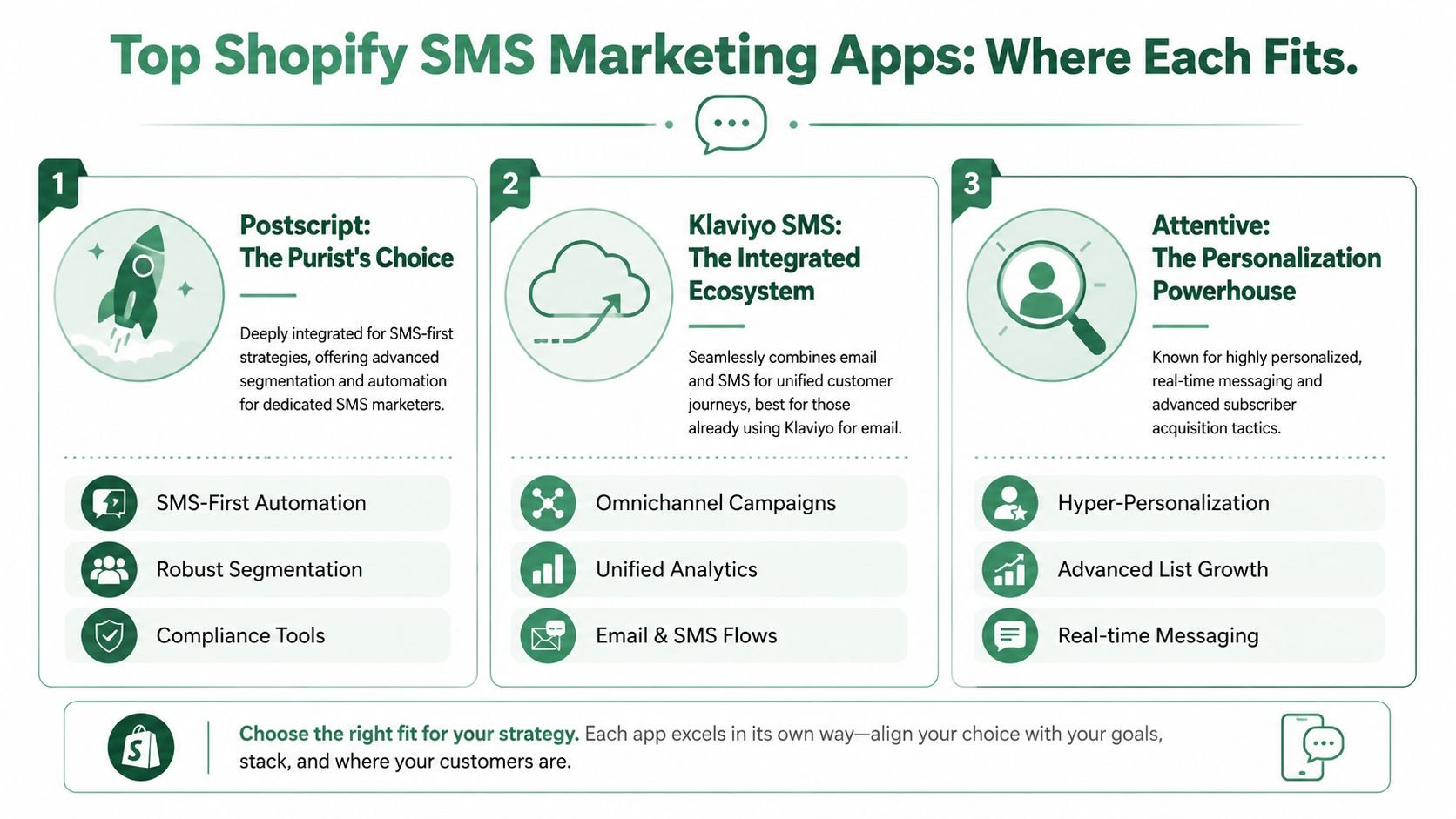
Three brands can run the same monthly SMS volume and get very different revenue from it. The gap usually comes from fit. Team structure, existing stack, traffic scale, and how much SMS revenue the brand expects to carry all matter more than a polished demo.
For that reason, I would evaluate Postscript, Klaviyo SMS, and Attentive through two filters first. What revenue per send can this platform realistically support at your current GMV stage? And how much operational overhead will it add to the team you already have?
According to the Shopify App Store SMS category, Klaviyo has broad adoption and Postscript holds a stronger merchant rating. That lines up with how these tools usually show up in real buying decisions. Klaviyo gets shortlisted because it fits an existing retention stack. Postscript gets shortlisted because SMS is expected to pull harder. Attentive enters the conversation when scale, onsite capture, and personalization justify a heavier setup.
Postscript
Postscript fits brands that treat SMS as a primary retention channel, not a supporting add-on.
That usually means more attention on subscriber growth, campaign pacing, compliance workflow, and channel-specific reporting. Teams that care about RPS often like Postscript because the product is built around text message execution first. That focus matters once SMS becomes material to monthly revenue and can no longer sit inside a broader email workflow without trade-offs.
Postscript tends to fit best for:
Dedicated retention teams that want more control over SMS performance
Brands with meaningful subscriber acquisition goals beyond a basic popup
Operators who want channel ownership to stay clear instead of being folded into one all-purpose platform
The trade-off is real. Another platform adds setup, QA, and reporting work. For brands doing enough SMS volume, that added work can pay back quickly. For smaller teams, it can slow execution.
Klaviyo SMS
Klaviyo SMS makes the most sense for stores already running core retention inside Klaviyo.
The value here is operational. Email and SMS can share the same customer profiles, flow logic, and reporting environment. That reduces handoff problems, lowers training time, and keeps campaign planning in one place. For lean teams, that matters more than having the deepest SMS feature set on the market.
A practical way to look at Klaviyo is simple. It usually fits brands where speed, coordination, and stack simplicity have a direct effect on output.
Best reason to choose Klaviyo SMS | Why it matters |
|---|---|
Shared flow builder | Email and SMS logic stay in one system |
Unified customer data | Segmentation is easier to maintain |
Lower training overhead | The team can launch faster with fewer process gaps |
The downside shows up later if SMS becomes a larger revenue driver. At that point, some brands want more channel-specific tooling and more specialized support than a unified platform typically gives. For many Shopify teams, minimizing drag across the retention stack outweighs the benefit of picking a more specialized SMS tool.
Attentive
Attentive fits larger operators with enough traffic and team maturity to use deeper personalization and onsite list growth well.
This is usually a stronger match for brands that already know how they want SMS, email, and onsite capture to work together. The platform tends to appeal to teams willing to invest more time in strategy, implementation, and testing to raise list quality and monetization. That can work well at higher GMV. It is often excessive for brands still building basic lifecycle discipline.
Attentive is usually strongest for:
Larger brands with more complex segmentation needs
Teams that want onsite capture tightly tied to SMS growth
Operators willing to accept more setup complexity for added control
The trade-off is overbuying. Mid-market brands are especially prone to it. They see the upside, sign for enterprise-style capability, and then run a fairly standard SMS program that never justifies the extra weight.
One useful step during evaluation is to ask for direct access to a founder, GM, or product lead, not just sales. The best vendors will usually give you that if the opportunity is serious. Ask what RPS range they see for brands at your GMV stage, what percentage of accounts fully implement their recommended flows, and where merchants struggle after onboarding. Those answers are often more useful than the demo.
Quick fit comparison
App | Best fit | Main strength | Main trade-off |
|---|---|---|---|
Postscript | Brands running SMS as a dedicated channel | Greater SMS focus and stronger channel ownership | Adds another platform to the stack |
Klaviyo SMS | Stores already invested in Klaviyo email | Shared flows, shared data, lower operational friction | Less depth for brands pushing SMS harder |
Attentive | Larger brands with mature lifecycle operations | Stronger personalization and onsite capture strategy | Heavier setup and more organizational complexity |
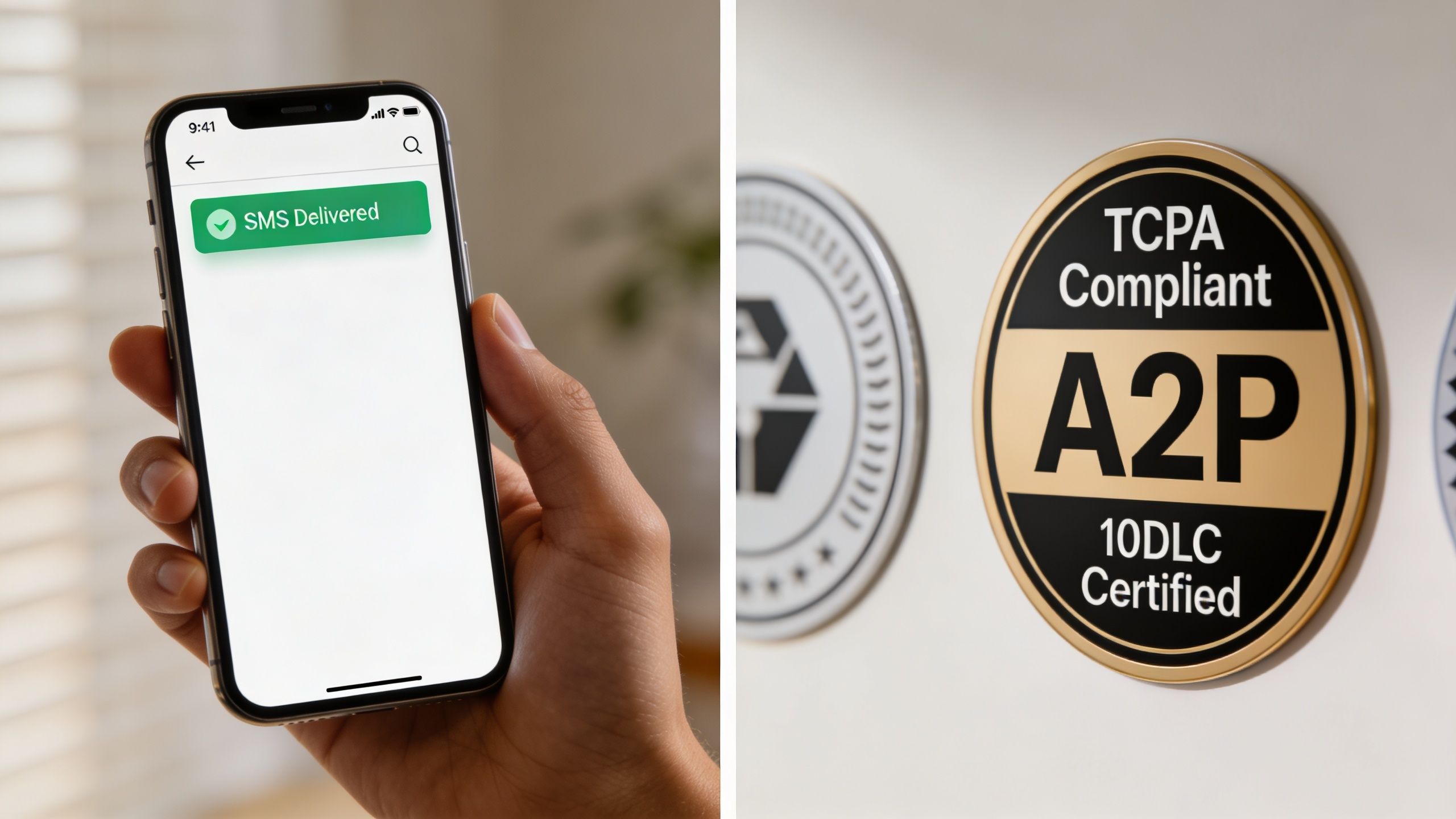
Compliance & deliverability
A flashy demo won’t matter if carriers filter the messages or if consent handling is sloppy.
What actually matters
For most Shopify teams, compliance starts with a few absolute necessities. Marketing texts need clear consent. Opt-out handling needs to work immediately. Suppression logic needs to be easy to audit. And the brand needs confidence that list growth tactics won’t create downstream delivery problems.
Deliverability is closely tied to that discipline. If the app makes it easy to blast broad audiences too often, complaints rise and performance slides. If the app makes segmentation and consent management easy, deliverability usually has a much better chance of holding up.
A good vendor should be able to explain, in plain English, how it handles:
Consent capture: Especially at popups, checkout, and other high-intent signup points
Opt-out processing: Including how STOP and suppression are enforced
Carrier sensitivity: How message patterns, content, and frequency affect filtering
List quality controls: How invalid or risky records are flagged and excluded
Non-negotiable: If a vendor answers compliance questions with vague reassurance instead of concrete workflow detail, that’s a warning sign.
Questions to ask vendors directly
Most mistakes happen before launch. The team gets excited about recovery flows, then glosses over the mechanics that keep the program safe and deliverable.
Ask direct questions in the sales process:
How is consent recorded and surfaced inside the platform?
What happens when a user opts out through different channels?
How does the platform prevent over-messaging the same segment?
What controls exist for quiet hours, suppression, and audience exclusions?
How does the team monitor delivery issues or carrier-related filtering?
The best SMS marketing apps for Shopify make compliance easier to operate, not harder to remember. That should be treated as product quality, not just legal hygiene.
Real RPS benchmarks
A retention lead pulls up SMS reporting after a strong month. Revenue is up, sends are up, and the list got bigger. Then you break performance down to revenue per send, and the story changes fast. One or two high-volume campaigns can hide weak targeting, tired segments, and flows that are underbuilt.
That is why I treat RPS as the operating metric, not a nice-to-have summary. It forces a harder question: which messages earned the right to be sent?
Public benchmark roundups, as noted earlier, are useful for setting expectations around automation and intent-based messaging. They are less useful for app selection unless you map them to your stage, your list quality, and your average order value. In practice, behavior-triggered flows usually produce stronger economics than broad campaign calendars because the customer is already closer to a buying decision.
The cleaner way to read SMS performance is by program area:
SMS program area | What a strong operator looks for |
|---|---|
Welcome flows | Early payback, controlled pacing, and a clear path to first purchase |
Abandoned cart | Recovery tied to product interest, cart value, and timing |
Post-purchase | Repeat purchase lift and retention contribution beyond transactional updates |
Campaigns | A specific commercial reason to send, narrow audience logic, and disciplined frequency |
The pattern across high-performing accounts is consistent. Automated flows carry a disproportionate share of revenue. Campaigns still matter, but mainly when the offer, audience, and timing are unusually clear. Teams that rely on blasts to carry the channel often see RPS soften as list fatigue sets in.
Improving RPS is more about timing and audience logic than merely writing louder copy.
There is also a storefront layer to this. If the opt-in path is weak, if product pages do not convert, or if social proof is thin, the downstream SMS program has less to work with. The same operator mindset shows up in adjacent buying decisions, especially in tools that affect conversion before the text is ever sent, such as this guide to best Shopify reviews apps in 2026.
For app selection, this is the practical takeaway. Do not ask which platform has the longest feature list. Ask which one is most likely to raise RPS for your current GMV stage. That is usually a mix of segmentation depth, flow flexibility, reporting clarity, and how quickly your team can get good campaigns and automations live. The best choice is rarely the app with the most features. It is the one your team can operate well enough to turn sends into profit.
Choosing by GMV stage
The cleanest way to choose among the best SMS marketing apps for Shopify is by operating stage, not by feature envy.
The internal brief behind this article points to stage-based recommendations from a network that includes 160+ brands at $500K to $1M and 80+ at $1M+. That’s useful as a directional lens. Teams at different GMV levels usually don’t fail with SMS for the same reasons.
Below the enterprise tier
Brands still building a stable lifecycle foundation usually need simplicity more than sophistication.
That usually means one of two paths. If the store already runs Klaviyo well for email, Klaviyo SMS is often the most practical extension. If the team wants SMS as a more focused revenue channel and is willing to manage it as a dedicated system, Postscript often makes more sense.
At this stage, overbuying is common. Teams sign with a platform designed for much larger operations, then underuse segmentation, underbuild flows, and end up sending broad campaigns because the setup overhead is too high.
When the team and stack get more complex
Once the brand has stronger retention operations, the decision shifts.
Now the questions are less about “Can this app send abandoned cart texts?” and more about whether the platform can support deeper personalization, more advanced acquisition, and more nuanced customer journeys across channels. That’s where Recart and Attentive become more relevant.
Recart fits brands that believe better conversations can raise purchase efficiency. Attentive fits brands that can support a heavier personalization and onsite capture model. Shopify Plus operators should also think about broader readiness across stack, process, and tooling, not just messaging. This overview of scaling Shopify Plus readiness is a useful frame for that wider decision.
The short list by stage
GMV stage | Usually best fit | Why |
|---|---|---|
Early growth | Klaviyo SMS or Postscript | Lower complexity, faster activation, clearer ownership |
Scaling brand | Postscript or Recart | Better when the team wants stronger SMS specialization or more conversational recovery |
Larger or more mature operator | Attentive or Recart | Better fit for deeper personalization and advanced lifecycle orchestration |
One final point matters more than most feature comparisons. The smartest buyers don’t just compare app pages and sales decks. They talk to people who’ve used the tools, switched away from them, or influenced their roadmaps. In a crowded app market, those conversations are often more useful than another polished demo.
If a Shopify operator wants a cleaner way to evaluate tools, share product feedback, and get paid for the time, app store research is a platform that connects Shopify merchants with paid product research interviews with app developers and UX teams. It gives brands a way to call with app teams, discover emerging tools without inbox spam, influence feature requests, and sometimes build stronger vendor relationships while getting compensated. The network includes 3,000 operators and has paid out $1M in incentives, and merchants who want to participate can sign up here.

Reviewed by
Filip Djokic
Product Designer at appstoreresearch.com
Filip is a Product and UI/UX Designer with over 10 years of experience in digital product design. With a strong background in the Shopify ecosystem, he focuses on improving user experiences and turning merchant insights into better product decisions at appstoreresearch..