
Author
Jonathan Kennedy
Founder at appstoreresearch
Jonathan Kennedy is the founder of app store research and shopexperts, platforms that connect operators, founders, and experts across the Shopify ecosystem to drive better decisions, product development, and growth.
Most Shopify merchants still spend too much time on pre-purchase upsells and not enough on the one surface that protects the original sale. A Shopify post-purchase upsell appears after payment is completed, usually before the thank-you page, so the main order is already secured. That's why Shopify-focused analysis points to 8% to 15% acceptance rates for well-targeted one-click offers and reports of 10% to 25% AOV growth when timing and relevance are right, according to Shopify's post-purchase offer documentation.
That matters because most upsell ideas fail for one of two reasons. They either interrupt checkout, or they ask the customer to make a second buying decision with too much friction. Post-purchase works when it does neither.
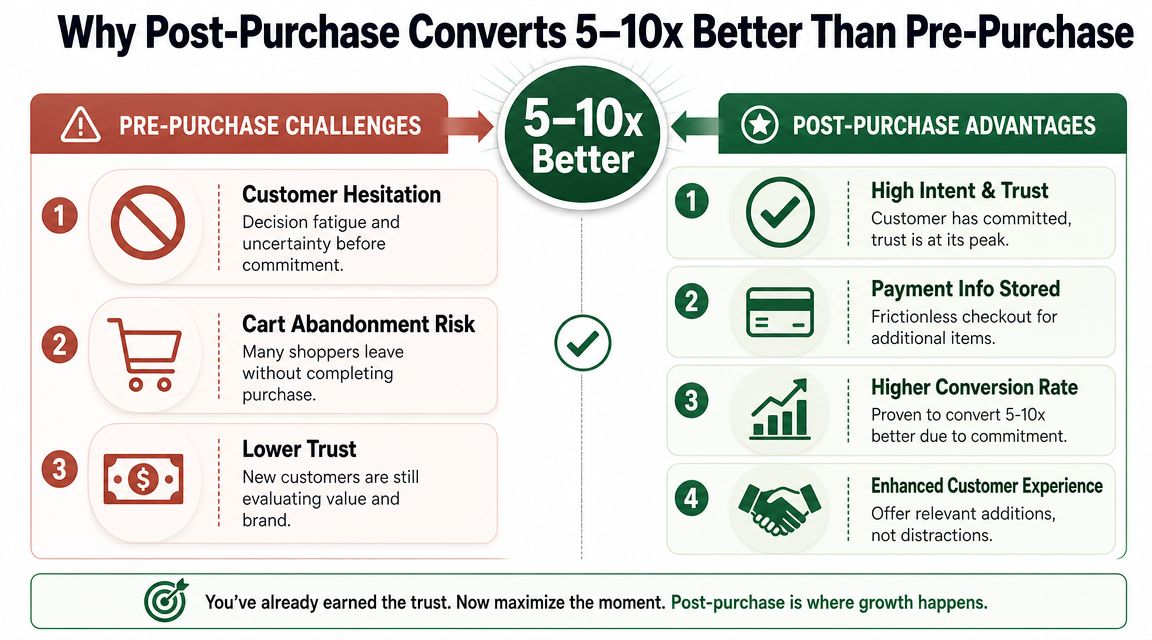
Why Post-Purchase Converts 5–10x Better Than Pre-Purchase
Post-purchase wins because the sale is already closed. The upsell no longer has to fight the checkout.
A pre-purchase offer adds cognitive load at the most fragile point in the funnel. The shopper is still deciding whether to finish the order, compare prices, or abandon the cart. A post-purchase offer appears after payment, so the decision is narrower: add one relevant item with one click, or decline and move on.
The conversion advantage is structural
The lift comes from placement, not copywriting magic.
Post-purchase offers sit in a low-friction moment. The original order is already secured, so the merchant is not risking the primary conversion just to chase a higher basket. That changes how aggressively a store can test offers, pricing, and sequencing. It also explains why acceptance rates tend to beat cart add-ons when the offer matches the product just purchased.
That is the difference between a cart upsell and a one click upsell Shopify flow after checkout. The cart offer competes with checkout completion. The post-purchase offer monetizes momentum that already exists.
Practical rule: If an upsell can lower checkout completion, hold it to a stricter relevance standard than a post-purchase add-on.
What this means for AOV strategy
For operators managing stores with high checkout abandonment, this should change prioritization. Start with the offer that adds revenue without adding friction to the core purchase path.
A strong post purchase upsell Shopify setup often beats a stack of cart popups, drawer prompts, and bundle interruptions because it protects the main conversion first. Teams trying to improve average order value in ecommerce often get better results from one disciplined after-purchase offer than from several pre-purchase tactics competing for attention.
Pre-purchase still matters. It does a good job with bundles, free-shipping thresholds, and planned cart building. But for operators focused on incremental revenue with less downside, post-purchase should get tested before they spend weeks tuning cart friction.
App Options ReConvert, AfterSell, and ConvertWise
Operators usually don't need the “best” app in the abstract. They need the right app for their store shape, traffic mix, and team style.
Some teams want funnel depth and broad post-purchase customization. Others want a clean one-click setup that can go live quickly and be tested without a long implementation cycle.
How operators should choose
ReConvert is usually the app to evaluate when the team wants a broader post-purchase environment, not just a single offer layer. It tends to appeal to stores that want more than one monetization block around the post-order journey.
AfterSell is often the fit when performance and a more focused post-purchase experience matter most. It's the option many operators consider when they want a dedicated after purchase upsell flow without extra complexity.
ConvertWise is worth attention for teams that want a more focused setup from a team with deep Shopify ecosystem context. There's a useful operator-facing profile on ConvertWise customer research that helps frame how merchants evaluate it in practice.
The shortcut is this:
Choose ReConvert if the team wants broader post-purchase page control.
Choose AfterSell if the priority is a tighter one-click upsell flow.
Choose ConvertWise if the team values a focused product with strong ecosystem familiarity.
The wrong app usually isn't “bad.” It's just built for a different operating style.
A wider view of category trade-offs is in this roundup of best Shopify upsell apps, which is useful when post-purchase is only one part of the stack review.
Post-Purchase App Comparison
App | Best For | Key Feature | Pricing Model |
|---|---|---|---|
ReConvert | Teams that want broader post-purchase customization | Post-purchase flow plus wider thank-you page style merchandising | App-based pricing with plan structure determined by the vendor |
AfterSell | Operators focused on dedicated one-click post-purchase offers | Streamlined post-purchase upsell experience | App-based pricing with plan structure determined by the vendor |
ConvertWise | Teams that want a focused option with ecosystem-specific context | Targeted upsell workflow and Shopify-oriented positioning | App-based pricing with plan structure determined by the vendor |
No app fixes weak merchandising. If the offer is generic, the tool won't save it. App choice matters, but offer design still decides whether the page prints revenue or gets skipped.
Offer Design That Actually Converts
Bad post-purchase offers usually fail for one reason. They feel disconnected from what the customer just bought.
Independent merchant analysis reports that well-implemented post-purchase offers typically drive 10% to 20% AOV lift, with some Shopify stores seeing 10% to 25% AOV growth and 15% to 20% revenue-per-session gains, because the offer happens after payment authorization and doesn't reopen abandonment risk, according to this merchant analysis of post-purchase upsell performance.
Relevance beats creativity
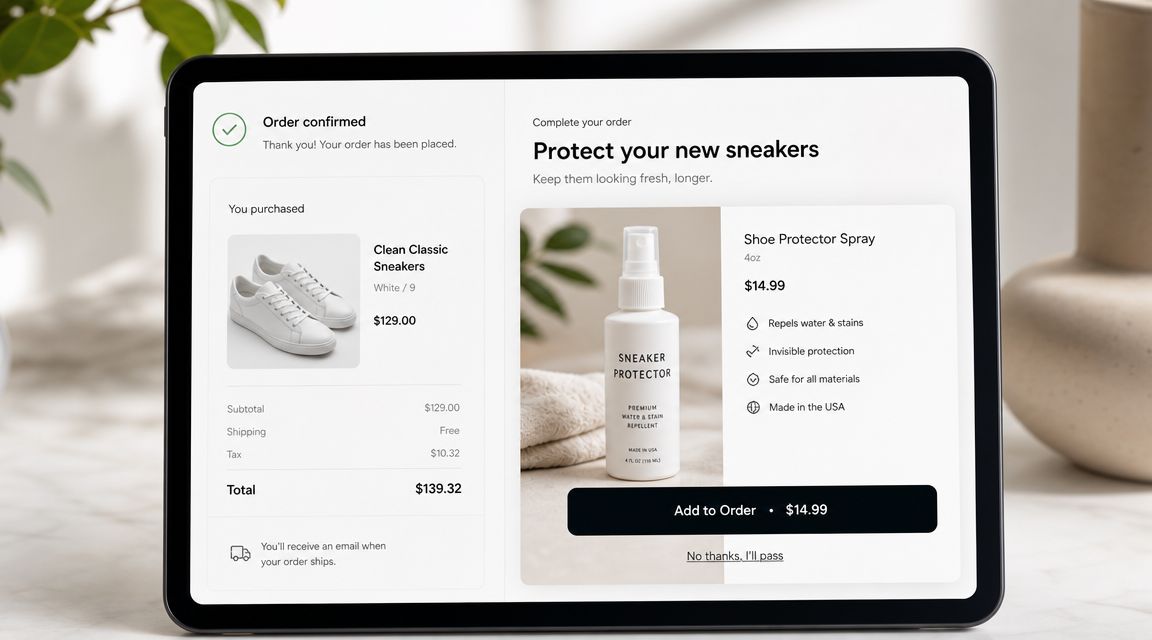
A fashion store selling sneakers should test protector spray, premium laces, or a second colorway. It shouldn't throw in a hat just because it has margin.
A coffee brand should offer a complementary roast, filters, or a grinder accessory. A branded mug can work, but only if the customer behavior supports it. A random T-shirt usually won't.
For operators working through broader merchandising ideas, Up North Media's AOV boosting insights are useful because they connect offer type to order context, not just discount mechanics.
A post-purchase offer should feel like the store anticipated the next need, not like it found extra inventory to push.
A simple framework for better offers
Three filters keep most one click upsell Shopify tests on track:
Relevance first
The product should connect directly to the original purchase. Accessories, replenishment, upgrades, or quantity expansion tend to make sense.Value must be obvious
The buyer should understand the benefit immediately. “Add another bag of a different roast” is clearer than a bundle explanation with too many conditions.Simplicity wins
One product beats a crowded grid. One clear CTA beats a mini landing page. The customer shouldn't need to compare multiple options while standing in the post-checkout window.
The strongest after purchase upsell offers usually fall into a few patterns:
Complementary add-ons with clear utility
A second unit of the same or related product
A lower-ticket, high-margin extra that feels easy to say yes to
The page isn't there to educate. It's there to convert a clean next step.
Pricing the Offer The Discount Paradox
Most operators assume the bigger discount wins. That's often where margin leaks start.
A post-purchase offer does usually need a pricing reason to act now. But the goal isn't maximum take rate. The goal is profitable acceptance.
Why deeper discounts often underperform
A steep cut can make the item look less valuable, train buyers to wait for a better deal, or eat the contribution margin that made the offer attractive in the first place.
The discount paradox manifests as follows: A lower discount can produce fewer accepts but better total profit. A higher discount can drive more accepts and still leave less money on the table after product cost, shipping pressure, and support complexity.
Margin check: A post-purchase offer only works if the accepted order is still worth fulfilling.
For many stores, percentage-off language works when it's simple and immediate. Dollar-off can work too, especially on higher-priced add-ons. The key is clarity. “Add this now for a post-purchase price” is better than layering conditions, bundles, and coupon logic into a page the customer will only see once.
What to test instead
Start with the offers that already have healthy margin and strong product adjacency. Then test:
A modest incentive instead of the deepest one
A same-product repeat offer against a complementary product
A cleaner message before changing the price
The offer itself often matters more than the discount level. If the product fit is weak, extra discount just hides the underlying problem for a while.
Sequencing Your Offers What to Test First
Most stores start too wide. The cleaner move is to start narrow and sequence tests in order of impact.
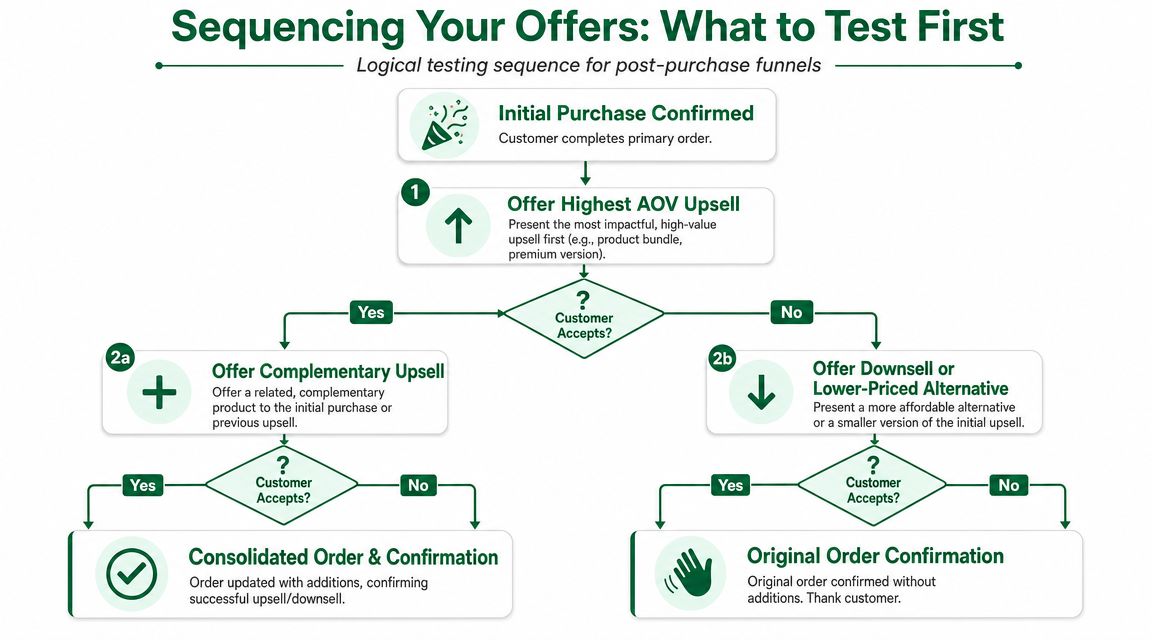
A practical rollout order
Begin with one offer on one top-selling product or collection. That gives the team a clear read on whether the category itself works post-purchase.
Then layer complexity only after the first offer has clean data and stable fulfillment handling.
A practical sequence looks like this:
Launch one high-relevance upsell
Pick the product with the clearest attachment logic.Add a downsell for declines
If customers reject the main offer, show a lower-priced or simpler alternative.Test a second offer after acceptance
Only after the first accepted path is healthy. Don't stack too early.Expand to more products
Move from bestsellers to secondary categories once the model is proven.
Every extra branch adds tracking, merchandising, and support overhead. A serious post purchase upsell Shopify setup should feel operationally boring before it feels advanced.
Post-Purchase and Subscription Nudges
For replenishable products, post-purchase can do more than lift the current order. It can move a one-time buyer toward recurring revenue.
The best version of this isn't a hard subscription sell. It's a nudge that fits the buying context. If the shopper just purchased a consumable, the post-purchase page can present a simple future-oriented offer instead of another physical add-on.
Where this works best
This tends to make the most sense for categories with natural repeat cycles, such as consumables, personal care, or other replenishable products. The message has to be clean and low-friction.
A good subscription nudge usually does one of two things:
Presents the recurring option clearly for future convenience
Frames the choice around continuity instead of a one-time promo rush
Teams reviewing that broader stack often compare this alongside best Shopify subscription apps, because subscription experience quality matters as much as the upsell itself.
The channel limit operators miss
There's one operational limit that gets missed in a lot of post-purchase advice. Post-purchase upsells only render for orders placed through the Online Store sales channel. Merchants using POS, draft orders, or some marketplace channels may not get the feature at all, which Shopify notes in its overview of post-purchase upsell behavior and channel constraints.
That changes the math for stores with mixed channel volume. An app may look good in demos and still touch only part of the order base.
Get Paid to Influence the Shopify App Ecosystem
Operators who spend enough time in Shopify apps develop a sharp read on what works, what breaks, and what vendors keep promising but still have not shipped. That perspective has value outside your own store.
App teams need feedback from merchants who have dealt with real constraints. They need to hear where post-purchase offers fail QA, where pricing blocks rollout, where migrations create risk, and which reporting gaps make optimization harder than it should be. Support tickets rarely capture that level of detail. Product interviews do.
One option is app store research, a platform that connects Shopify merchants with paid research interviews with app developers and UX teams. For merchants comparing tools like ReConvert, AfterSell, and ConvertWise, that can be useful on two levels. You get paid for informed feedback, and you get access to the people shaping the products you may depend on next quarter.
That access matters.
The merchants with the strongest input are usually the ones who have run enough tests to speak concretely about trade-offs. They can explain why one-click upsells convert but create edge cases in fulfillment, why a low-priced add-on lifts acceptance but can drag margin, or why a post-purchase flow that looks good in a demo falls apart once customer support starts handling order edits. That kind of feedback is more useful to vendors than generic feature requests, and more useful to merchants than another webinar.
If direct conversations with app founders, product teams, and UX leads sound more useful, join the network. The cash helps. The bigger upside is influence, better context on where the app market is headed, and earlier visibility into what teams are building.

Reviewed by
Filip Djokic
Product Designer at appstoreresearch.com
Filip is a Product and UI/UX Designer with over 10 years of experience in digital product design. With a strong background in the Shopify ecosystem, he focuses on improving user experiences and turning merchant insights into better product decisions at appstoreresearch..