The Best Shopify Subscription Apps for Operators (2026)
/
Subscriptions usually look simple until the second hard question shows up. The first app gets installed, recurring orders start, then support volume climbs, cancellation reasons get messy, and the team realizes the subscription app is no longer a billing tool. It's now part of retention, CX, and margin management.
That's why most “best shopify subscription apps” lists miss the point. Operators don't just need a feature grid. They need to know which platform fits the current stage, what migration friction is like, and where subscribers churn because the portal, payment recovery flow, or cancellation experience creates avoidable drop-off. The operators making the best decisions usually anchor on metrics that truly matter, then choose the stack that supports those numbers instead of bloating it.
The market is crowded enough to make lazy selection expensive. Shopify's App Store hosts over 11,905 apps, and 87% of Shopify merchants use apps. In subscriptions, that means serious operators need a sharper filter. The shortlist below focuses on real buying decisions, especially for teams comparing recharge alternatives, planning a subscription box Shopify setup, or deciding whether migration is worth the operational hit.
The subscription app landscape on Shopify in 2026
A year ago, you could shortlist a few subscription apps, compare pricing, and call it a day. In 2026, that approach gets expensive. The key decision is not which app can charge on a schedule. It is which app fits your stage, your retention problem, and your tolerance for migration pain.
Shopify still maintains a dedicated Subscriptions category in the App Store. That tells you demand is established and vendor competition is mature. It also means feature tables are less useful than they look, because recurring billing is no longer the hard part.
The hard part starts after the first renewal.
Operators get burned when they evaluate for launch instead of month two. A subscription app can look fine at checkout and still create support load once customers want to skip, swap, pause, or change cadence on their own. That is why portal quality, failed payment recovery, cancellation flows, and account management rules matter more than a long feature list. Teams running a structured selection process should use a clear framework for evaluating Shopify apps, then pressure-test each subscription tool against retention operations, not just setup.
One pattern shows up across our network again and again. Subscriber churn is rarely about billing logic alone. It usually comes from a bad post-purchase experience, weak self-serve controls, poor cancellation intervention, or a migration that breaks customer trust. Those costs do not show up on the pricing page, but they hit revenue fast.
The market also tightened in 2026. Recharge acquired Skio, which reduced the number of serious independent options at the top of the category. That matters because app selection is now less about finding a hidden gem and more about choosing the right tradeoff. Do you want scale and integration depth, cleaner admin UX, stronger churn recovery, AI-led retention, or the lowest possible software cost?
That is the lens to use here.
The names that keep coming up are still familiar. Recharge, Loop Subscriptions, Skio, Smartrr, Bold Subscriptions, and PayWhirl continue to show up in serious operator evaluations because they solve different problems for different teams. The gap between them is no longer basic functionality. It is implementation fit, retention upside, and how painful it will be to switch later if you choose wrong.
Recharge when it's still the right call
Recharge is still the conservative choice for operators who value ecosystem depth, established support paths, and broad integration coverage over novelty. For larger teams, especially those already tied into a mature stack, that matters more than cleaner UX.
Who should keep Recharge
Recharge fits brands that already have meaningful operational complexity. If subscriptions touch loyalty, bundles, analytics, support tooling, and multiple internal stakeholders, a mature platform can be the right trade. That's especially true when the business can't afford billing instability during a growth phase.
Recharge also remains one of the first names merchants evaluate when they're deep in the Shopify ecosystem. That's not just market inertia. It's a function of reputation, scale comfort, and the fact that many agencies and operators already know how to work inside it. Teams that want a disciplined evaluation process should use a framework like this guide on how to evaluate Shopify apps before making the jump.
Where teams get stuck
Recharge gets expensive when a merchant pays for capability it doesn't use. It also gets frustrating when the team expects a lightweight app experience from a platform built for broader use cases.
The friction usually isn't “Recharge is bad.” It's “Recharge is heavier than this business needs.” If a brand has a straightforward subscribe-and-save model and wants speed, lean admin workflows, and fewer moving parts, Recharge can feel like too much surface area.
Practical rule: Keep Recharge when the cost of retraining, rebuilding workflows, and risking billing disruption is higher than the cost of platform complexity.
Skio when it's the upgrade
Skio earned attention because it felt modern in places where older subscription tools felt dense. Cleaner admin patterns, fast bulk operations, and strong lifecycle tooling made it attractive to midsize operators who were tired of managing around clunky subscription workflows.
Why operators liked Skio
The product leaned into usability. That matters more than many teams admit. Subscription operations are repetitive, and poor UX compounds over time through internal errors, slower support handling, and more brittle subscriber management.
For brands that care about segmentation, payment recovery campaigns, lifecycle automation, and international support, Skio often looked like the cleaner operational step up from older setups. The acquisition changes the context, but it doesn't erase the reasons teams were drawn to it.
Who should evaluate it now
Skio makes the most sense for operators who liked the modern retention-first feel of newer subscription software and are comfortable tracking how the product evolves under Recharge ownership. It's still relevant for merchants comparing recharge alternatives because the core question isn't brand name. It's product direction.
This is the right pick for teams that want better lifecycle controls than a basic subscription app offers, but don't want to bolt together too many extra apps around the core billing engine.
Some operators don't need a different feature list. They need a subscription app their team can move through faster every day.
Loop strongest for churn-recovery focus
A familiar scenario. Subscriptions are live, revenue looks healthy, and then the weekly report shows the underlying problem. Too many subscribers cancel at the next charge, support is buried in skip and swap requests, and your team is patching retention with discounts instead of fixing the system.
That is the point where Loop becomes a serious option.
Why Loop keeps showing up
Loop earns attention from operators who care less about app-store noise and more about reducing preventable churn. Its strongest case is not basic recurring billing. It is the layer around billing that helps you keep subscribers longer without turning support into a manual rescue function.
The product is strongest in the parts of subscription operations that influence margin. Cancellation flows. Prepaid offers. Gift subscriptions. Build-a-box setups. Self-serve portal control. Upsells that appear at the right moment instead of after the customer is already gone.
That matters because subscriber churn usually does not start with failed payments alone. It starts when the customer cannot easily adjust the subscription to fit real life. Skip this month. Swap the flavor. Delay the next order. Send it as a gift. If those actions are clumsy, cancellation becomes the easiest path.
Best fit
Choose Loop when your team is past launch and now needs tighter churn-recovery mechanics. It fits brands that already know retention is an operational problem, not just a CRM problem.
It is also a practical choice for merchants who want serious subscription infrastructure without getting pulled into a heavy enterprise buying process. Teams often pick Loop because they want stronger subscriber controls and responsive support, while still keeping the software stack manageable.
As noted earlier, the Shopify subscription category is crowded. That is exactly why Loop has a clear lane. It appeals to operators who are filtering for outcomes, especially lower cancellation rates and better self-serve retention, not just a longer feature list.
For a subscription box brand, that distinction matters fast. If your churn problem is really a flexibility problem, Loop belongs on the shortlist.
Stay AI strongest for AI-driven retention
Stay AI is not the default choice for every merchant. It's the right choice for operators who already understand that subscriber retention is a system, not a discount setting.
Where Stay AI stands out
The strongest case for Stay AI is when the team wants cancellation prevention, testing, and lifecycle optimization to sit closer to the center of the subscription program. That's different from needing recurring billing.
Stay AI is best viewed as retention software wrapped around a subscription engine. For teams willing to work the system, that can be the right posture. For teams that only need baseline recurring commerce, it's too much.
Who should pay for this level of tooling
This is for brands running a meaningful subscription business where churn analysis, cancel-save logic, prepaid strategy, and win-back paths already show up in weekly conversations. It's also a fit for teams that can support testing and iteration.
A lot of teams buy advanced retention tooling too early. That's the mistake. Stay AI should be purchased when the business is ready to act on churn signals, not just admire them.
Operator signal: If the retention team already debates pause versus cancel, skip logic, and save offers, Stay AI belongs on the shortlist.
Native Shopify Subscriptions when it's enough
A lot of brands overbuy here. They install a heavyweight subscription stack before they have enough complexity to justify it, then spend the next year paying for features the team never uses.
The right use case
Native Shopify subscriptions make sense when the job is straightforward recurring revenue, not retention engineering. If you sell a small set of replenishment products, run a standard subscribe-and-save offer, and do not need a highly customized subscriber portal, native can carry the load.
That matters early.
You get a cleaner setup, fewer vendors to manage, and less operational overhead for a team that is still proving subscription demand. For lean operators, that simplicity has real value. It reduces implementation drag and keeps the program easier to support across ops, CX, and finance.
Where native is the smart choice
Choose native if your subscription program looks like this:
low SKU complexity
simple billing cadence
limited need for skips, swaps, bundles, or advanced plan logic
no dedicated retention owner working churn reduction every week
a clear chance you may outgrow the setup later, but no reason to pay for that now
This is the right starting point for brands validating whether subscriptions will become a real revenue stream or stay a useful add-on.
When native becomes a ceiling
The ceiling shows up fast once the subscription business starts to matter. If your team wants better customer self-serve, more control over failed-payment recovery, stronger cancel-save flows, or more flexibility in how subscribers edit orders, native starts to feel restrictive.
That is where operators make the wrong call. They compare monthly app pricing and ignore the cost of switching later.
Cost sits in migration work, support retraining, subscriber communication, portal changes, and the churn risk that follows a clumsy move. If you already know you will need advanced retention and portal controls within the next couple of quarters, starting native can create extra work instead of saving money.
Use native when simplicity is the advantage. Skip it when it is obviously a temporary stop on the way to a more capable stack.
Migration playbook and what it really costs
Migration is the most underplayed issue in the subscription category. It's where good selection discipline pays off and where bad assumptions get expensive.
What migration actually breaks
Operators usually focus on whether subscriber records can move. That's only one layer. Migration affects portal experience, subscriber communication, support scripts, cancellation logic, dunning setup, analytics continuity, discounts, bundles, and internal team habits.
It also creates short-term confusion for customers if messaging is sloppy. Subscribers notice when the portal changes, when card updates behave differently, or when self-serve options move.
For product teams and operators doing this carefully, direct input from experienced merchants matters. app store research connects Shopify merchants with paid product research interviews with app developers and UX teams. In a category this crowded, direct conversations often surface migration risks earlier than public app listings do.
How smart teams de-risk the move
Strong teams treat migration as a retention project, not just a technical project.
Audit subscriber journeys first: Map how customers pause, skip, swap, update addresses, and cancel today. If the new app weakens those paths, churn can rise even if billing works.
Rebuild support macros early: Support should know what changes in the portal before subscribers ask.
Pressure-test edge cases: Bundles, prepaid plans, gifts, legacy discounts, and shipping logic usually expose migration pain first.
Use founder access when possible: In crowded app categories, direct calls with app teams can surface roadmap gaps, workarounds, and implementation realities faster than sales pages.
Migration cost is mostly operational. The technical move is only one part of the bill.
Choosing by subscriber count
Subscriber count shouldn't be the only selection lens, but it's still one of the fastest ways to narrow the field.
Small base and first launch
For an early subscription launch, overbuying is common. Native Shopify Subscriptions, Seal, PayWhirl, or Appstle usually make more sense than jumping straight into a heavyweight platform. At this stage, speed to launch and a usable portal matter more than advanced retention architecture.
Growing program
Once subscriptions become a real operating lane, the center of gravity shifts. At this point, Loop, Skio, Appstle, Smartrr, and Stay AI become more relevant depending on what's breaking. If support load is rising, customer portal quality matters. If churn is rising, retention workflows matter. If operations are messy, admin usability matters.
Internal network research also points in a clear direction. A meaningful share of operators participating in these product conversations are on Shopify Plus, and the typical subscription-app audience often sits at $200K+ MRR. That's why smarter teams stop treating app selection as a feature checklist and start treating it as a tool for influencing retention, support cost, and vendor responsiveness.
Scaled subscription business
At scale, reliability and change management dominate. Recharge still belongs here. Ordergroove belongs here. Stay AI can belong here. Loop can, too, depending on the model and team needs.
The main selection question changes from “What features are missing?” to “What operational risk can this team absorb?” That's the right lens for a scaled program.
1. Recharge Subscriptions
A brand with real subscription volume usually stops asking which app has the longest feature list. The essential question is which platform can carry operational complexity without creating new failure points. Recharge still earns its place on that shortlist.
Best for operational stability
Recharge is the mature option for operators running subscriptions inside a broader stack of retention, support, analytics, and custom workflows. If your team already depends on tools like Klaviyo, Gorgias, Stripe, or internal systems that need clean handoffs, Recharge is often the safer choice than a lighter app that looks simpler in a demo and turns brittle under pressure.
That does not make it the automatic winner.
Recharge tends to fit brands with enough scale, process, and internal ownership to handle a heavier system well. The hidden cost is not usually missing functionality. It is admin overhead, implementation drag, and the extra discipline required to keep the program clean after launch. That distinction matters, especially for teams comparing sticker price instead of total operating burden.
The right way to vet Recharge is to pressure-test the day-two experience, not the sales pitch. Look hard at customer portal usability, dunning logic, bundle flexibility, cancellation-saver flows, bulk operations, and how easily your team can make changes without filing tickets or creating workarounds. A sharper framework for that review is this guide on how to evaluate Shopify apps.
Choose Recharge when the business is already complex and failure is expensive. Choose something else when your subscription program is straightforward and your team wants speed, simplicity, and lower maintenance. Reputation alone is a weak reason to buy. Operational fit is the only reason that holds up six months later.
2. Skio now part of Recharge
Skio built its reputation by feeling cleaner than older subscription platforms. That matters because admin UX affects daily speed, support efficiency, and how much friction the team feels every time it touches subscriber operations.
Best for cleaner admin UX
Skio is a strong fit for midsize brands that want a modern subscription app with analytics, segmentation, payment recovery campaigns, and lifecycle automation built closer to the core product. Operators who disliked cluttered admin experiences often moved Skio to the top of the list for exactly that reason.
The acquisition by Recharge changes the buying conversation, but not the original fit. Teams should still evaluate whether the product direction matches what they need now, especially if they care about bulk operations, lifecycle tooling, and a clearer backend than older systems usually provide.
This is often the better answer for a team that wants an upgrade in day-to-day usability, not just more features on paper. It's also one of the cleaner recharge alternatives for operators who previously wanted the category leader's depth without inheriting all of its weight.
Skio isn't the default choice for a first-time subscription launch. It's better for brands that already know where their current workflow is slow and want a sharper operating surface.
3. Appstle Subscriptions
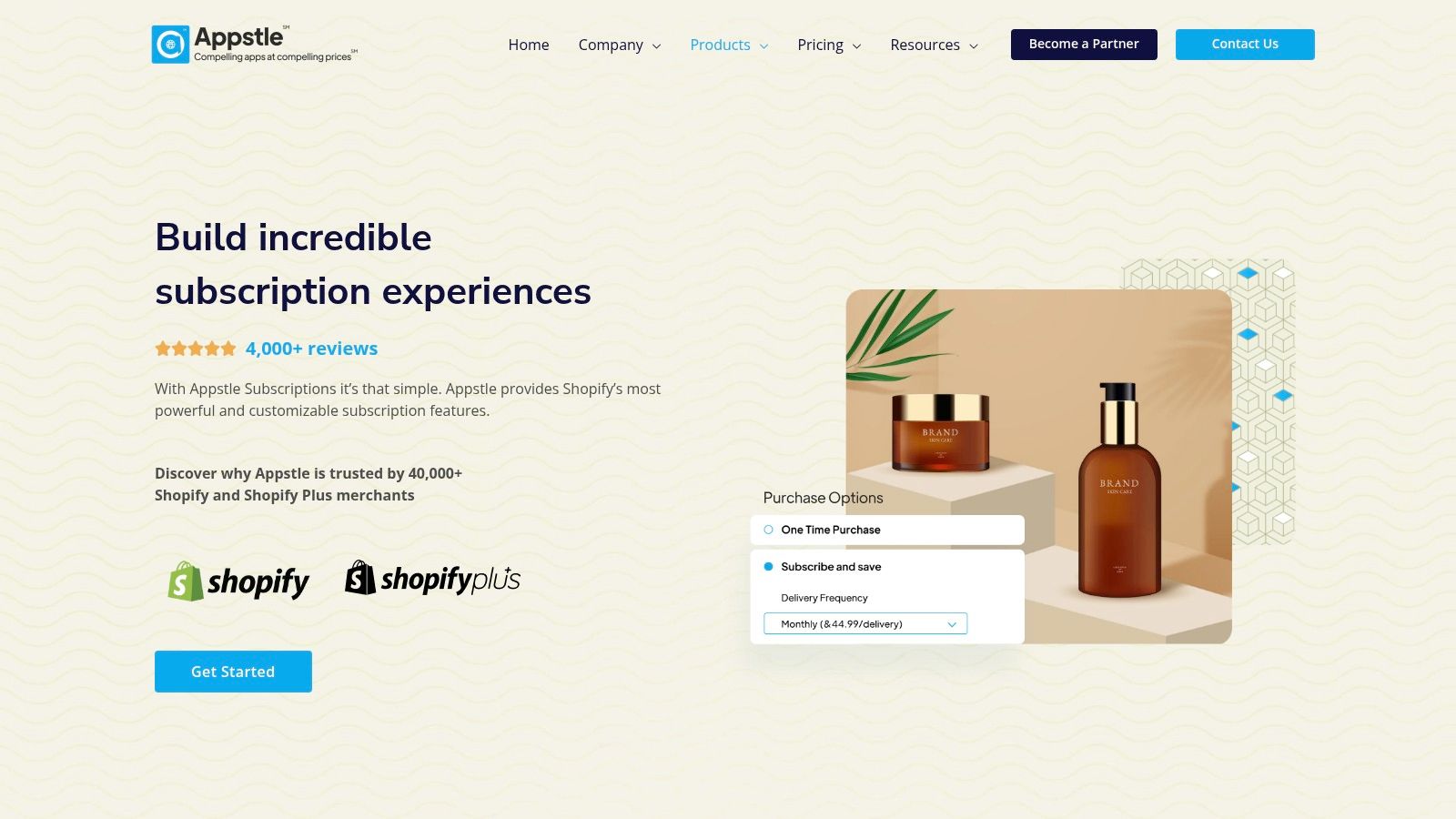
Appstle earns its place because it covers a lot of ground without requiring a full enterprise-style commitment. That's a real advantage for operators who need broad functionality but still want to move fast.
Best for feature depth without a heavyweight enterprise setup
Appstle fits brands that want bundling, build-a-box, flexible billing, prepaid options, a customizable portal, bulk edits, and automations in one platform. It's especially attractive when the operator wants to reduce dependency on extra add-ons for basic subscription functionality.
Support is part of the story here. Teams that value hands-on help often shortlist Appstle because practical responsiveness matters when the subscription setup gets more complex than expected. That's particularly relevant for subscription box Shopify programs where shipping logic, bundle behavior, and customer self-serve options need to work together.
The caution is straightforward. Advanced setups should be tested carefully against theme behavior and other installed apps. A tool with broad native feature coverage can still create friction if the storefront environment is already crowded.
Appstle is a smart middle-ground choice. It gives serious operators more room than a starter app, without forcing them immediately into the cost and process profile of a heavier platform.
4. Loop Subscriptions

Loop is one of the few tools in this category that feels purpose-built for growth-stage DTC brands instead of retrofitted from older subscription patterns. That's why it keeps showing up on serious shortlists.
Best for independent operators prioritizing retention workflows
Loop stands out when the brand cares about cancellation flows, prepaid and gift subscriptions, upsells, bundles, and a customer portal that doesn't create support debt. Passwordless access and retention-oriented tooling are practical strengths, not brochure features.
The platform is also easier to recommend because it sits in the serious-operator tier without feeling bloated. Brands that want competitive pricing, good support responsiveness, and enough depth to scale usually find Loop in a comfortable middle position between lightweight apps and enterprise-heavy systems.
The main caution is that some early-stage modules may benefit from more hands-on onboarding. That's not unusual in a product pushing into a broader retention feature set. It just means the merchant should expect implementation effort if the setup is more involved.
Loop is one of the best shopify subscription apps for brands that know retention matters and want that reflected in the core product, not patched in later.
5. Smartrr
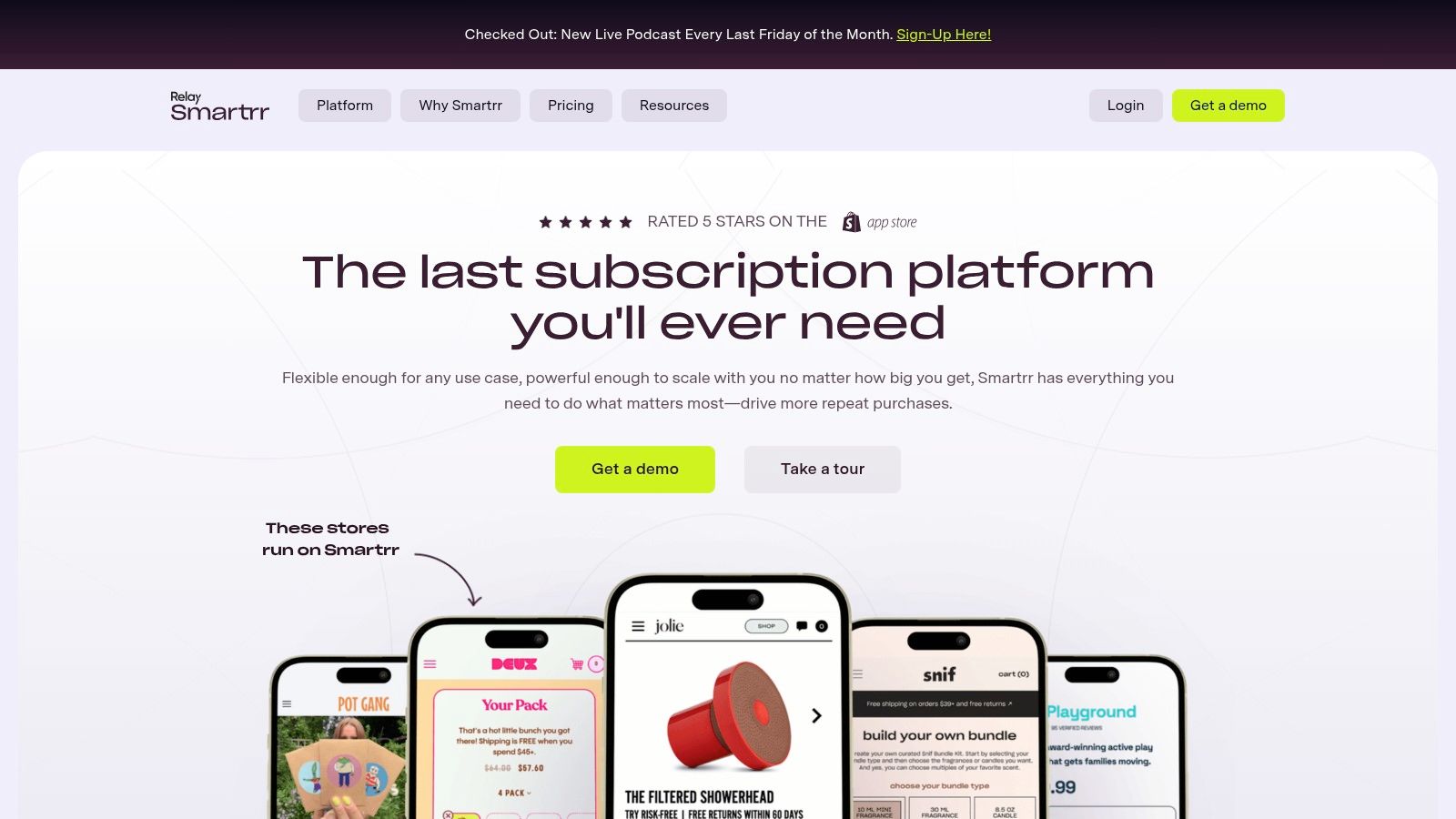
Smartrr appeals to operators who see subscriptions as part of a broader customer value program, not just recurring billing. That's an important distinction. It changes what “best” means.
Best for subscriber experience and loyalty-led programs
Smartrr is strongest when a brand wants a branded customer portal, retention actions, dunning, analytics, and loyalty-flavored post-purchase experiences working together. For operators trying to drive repeat behavior through both subscriptions and member-style benefits, that's a cleaner proposition than stitching separate tools together.
The platform is also attractive to teams that care about pricing transparency and want to avoid vague packaging. Clarity matters in this category because hidden costs often show up later, after migration gets harder.
The tradeoff is that some advanced functionality sits on higher tiers, and certain pricing changes for existing subscribers require process. That's manageable for organized teams, but it should be known upfront.
Smartrr is the right fit when subscriber experience is part of the retention strategy, not an afterthought. Brands focused on LTV programs usually understand the appeal quickly.
6. Stay AI
Stay AI is built for operators who want to treat churn like a system that can be tested, not a fixed output they review after the damage is done.
Best for teams treating churn as a product problem
The strongest features here are AI-driven churn prevention, cancellation and win-back flows, prepaid and gifting support, workflows, and analytics geared toward retention decisions. That makes Stay AI a strategic tool, not just a billing layer.
This is one of the best recharge alternatives for brands that believe billing reliability is table stakes and want deeper control over retention mechanics. It's also one of the few tools that clearly signals a philosophy: subscriber save flows, experimentation, and modern retention logic deserve dedicated tooling.
The obvious downside is that earlier-stage stores can pay for sophistication they won't use. If the team doesn't have bandwidth to run tests or act on churn insights, the product can outrun the organization.
Stay AI is worth it when the business already knows that churn isn't a marketing side issue. It's a core operating problem.
7. Bold Subscriptions V2
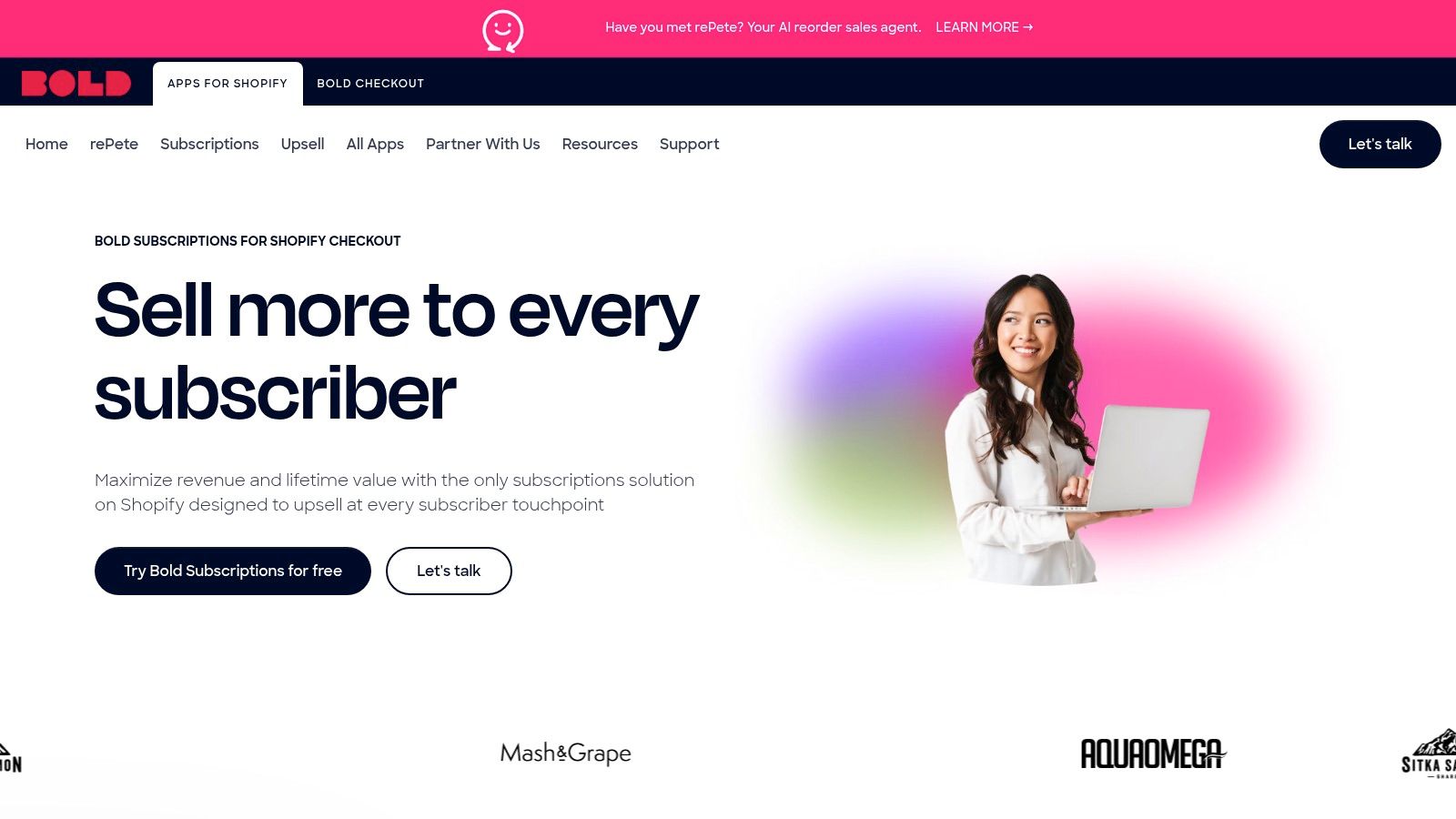
Bold stays relevant because some operators don't need a high-concept subscription platform. They need a mature vendor that can handle straightforward replenishment programs without drama.
Best for simpler replenishment programs
Bold Subscriptions V2 is a practical option for merchants who want self-serve customer management, cancellation saver flows, dunning, and flexible intervals without forcing a full retention transformation. That makes it easier to recommend for less complex models.
There's value in experience here. Bold has been around the category long enough that many agencies and operators already understand the product shape, support posture, and implementation tradeoffs. For some teams, familiarity lowers execution risk.
The caveat is fee structure and plan details. Those should always be verified before purchase because costs can become less attractive if the merchant assumes a simpler setup than the plan is designed to support.
Bold works best when the subscription strategy is clear, the use case is straightforward, and the team wants a known vendor with enough customer management tooling to reduce avoidable churn.
8. PayWhirl Subscriptions
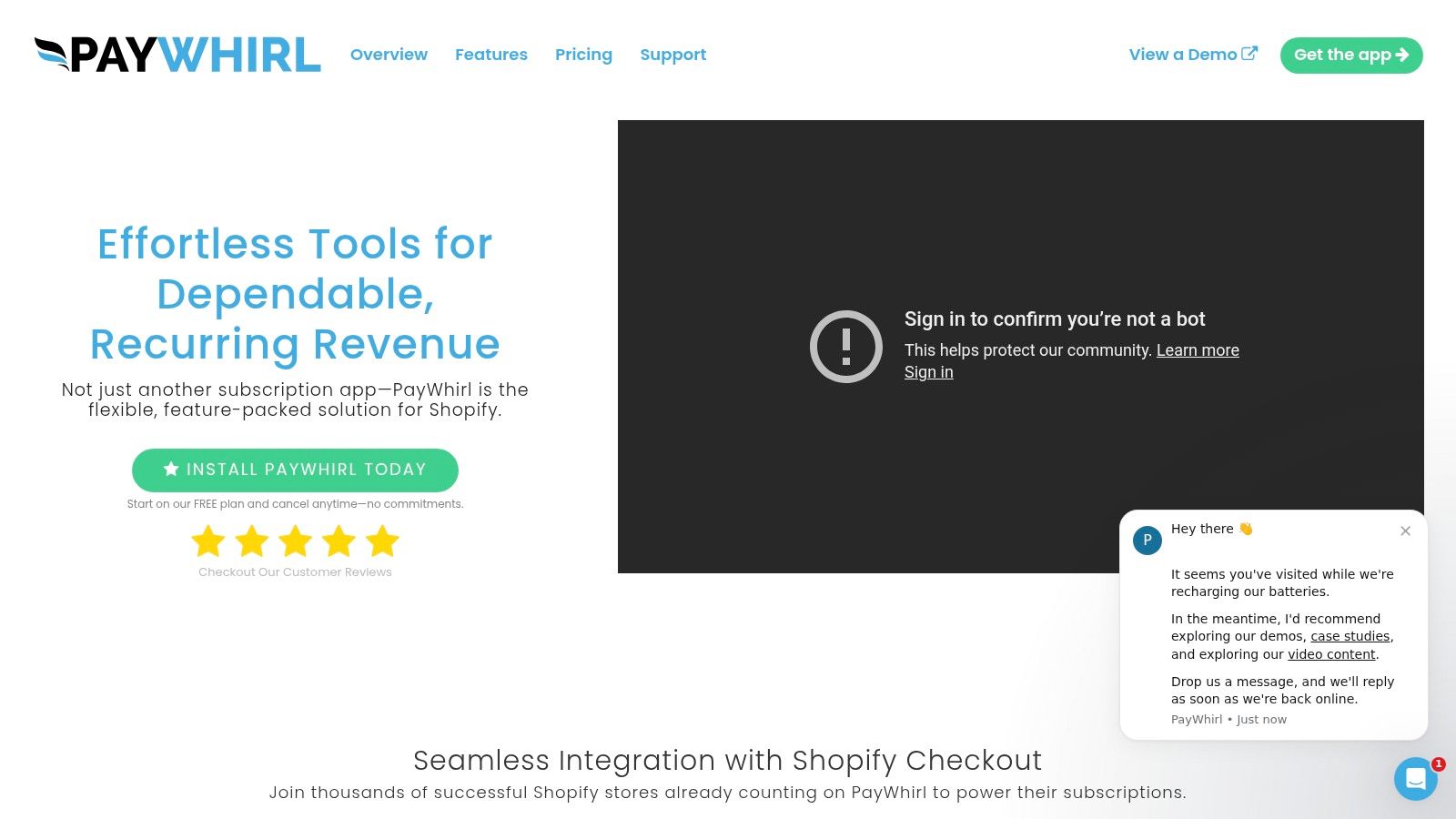
PayWhirl is one of the cleaner options for merchants who want flexibility without the feeling that every serious feature is hidden behind a custom sales process.
Best for operators who want pricing clarity
PayWhirl is usually shortlisted by cost-aware operators who still want native Shopify checkout integration, developer APIs, workflow automation, dunning, and usable documentation. That combination matters because pricing clarity is only helpful if the product is credible once the business scales.
The app is often a strong fit for merchants who want to test, iterate, and control spend while the subscription program grows. It also deserves attention from teams with a more technical bent, since webhooks and API access can be meaningful differentiators.
The limitation is familiar. Some advanced capability sits on higher tiers, and per-transaction fees are part of the equation on most plans. That doesn't make PayWhirl a bad choice. It just means the operator should evaluate total cost over time, not just starting cost.
PayWhirl is a smart pick for disciplined teams that want a published pricing path, decent flexibility, and fewer surprises.
9. Seal Subscriptions
A lot of stores do not need a heavyweight subscription stack on day one. They need a low-cost way to prove that customers will reorder before they take on migration risk, ops complexity, and a larger software bill.
Best for cost-sensitive early-stage stores
Seal makes sense for operators running a simple subscribe-and-save offer and watching cash closely. If you are still validating product-market fit on subscriptions, or your subscriber base is small enough that retention work is still manual, Seal is often the disciplined choice.
The appeal is straightforward. You can get recurring orders live without committing to the pricing, implementation time, and workflow sprawl that come with more advanced platforms. For a founder-led brand or lean ecommerce team, that matters more than a long feature list.
Its fit is narrow by design. Basic recurring orders, cancellation handling, dunning, prepaid options, and onboarding support cover the core job. If your program mostly needs customers to start, manage, and renew subscriptions without a lot of edge-case logic, Seal can do that job well.
The limit shows up later, not immediately.
Once the subscription channel starts to matter, the missing depth becomes expensive in a different way. Reporting is lighter, retention experimentation is less developed, and broader stack integration can become a bottleneck. That is usually the point where operators outgrow the app and face the true cost of any budget-first decision. Migration, customer payment token handling, and subscriber communication all become projects.
Seal is the right call when you want proof before optimization. Use it to validate demand. Do not choose it if you already know subscriptions will be a major retention channel and you want to reduce the odds of a second platform move in a year.
10. Ordergroove
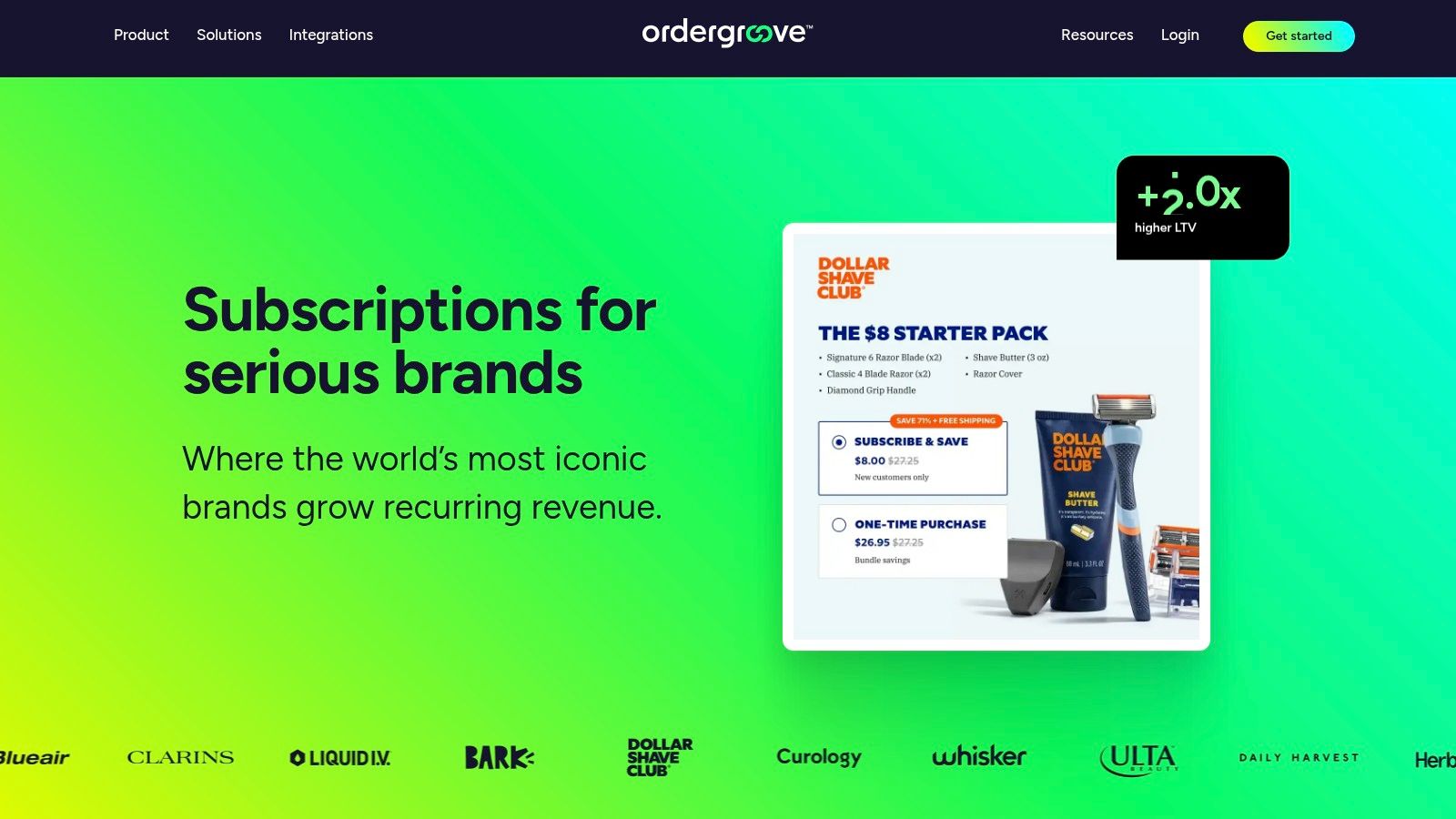
Ordergroove is not for lightweight setups. It's for brands with enough catalog, process, and channel complexity that SMB-oriented apps start to look undersized.
Best for enterprise complexity
Ordergroove is a serious option for larger brands that need prepaid, rotating, and bundled subscriptions, more advanced cancellation-save logic, promotions, cart opt-ins, powerful APIs, and a vendor that understands enterprise onboarding. That combination matters when subscriptions touch more than one operational system.
The biggest reason to shortlist Ordergroove is complexity tolerance. Teams with omnichannel demands, deeper internal process requirements, or more custom workflow expectations often need that level of support. Smaller brands usually don't.
The downside is exactly what buyers should expect. Quote-based pricing, longer implementation cycles, and a more involved setup come with the territory. That's acceptable if the brand needs enterprise-grade control.
Ordergroove is the right tool when the subscription business is large enough that operational fit matters more than app-store convenience.
Top 10 Shopify Subscription Apps Comparison
App | Core features | UX & support | Pricing / value | Ideal for | Benefits via AppStoreResearch |
|---|---|---|---|---|---|
Recharge Subscriptions | Billing, customer portal, bundles, loyalty, dunning, analytics | Reliable at scale, deep integrations, mature migrations | Enterprise-grade; per-transaction fees on many tiers | High-volume merchants, Shopify Plus, complex integrations | Paid calls with app devs, influence roadmap, occasional deals/consulting, join 3,000 operators, $1M+ paid incentives |
Skio (now part of Recharge) | Analytics & segmentation, journeys automation, SMS, Markets AI | Merchant-loved UX, fast bulk ops, clean admin | Comparable to pro-tier pricing; roadmap evolving under Recharge | Midsize brands prioritizing UX and lifecycle automation | Fast feedback calls with founders/devs, early access, influence features, get paid to join 3,000 operators |
Appstle Subscriptions | Bundles, build-a-box, flexible billing, customizable portal, 24/7 support | Fast hands-on support, broad native features | Strong value for features; confirm pricing details | SMBs and Plus brands wanting native coverage without many add-ons | Discover new apps, get paid sessions with teams, reduce app costs, shape product direction |
Loop Subscriptions | Passwordless portal, upsell engine, box builder, Loop Flows automation | Responsive support, solid analytics, competitive UX | Competitive pricing for feature depth | Growing DTC brands seeking accessible feature set | Speak with app teams for incentives, early deals, feature requests heard by founders |
Smartrr | Subscribe-and-save, branded portal, retention actions, advanced analytics | Transparent plans, merchant-first onboarding | % of subscription GMV pricing model (no app tx fees) | Brands focused on LTV and retention-driven growth | Influence retention features via paid calls, sometimes get consulting or deals |
Stay AI | A/B testing, AI churn prevention, advanced win-back flows, native checkout | Flat feature access, strategy-minded onboarding | Pro plans on higher end; per-transaction fees apply | Brands treating retention as strategic growth lever | Test ideas with devs, get paid feedback sessions, help steer AI-driven features |
Bold Subscriptions (V2) | Self-serve portal, cancellation savers, dunning, configurable intervals | Mature vendor support, extensive help center | Transaction fees vary by plan; check latest docs | Straightforward replenishment programs, merchants wanting proven vendor | Talk directly to founders/devs, find deals/consulting, avoid noisy app discovery |
PayWhirl Subscriptions | Native checkout, developer API, workflows, dunning, Klaviyo | Clear docs, quick testing, published pricing tiers | Clear published pricing, free plan threshold; tx fees on most plans | Cost-sensitive merchants scaling with clear pricing path | Join paid sessions with devs, preview integrations, influence roadmap |
Seal Subscriptions | Subscribe-and-save, basic dunning, prepaid/membership options, migration guides | Budget-friendly, simple UX | Free tier available, affordable paid plans | Early-stage stores, cost-conscious brands | Low-friction paid calls to discover practical apps, migration help, $1M+ paid out to operators |
Ordergroove | Prepaid/rotating subscriptions, build-a-box, omnichannel workflows, robust APIs | Enterprise onboarding, professional services | Quote-based enterprise pricing, higher cost | Large US brands with complex catalogs and omnichannel needs | Enterprise-level access to vendor teams, paid research sessions, shape advanced product work |
Final Thoughts
The best shopify subscription apps aren't “best” in the abstract. They're best for a specific stage, team, and retention problem.
Recharge is still the safe call for complexity and scale. Skio is compelling for teams that prioritize cleaner operations and modern lifecycle tooling. Loop is one of the strongest independent options for brands that care about churn recovery and practical retention depth. Stay AI is the sharpest choice when the business wants to actively engineer retention, not just report on it. Native Shopify Subscriptions is fine when the use case is simple and the team has no reason to buy complexity yet.
The wrong way to buy a shopify subscription app is to compare only features and entry pricing. The right way is to ask harder questions. What happens when subscribers want to pause or swap? How many support tickets does the portal create? What breaks during migration? Which vendor will engage when the team needs roadmap influence, not just a help article?
That last point matters more than most merchants admit. Shopify's app ecosystem is large, crowded, and noisy. Public listings help, but they don't replace direct contact with app teams, especially when a merchant is evaluating recharge alternatives, planning a migration, or trying to reduce the long-term cost of a subscription stack decision.
For operators who want more influence in those conversations, app store research is relevant because it connects Shopify merchants with paid product research interviews with app developers and UX teams. That gives experienced operators a way to influence tools they already use, push on migration pain points, and get early visibility into what vendors are building next. In a crowded app market, that kind of access is often more useful than another comparison page.
The cleanest decision framework is simple. Start with current complexity. Check where churn and support burden come from. Then pick the platform that solves today's operational problem without locking the business into tomorrow's migration.
The strongest Shopify operators don't just install apps. They build strong relationships with the vendors behind them. Join the network to take part in paid conversations with the app founders, product teams, and UX researchers shaping the tools used every day. The value is access, influence over roadmaps, and early visibility into what's coming next. The incentive is a byproduct.

Author
Jonathan Kennedy
Jonathan Kennedy is the founder of app store research and shopexperts, platforms that connect operators, founders, and experts across the Shopify ecosystem to drive better decisions, product development, and growth.