Most “best Shopify upsell apps” lists fail for one reason. They lump together product-page bundles, cart drawer offers, checkout blocks, and post-purchase one-click offers as if they solve the same problem.
They don't.
A store trying to lift AOV without hurting conversion has to decide where the upsell belongs in the journey. Pre-purchase works when the add-on helps the shopper make the buying decision. In-cart works when the offer strengthens the order before checkout. Post-purchase works when the original conversion is already secured and the follow-up offer feels like a clean extension of the order. That's the lens serious operators use when they review the 2026 ecommerce scaling guide and when they audit app stacks that have grown messy over time.
The Shopify category itself shows how mature this market has become. Shopify groups upsell tools under marketing and conversion, and category roundups now list 20+ specialized apps across bundles, cart offers, checkout offers, and post-purchase flows on the Shopify upsell and bundles category page. The better question isn't which app is “best” in the abstract. It's which app fits the exact moment in the funnel that needs work.
The three places to upsell and the apps for each
The useful way to rank the best Shopify upsell apps is by placement, not by feature count. Placement determines customer psychology, design constraints, and how much risk the offer adds to the original conversion.
How placement changes the job
Pre-purchase upsells sit on the product page or nearby. These work best when the add-on clarifies the purchase. Think bundles, accessories, quantity breaks, or “complete the set” logic.
In-cart upsells sit in the drawer or cart page. These work when the shopper has already committed to buying and just needs a strong nudge to expand the basket. Cart placement is often the cleanest AOV optimizer Shopify teams can roll out without changing checkout.
Post-purchase upsells appear after payment. This is a different game entirely. The original order is already secured, so the follow-up offer can be more direct if it's relevant and friction-light.
Practical rule: Don't ask one app to solve three different conversion problems unless the team actually wants one vendor controlling the full funnel.
A practical way to choose
For most stores, the shortlist looks like this:
Full funnel coverage: Zipify OCU, Rebuy, ReConvert, Bold, Honeycomb
Cart and pre-checkout focus: ICU, Frequently Bought Together, Selleasy
Post-purchase strength: AfterSell, CartHook, ReConvert, ConvertWise research profile
That split matters because operators aren't choosing whether to upsell anymore. They're choosing which funnel point deserves optimization and which app creates the least stack friction.
Pre-purchase ReConvert Bold Honeycomb
Pre-purchase is where teams often make the first mistake. They show too much, too early, to shoppers who haven't decided to buy the base product yet.
What pre-purchase upsells are good at
Pre-purchase placements work when the offer feels like part of product discovery. A matching accessory, a bundle that saves the shopper time, or a quantity incentive all fit here. A random popup for an unrelated SKU usually doesn't.
Technical guides also show that better-performing implementations are placement-specific. Extensiv notes that Bold can surface upsell, cross-sell, and post-purchase popup offers, while Plumrocket highlights ReConvert's one-click post-purchase and thank-you-page optimization. Rep AI adds that modern tools are increasingly built around behavior tracking and funnel-specific recommendations, summarized in the Extensiv Shopify Plus apps guide.
Where each app fits
ReConvert is useful when a team wants broad coverage but doesn't want to overbuild from day one. It expanded beyond thank-you-page roots into product, cart, checkout extensions, and post-purchase offers. That makes it viable for stores that want one app to test multiple placements before specializing.
Bold is still one of the more durable general-purpose options. It supports pre-purchase, cart, in-checkout, and post-purchase placements, which makes it attractive for merchants that want many offer types under one vendor relationship. The trade-off is that broad coverage can create a heavier setup process.
Honeycomb fits smaller and mid-market stores that want visual funnel building without a lot of theme work. It tends to appeal to teams that need to move fast, test basic logic, and avoid development lift.
Pre-purchase wins when the offer helps the customer buy. It loses when the offer interrupts the decision.
In-cart slide cart and AOV optimizers
The cart drawer has become one of the most important surfaces in the stack because it sits at a high-intent point without touching payment itself.
Why the cart drawer matters
An in-cart offer can raise AOV without introducing as much risk as a product-page popup. The shopper has already chosen something. The remaining job is to make the order feel more complete, more efficient, or better valued.
This is also where app category sprawl shows up fast. Shopify's market has matured into a crowded field with 20+ specialized options and pricing that ranges from free plans to paid tiers and custom pricing on the Shopify App Store upsell market page. That breadth is useful, but it also means stores can end up with a bundle app, a cart app, a free gift app, and a post-purchase app all competing inside one flow.
Which apps make sense here
ICU is the clean pick when the team mainly wants cart and product-page logic with predictable setup. It doesn't try to be the deepest post-purchase platform. That's a strength when simplicity matters more than stack ambition.
Frequently Bought Together is a classic choice for accessory-led merchandising. It works especially well on stores where the main goal is to attach complementary products without introducing popups or a more aggressive CRO layer.
Selleasy is one of the stronger budget options in this lane. In a Ringly comparison, Selleasy was listed at 4.9 stars from over 2,160 reviews, which makes it the most review-heavy app in that roundup and a meaningful adoption signal in the Ringly Shopify upsell app comparison. That doesn't make it universally best. It does suggest broad merchant usage and enough volume of feedback to take seriously.
Post-purchase AfterSell ConvertWise ReConvert
Post-purchase is where many operators see the cleanest incremental revenue because the offer doesn't threaten the original checkout.
Why post-purchase often converts cleanly
Baymard's checkout research has long pushed teams to reduce friction at checkout. That principle matters here too. If a store wants a more assertive upsell strategy, the safest place is usually after payment, not before it, because the shopper can accept with less mental load and without reopening purchase doubt. That's consistent with broader Baymard checkout UX research.
AfterSell has become one of the category references for this approach. In its 2026 roundup, Aftersell states that merchants using its platform see an average 30% boost in AOV in the Aftersell upsell app roundup. That's one of the clearest published benchmarks in this category, and it's one reason buyer expectations have shifted toward measurable revenue lift.
The operator trade-offs
AfterSell is strongest when the store already has product and cart merchandising covered and wants a specialized post-purchase engine. It also suits Shopify Plus teams that want checkout customization layered into the same vendor ecosystem.
ReConvert remains relevant because it combines post-purchase and thank-you page control with broader funnel coverage. It's often the easier “good enough across more surfaces” choice, especially for teams that don't want a separate tool for every funnel stage.
ConvertWise belongs in the conversation because operators evaluating post-purchase and AOV flows increasingly want direct feedback from peers, not just polished app-store positioning. The ConvertWise profile on app store research is useful for teams that want context on how merchants evaluate this part of the stack through real research conversations.
Realistic AOV lift benchmarks what operators actually see
This category is full of inflated promises. The only numbers worth using are the ones that can be cited directly.
What can be cited with confidence
Rep AI says sales-first AI upsell systems can improve AOV and conversion by 10 to 30% in its 2026 guide, summarized in the verified market research above. That range matters because it reflects realistic merchant expectations for well-matched upsell logic, not fantasy outcomes from poor-fit offers.
A separate benchmark comes from Aftersell's published average AOV lift, noted earlier. Together, those figures create a practical frame. Good upsell apps can drive meaningful AOV gains. They don't rescue a weak offer, a cluttered funnel, or a bad fit between placement and intent.
How to interpret those numbers
AOV lift isn't enough on its own. Operators still need to ask whether the app adds friction, duplicates another app's job, or creates enough engineering and QA overhead to erase the upside.
Community discussions also show why that question has become sharper. Merchants already complain that tools like ReConvert, Honeycomb, and Zipify OCU can run roughly $30 to $100+ per month and may scale with order volume in the Shopify community discussion on upsell app costs. In a crowded market, the smart comparison isn't feature count. It's cost versus incremental orders, plus the implementation risk.
Operator lens: The right benchmark isn't “Did AOV go up?” It's “Did contribution improve after app cost, added complexity, and any hit to conversion?”
What kills upsell conversion
Most upsell failures aren't caused by weak software. They're caused by poor offer discipline.
The common failure modes
The first failure is bad timing. A high-friction offer before checkout can undercut the very conversion it's meant to improve. That's why placement-specific tools keep gaining ground.
The second failure is irrelevance. If the app recommends a product that doesn't obviously belong with the order, shoppers treat it as noise. AI recommendations don't fix weak merchandising logic.
The third failure is clutter. Stores stack a bundle widget, a sticky cart, a free shipping bar, an order bump, and a popup into one path. The result isn't a stronger funnel. It's a mess.
Too many surfaces: One strong offer often beats several mediocre ones.
Wrong incentive: A discount can help, but not if it trains shoppers to second-guess the first purchase.
Weak mobile UX: Cart drawers and offer blocks need to feel native on mobile, not bolted on.
What usually works better
The strongest offers tend to be obvious add-ons, replenishment items, or practical complements. They answer “why this product now?” without making the shopper do extra work.
Post-purchase is often the cleanest place for a more aggressive pitch. Pre-purchase and in-cart placements usually need more restraint.
How to test app-on-app stacks
Most stores don't run one tool. They run a stack. That's where clean testing matters.
A cleaner testing sequence
Start with one placement and one job. If the cart drawer is weak, fix that before adding post-purchase logic. If post-purchase is already working, don't let a new product-page widget muddy the attribution.
For full-funnel platforms like Zipify OCU or Rebuy, the main advantage is reduced tool sprawl. Shopify app listings and roundups repeatedly cite funnel coverage, analytics, and testing depth as key differentiators, especially for tools like Bold and Zipify. Zipify is often noted for in-checkout and post-purchase optimization with advanced analytics and A/B testing in the verified category research.
When to simplify instead of adding another app
A stack should get simpler as the store matures, not more chaotic. If one vendor can responsibly replace a cart app, a basic upsell app, and a post-purchase point solution, consolidation can be a true win.
That's also where product feedback becomes valuable. In a market with broad selection, teams need direct conversations with operators to understand what feels useful versus spammy, what can replace multiple apps, and what buyers are willing to pay for. That's one reason app founders increasingly use merchant interview networks rather than relying on app-store reviews alone.
1. Zipify OneClickUpsell OCU
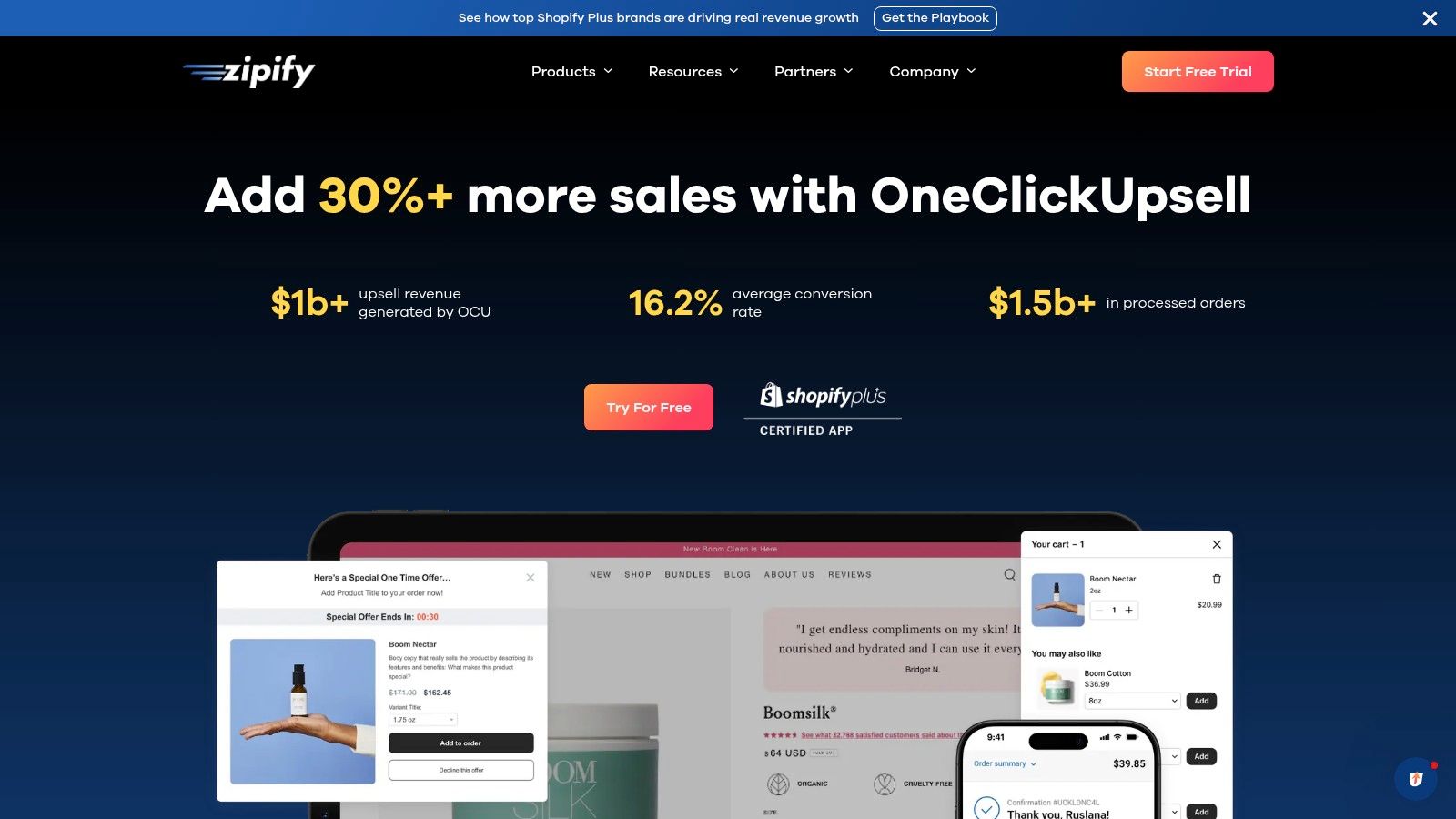
Zipify OCU is one of the strongest options for teams that want a single app across most upsell surfaces. It's especially relevant when the store wants pre-purchase, slide cart, in-checkout for Plus, post-purchase, and thank-you page logic in one system rather than spread across multiple vendors.
Best fit
This works best for operators treating upsells as a full-funnel program, not a single widget. The built-in testing and analytics matter because broad placement coverage creates more decisions, and those decisions need a clear read on performance.
The trade-off is cost control and setup discipline. Full-funnel capability often means the app can do far more than the team should launch at once. A better approach is to connect OCU to a clear average order value strategy and add surfaces gradually.
2. AfterSell by Rokt
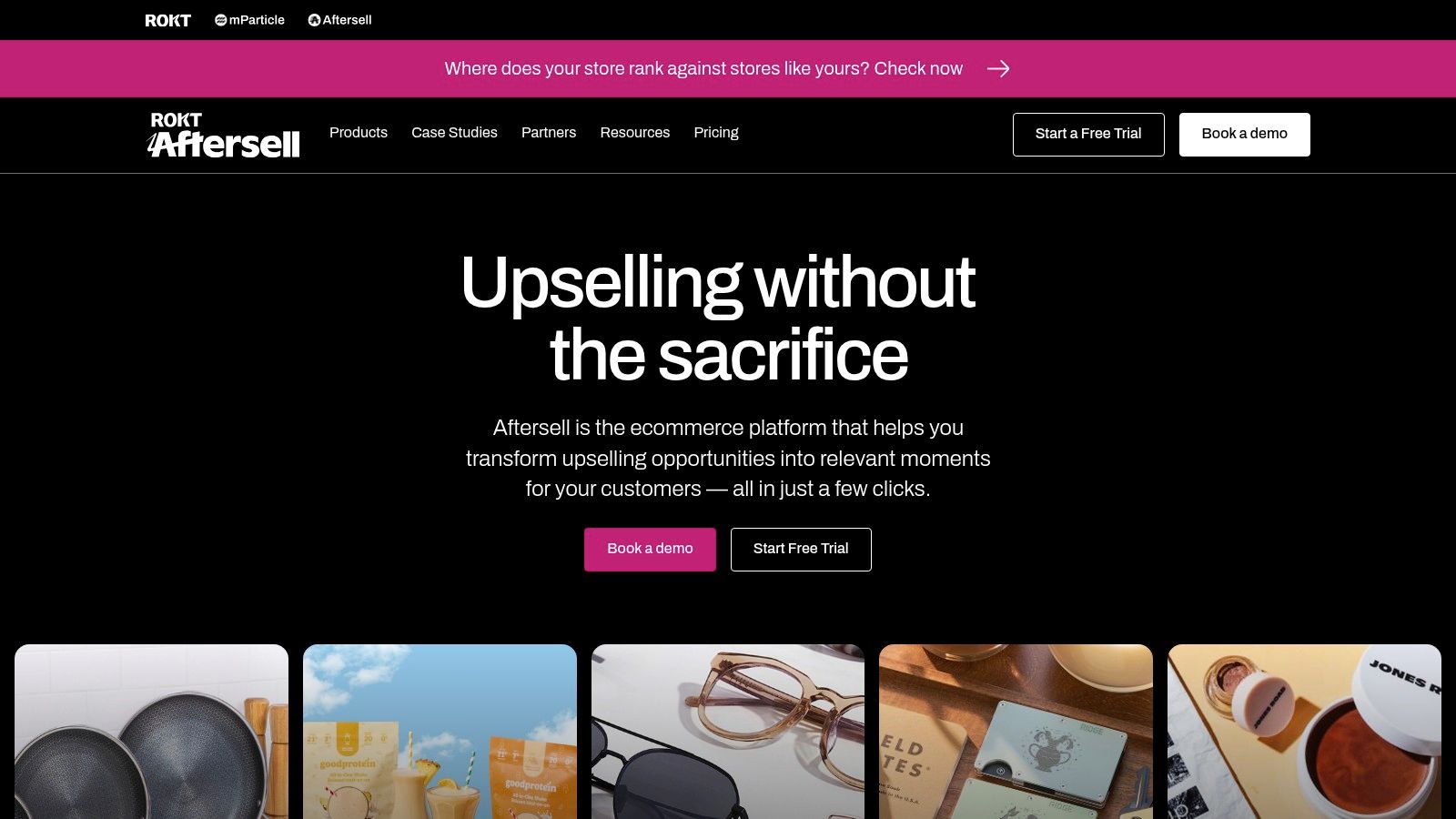
AfterSell is the specialist pick for post-purchase and thank-you page monetization. It makes sense when the store already has pre-purchase and cart motions covered and wants to extract more from the immediate after-checkout window.
Best fit
This is a strong fit for brands that care about conversion efficiency and don't want to risk cluttering the buying path before payment. The optional cart drawer and Shopify Plus checkout customization broaden the use case, but the center of gravity is still post-purchase.
The practical downside is module sprawl. Teams should verify whether they need only post-purchase, or whether they're about to buy separate components while also paying for adjacent CRO tools. That's the same decision logic behind a tighter Shopify conversion rate optimization stack.
3. Rebuy Personalization Engine
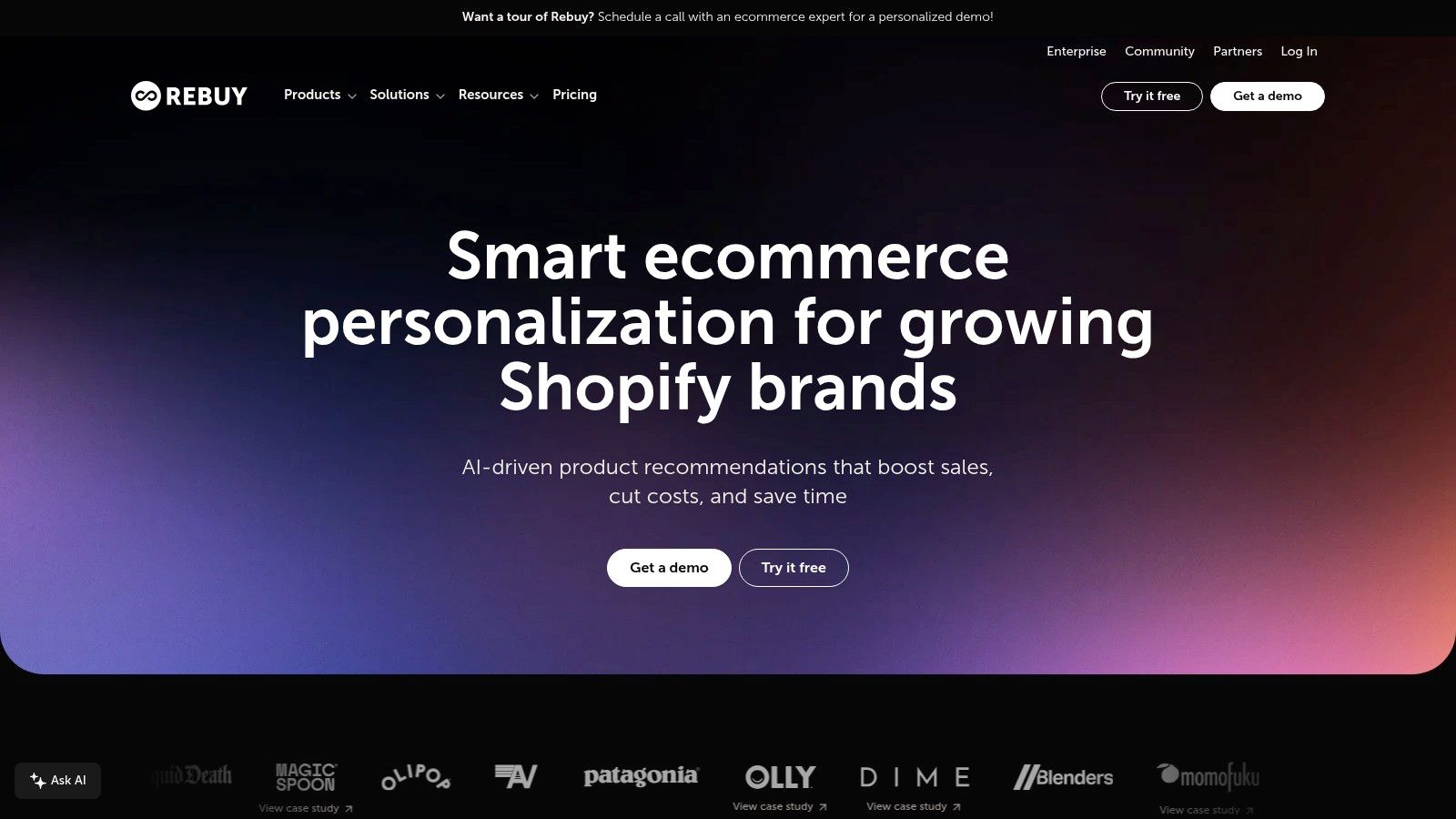
Rebuy is built for teams that want merchandising logic and personalization across the funnel, not just isolated upsell widgets. It's often the app chosen when a brand wants one enterprise-grade layer handling recommendations, cart logic, checkout extensions, and post-purchase surfaces.
Best fit
The appeal is consolidation. Smart Cart, rules, AI recommendations, and broader merchandising controls can reduce the need for several narrower apps. That's attractive for larger catalogs and more complex stores.
The downside is operational. Rebuy usually asks for more planning, more QA, and more internal alignment than a simpler app. Teams comparing it against lighter tools should use a stricter framework for evaluating Shopify apps, especially around implementation depth and ownership.
Rebuy Personalization Engine website
4. Upsell.com ReConvert Bundles ex-ReConvert
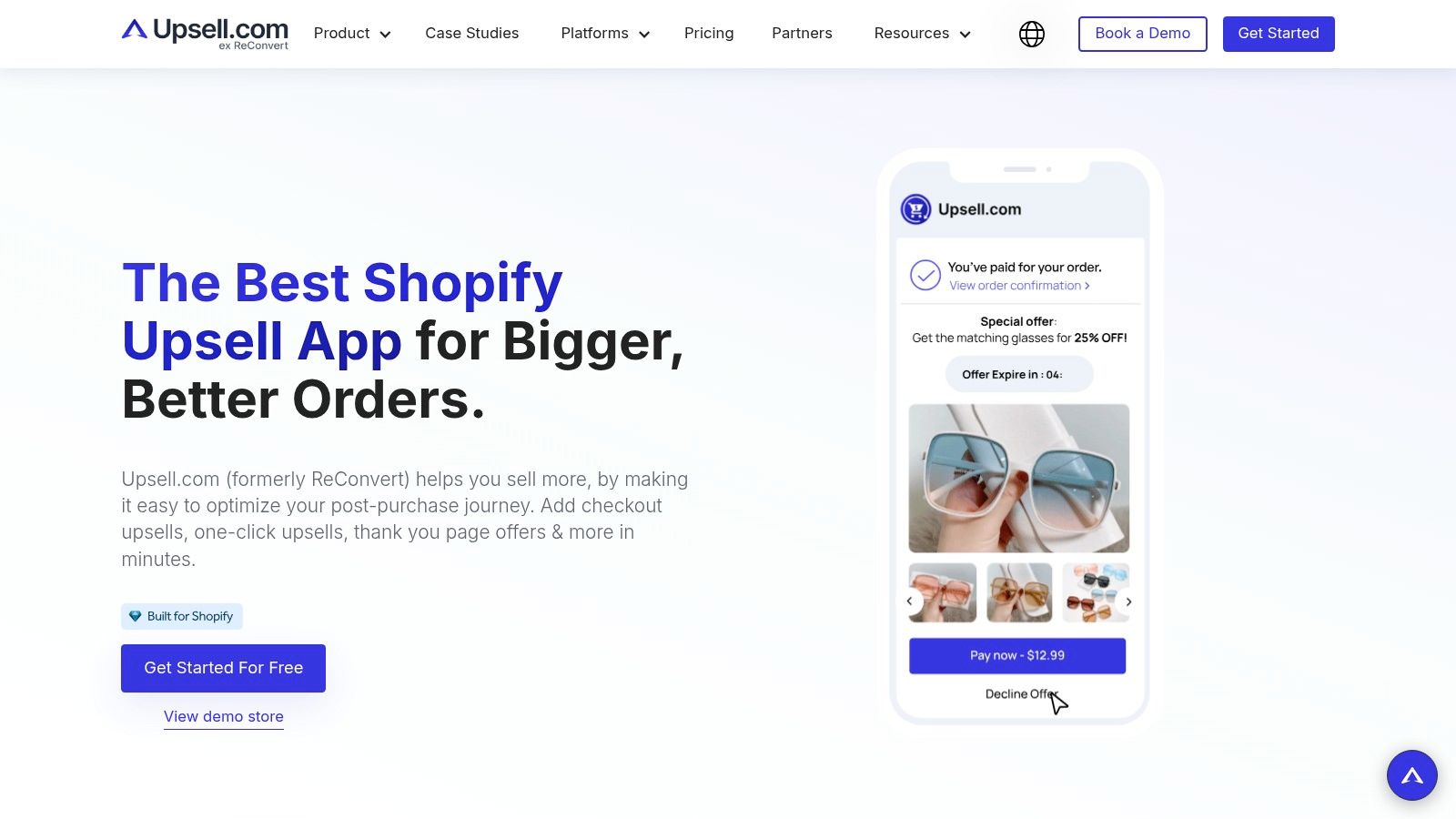
ReConvert has stayed relevant by moving beyond thank-you-page roots into broader funnel coverage. That makes it a practical middle ground for stores that want one vendor handling product, cart, checkout extensions, and post-purchase offers without jumping immediately to a heavier enterprise platform.
Best fit
This is a good fit for operators who want fast testing across multiple placements and low-friction entry. It's often easier to justify than a more expensive stack because it can validate whether the store's biggest opportunity sits before checkout or after it.
Its weakness is precision. Some teams eventually want more design control or deeper targeting than the defaults provide. That's usually the point where they either specialize by placement or move upmarket.
5. Honeycomb Upsell and Cross Sell Conversion Bear
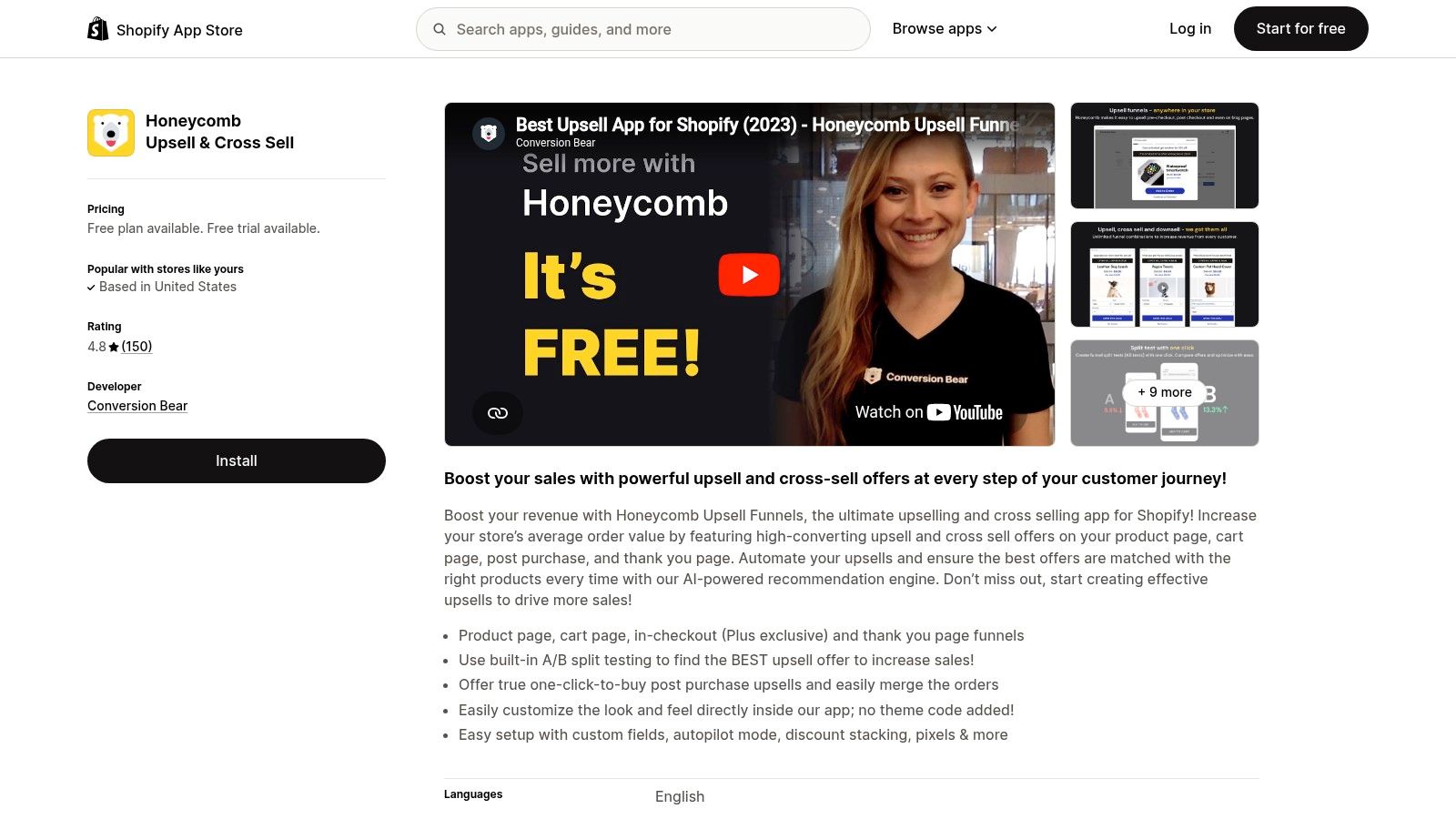
Honeycomb earns attention because it lowers the operational barrier to launching funnels. Stores that don't want theme edits or a heavy implementation cycle often find it easier to ship with this than with more customizable platforms.
Best fit
It fits smaller to mid-market brands that want product-page, cart, post-purchase, and thank-you page offers in one approachable interface. The visual funnel builder helps when the team needs something usable by marketers and operators, not just developers.
The main trade-off is ceiling. Teams with more complex integrations or more demanding enterprise requirements often outgrow it. For stores in that middle band, though, simplicity can outperform sophistication.
Honeycomb Upsell and Cross Sell website
6. In Cart Upsell and Cross-Sell ICU
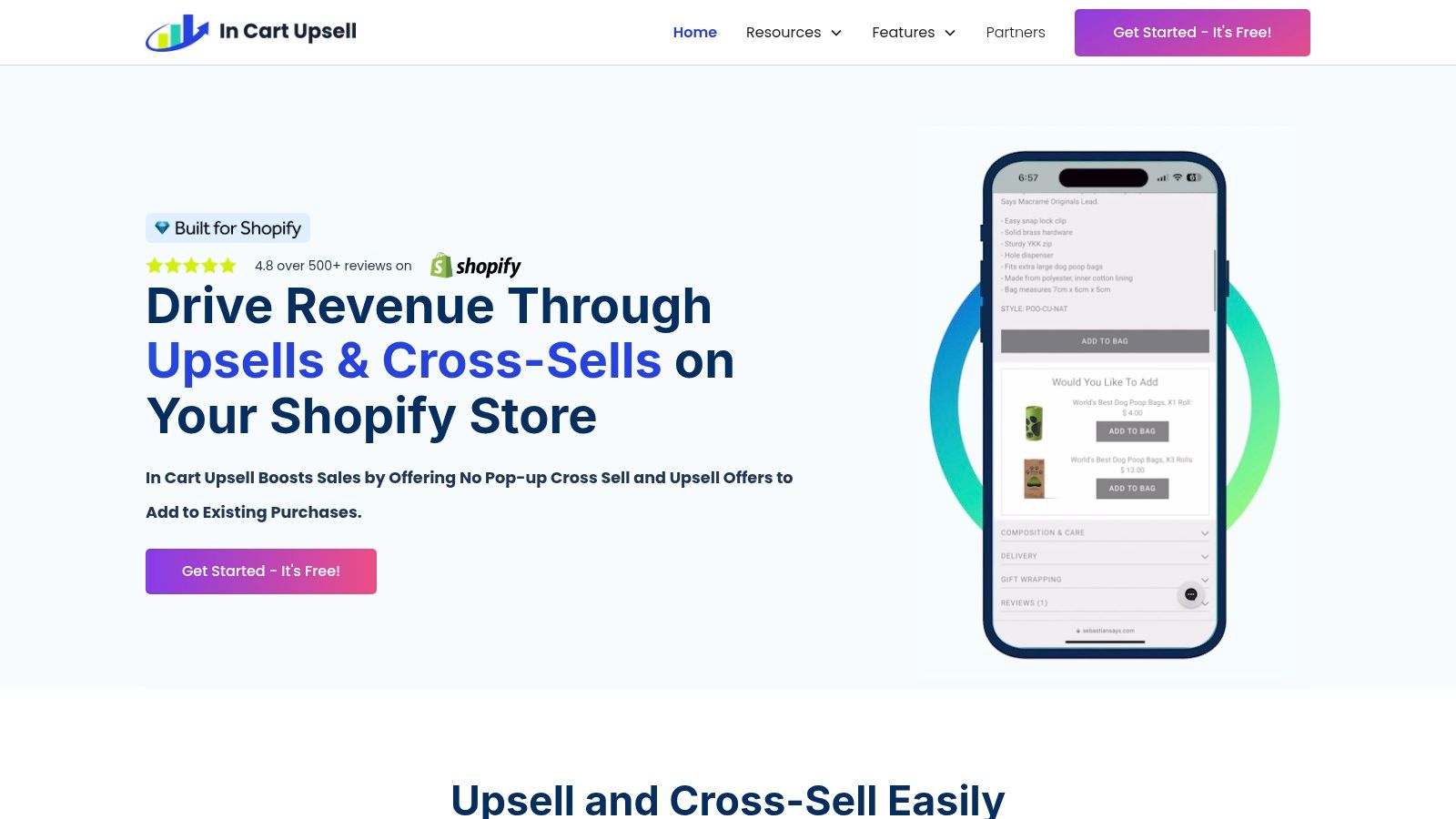
ICU is a focused tool. That's exactly why some teams prefer it.
Best fit
When the goal is straightforward product-page and cart-drawer upsells, ICU is easier to reason about than a broad platform with overlapping features the store may never use. It's a sensible choice for operators who want predictable pre-checkout logic and don't need a deep post-purchase suite.
A narrow app is often the better app when the store already knows where the conversion gap is.
The limitation is obvious. Stores that later want stronger post-purchase analytics or more advanced funnel design may need a second tool.
7. CartHook Post-Purchase Offers
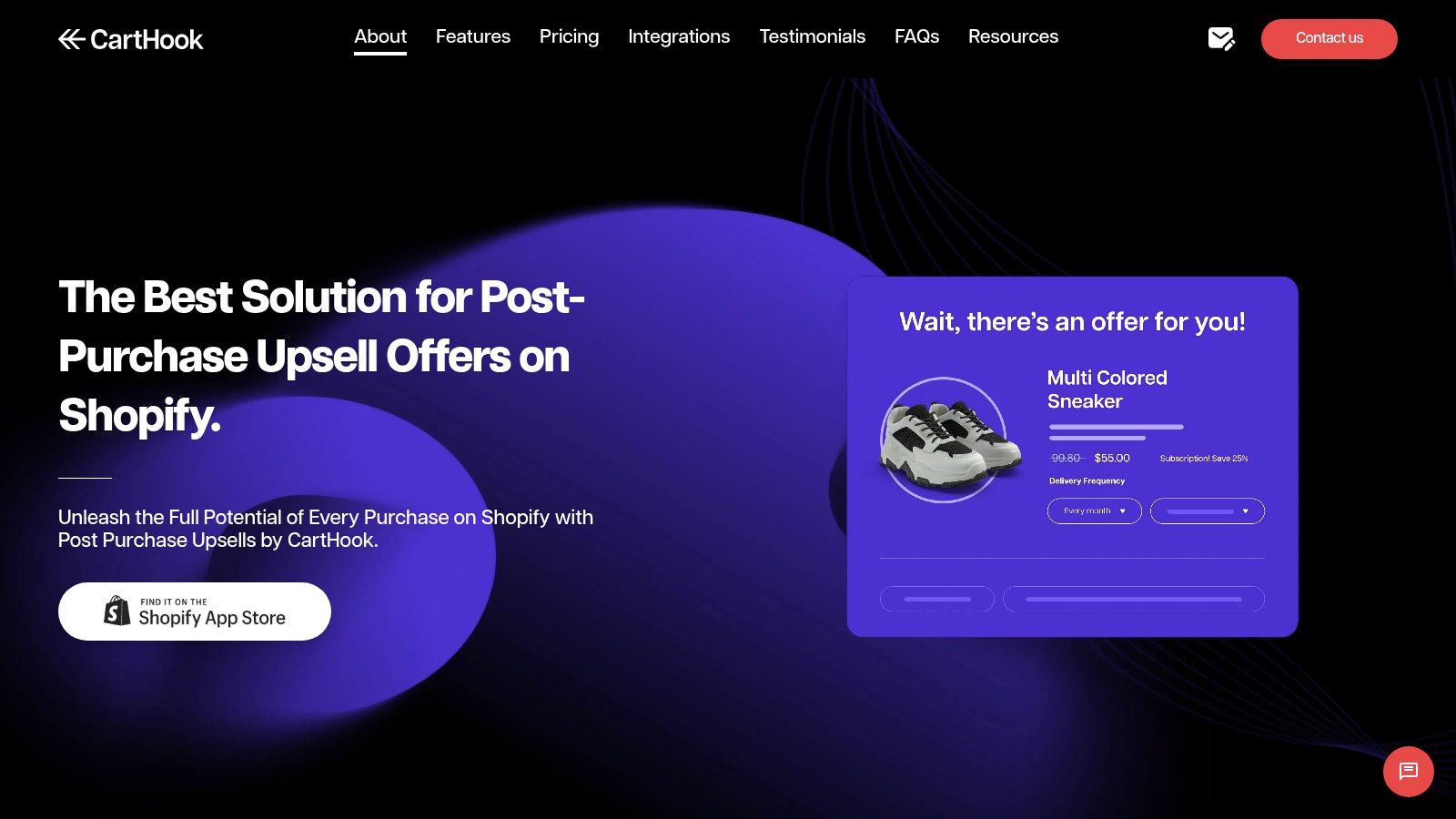
CartHook is still one of the cleaner choices for merchants who want dedicated post-purchase functionality without trying to run the full funnel inside one app.
Best fit
This works for stores that already have a preferred cart, bundle, or product-page setup and want a specialist for the one-click post-purchase moment. The drag-and-drop flow is useful when the team values speed to launch over broader merchandising control.
The downside is stack fragmentation. If the store doesn't already know its pre-purchase and in-cart plan, CartHook can become one more point solution in an already crowded setup.
8. Frequently Bought Together Code Black Belt
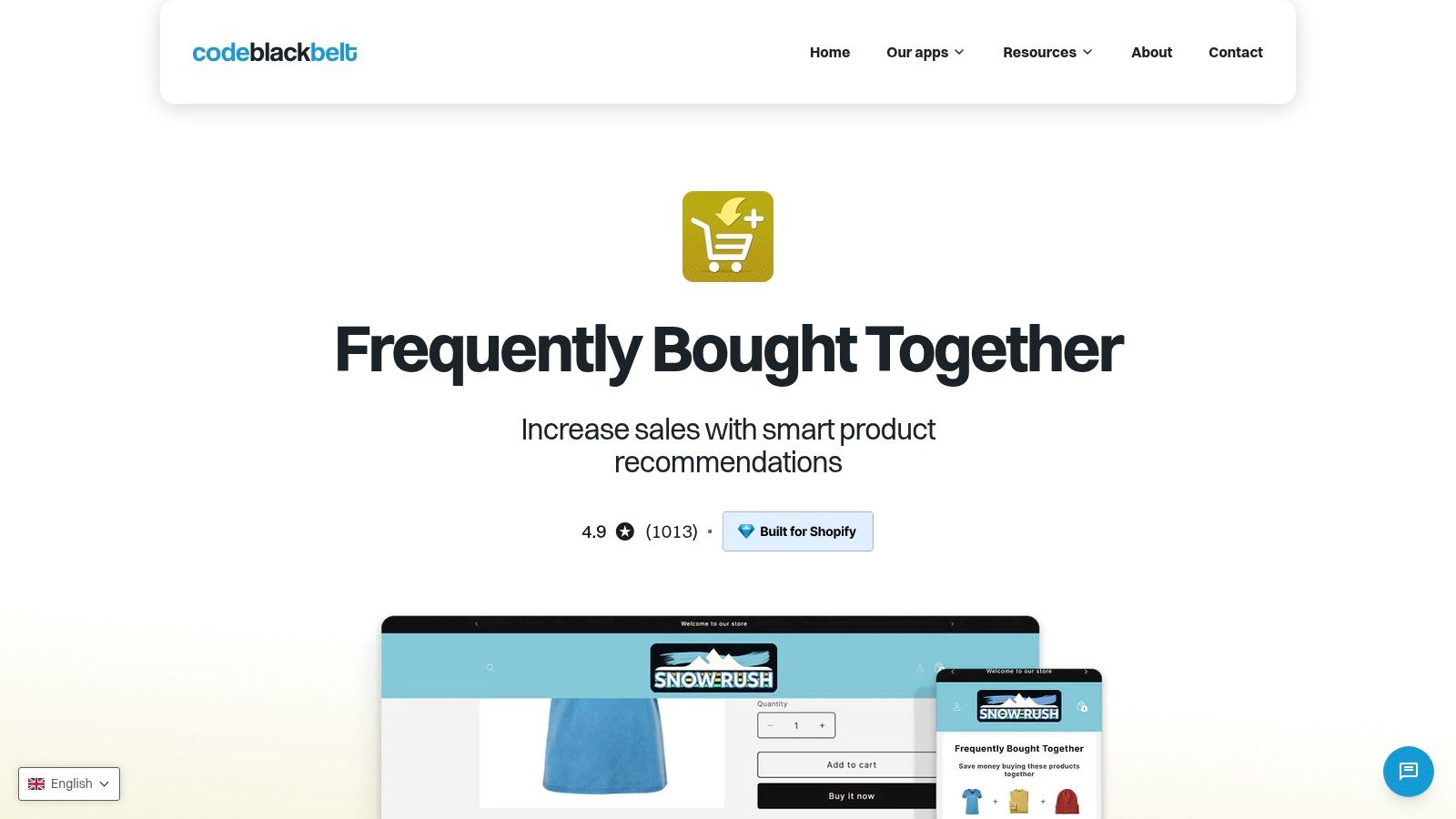
Frequently Bought Together solves a narrower, older, still useful job. It gives shoppers a familiar bundle recommendation block on the product page without turning the storefront into a conversion experiment.
Best fit
This app is strongest for stores with obvious accessory logic. Beauty, electronics, home, and gifting brands often benefit when the main upsell motion is to help the shopper assemble a complete purchase.
Its limitation is equally clear. It won't replace cart optimization, checkout extensions, or a post-purchase engine. But if the store wants a lightweight, recognizable bundle UX, that focus is the point.
Frequently Bought Together website
9. BOLD AI Upsell and Cross-Sell Bold Upsell
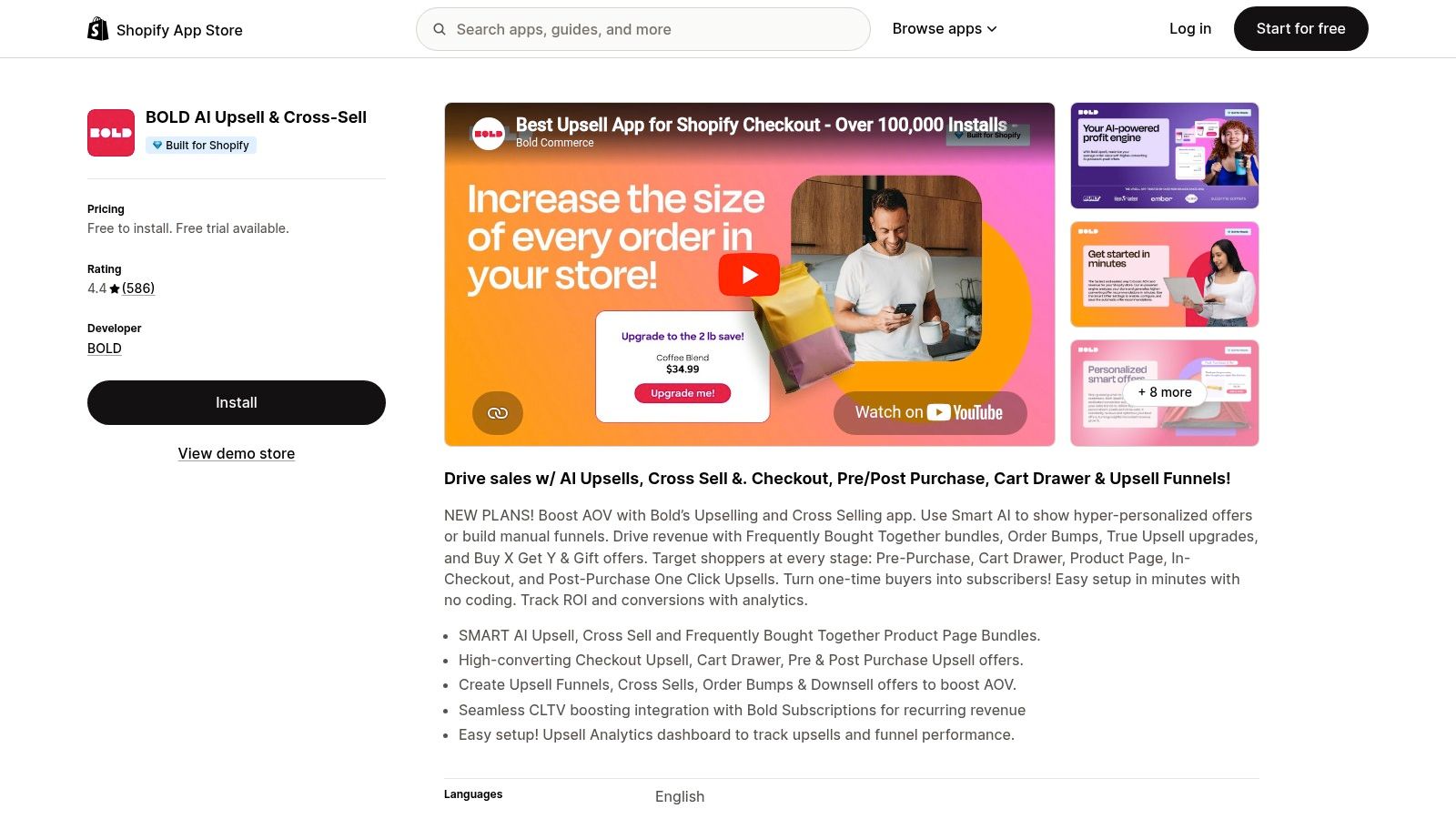
Bold remains one of the longer-standing names in this category, and that history still matters. Stores that value a battle-tested app with broad offer types often keep Bold on the shortlist.
Best fit
It suits merchants that want flexibility across product pages, cart, bundles, order bumps, and post-purchase funnels from one vendor with a long Shopify track record. That breadth can be helpful for generalist ecommerce teams that don't want to manage several niche tools.
The caution is usability versus modern alternatives. Some operators prefer newer interfaces and testing workflows. Others care more that the tool covers a lot of scenarios and has broad integration familiarity.
BOLD AI Upsell and Cross-Sell website
10. Selleasy Upsell and Cross-Sell LogBase
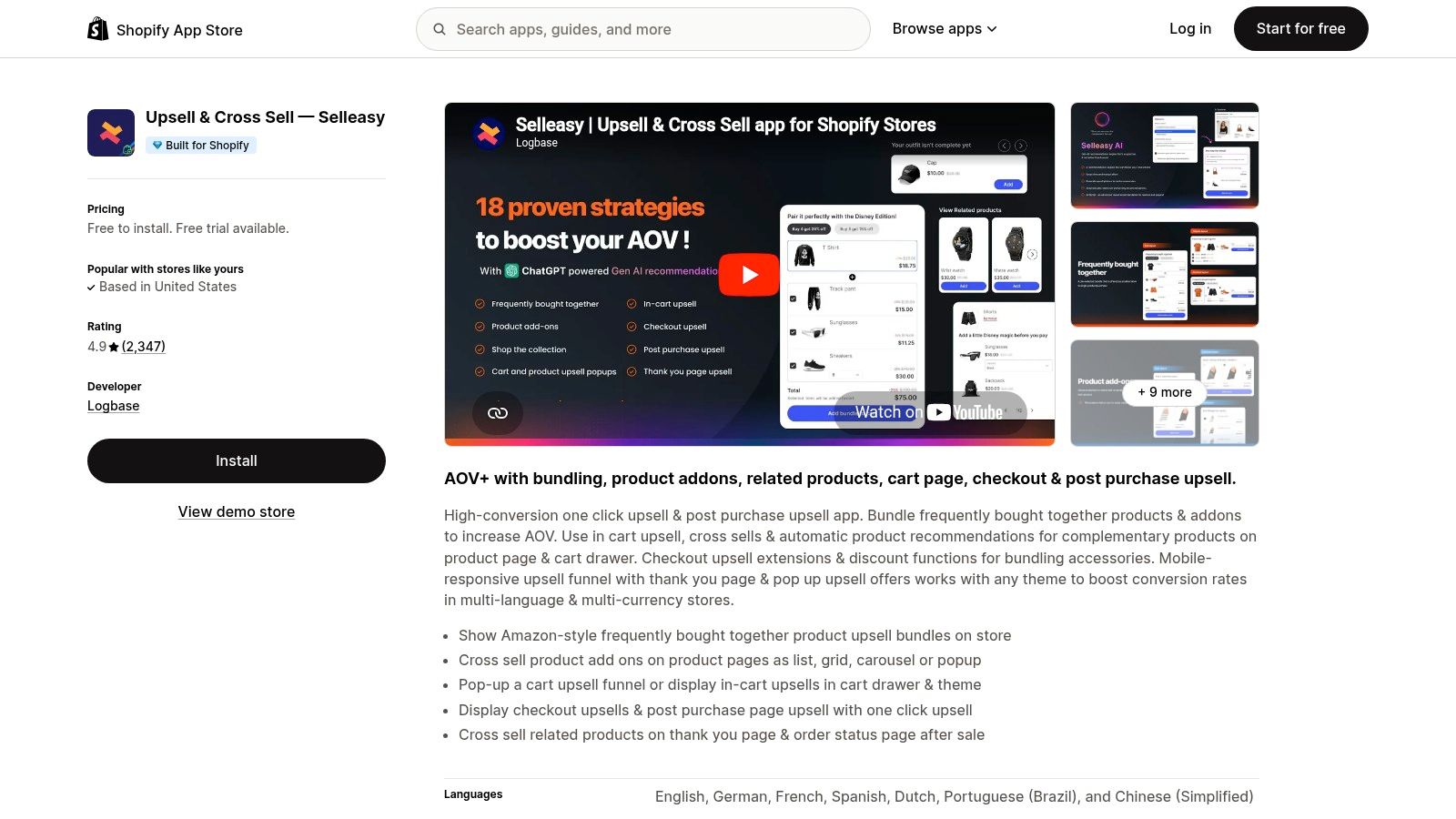
Selleasy is one of the more practical choices for lean teams that need broad upsell coverage without a large software commitment.
Best fit
It's well suited to SMB stores that want product add-ons, frequently bought together logic, in-cart offers, and lighter post-purchase support at accessible entry points. That's part of why it continues to show up in top-tier comparison lists.
Its trade-off is depth. Sellers that need more advanced AI, more nuanced reporting, or a more enterprise-oriented merchandising layer usually look toward tools like Rebuy or Zipify. For many stores, though, “good coverage at a sane cost” is exactly the brief.
Top 10 Shopify Upsell Apps, Features & Pricing
A practical shortlist looks different once you sort apps by where they act in the funnel. A product-page bundle tool, a cart drawer upsell app, and a post-purchase offer app can all raise AOV, but they do it with different UX trade-offs, setup demands, and margin impact.
The table below compares the ten apps in this guide on placements, fit, and pricing shape. I've kept the focus on what operators usually care about during selection: where the app inserts offers, how much stack complexity it adds, and where costs tend to climb.
App | Core placements & features | Best for / Target audience | Strengths / Caveats | Pricing note |
|---|---|---|---|---|
Zipify OneClickUpsell (OCU) | Pre‑purchase, slide cart, in‑checkout (Plus), post‑purchase, AI funnels, A/B testing | Teams wanting broad upsell coverage with fewer separate tools | Good option for reducing app sprawl. In‑checkout features depend on Shopify Plus, and performance pricing needs close margin monitoring | Performance‑based; 30‑day trial |
AfterSell (by Rokt) | Post‑purchase / thank‑you monetization, Upcart slide cart, Plus checkout extensions | Brands focused on post‑checkout monetization | Strong after-checkout offer flow. Often works best paired with a separate pre‑purchase or cart app, which can add stack complexity | Separate pricing per module |
Rebuy Personalization Engine | AI recommendations + rules across product, cart, checkout (Plus), post‑purchase, A/B testing | Enterprise and mid‑market teams running personalization across multiple touchpoints | Deep rules and merchandising control. Setup is heavier, and usage-based pricing can become expensive as volume grows | Volume/order based |
Upsell.com ReConvert | Product, cart, checkout, post‑purchase, AI recs, A/B testing | SMBs testing full‑funnel upsells without a large upfront commitment | Broad placement coverage at a lower entry point. Design control and advanced merchandising logic are less detailed than higher-end tools | Low starting tiers; scales with orders/revenue |
Honeycomb Upsell & Cross Sell | Visual funnel builder for product/cart/post, no‑code styling, A/B testing | Small to mid‑market teams wanting fast deployment | Easy to launch and usually light on theme work. Integration depth is lighter than more enterprise-oriented platforms | Free tier + view‑based plans |
In Cart Upsell & Cross‑Sell (ICU) | Product page and cart drawer upsells, triggers/rules, basic post‑purchase | Merchants needing predictable in‑cart logic and clear pricing | Straightforward setup with clear rules. Reporting and experimentation are less advanced than premium tools | Flat tiers tied to Shopify plan |
CartHook Post‑Purchase Offers | Drag‑and‑drop post‑purchase templates, one‑click offers, BOGO | Stores specializing in post‑checkout one‑click offers | Mature post‑purchase product with focused functionality. Usually best as part of a multi-app setup rather than a single-app stack | Shopify billing; verify tiers before scale |
Frequently Bought Together (Code Black Belt) | Amazon‑style product bundles, AI suggestions, no‑code install | Stores wanting classic product‑page bundles to lift AOV | Lightweight and familiar for shoppers. Best for product-page bundling, not for broader funnel testing or heavy experimentation | Flat paid plan; no revenue share |
BOLD AI Upsell & Cross‑Sell | Pre‑purchase popups, order bumps, FBT, post‑purchase, AI offers | Merchants wanting a flexible all-round app with a long track record | Covers several upsell motions and supports many store setups. Interface and testing workflow feel less current than newer products | View‑based / tiered pricing |
Selleasy, Upsell & Cross‑Sell | Product add‑ons, FBT bundles, cart offers, checkout & post‑purchase, multi‑currency | Lean teams and early‑stage stores on tight budgets | Broad feature coverage for the price. AI, reporting, and merchandising depth are lighter than premium stacks | Freemium + low flat tiers |
The main decision is rarely “which app has the most features.” It's which app fits the part of the funnel you want to optimize without creating duplicate widgets, slower pages, or overlapping offer logic.
If you want to turn that implementation experience into paid product feedback, the closing section covers how app store research fits into that.
Your Stack Your Say Get Paid for Your Expertise
Choosing an upsell app is the easy part. The harder part is implementation, testing, and deciding which vendor deserves a bigger share of the stack. That's especially true now that the Shopify upsell market is crowded, fragmented, and expensive enough that every added subscription needs to justify itself.
That crowded market also changes how smart operators discover tools. App founders are actively looking for merchants who can tell them what's working, what feels spammy, what breaks trust, and which features would replace other apps in the stack. Those conversations matter because they influence roadmaps, pricing, positioning, and sometimes even the quality of support and strategic access a merchant gets from the vendor.
App store research is relevant here because it connects Shopify merchants with paid product research interviews with app developers and UX teams. The platform includes over 3,000 operators and has paid out $1M in incentives, based on the verified company data provided for this article. For serious operators, the value isn't just the incentive. It's access to founders, influence over the tools used every day, and earlier visibility into what's being built before the rest of the market catches up.
For merchants who are already testing upsell apps, this is one of the more practical ways to turn day-to-day operating knowledge into advantage. Instead of getting spammed by vendors or relying only on polished app listings, operators can have direct conversations with the people building the products and shape decisions that affect their own stack.
If that kind of access is useful, apply to participate in the network. Upsell-app founders are actively recruiting operators for feedback right now.
Operators who spend their week inside Shopify themes, checkout flows, cart drawers, subscription stacks, and upsell funnels usually have sharper product insight than most vendor advisory boards. App store research is where those operators get paid to talk directly with app founders, influence roadmaps, see emerging tools early, and build stronger vendor relationships while the cash is a byproduct of that access.

Author
Jonathan Kennedy
Jonathan Kennedy is the founder of app store research and shopexperts, platforms that connect operators, founders, and experts across the Shopify ecosystem to drive better decisions, product development, and growth.