Loop vs Redo vs ReturnGO: A Returns App Comparison (2026)
/

Author
Jonathan Kennedy
Founder at appstoreresearch
Jonathan Kennedy is the founder of app store research and shopexperts, platforms that connect operators, founders, and experts across the Shopify ecosystem to drive better decisions, product development, and growth.
What the data says: Across 15 operator reviews of these returns apps (8 Loop, 5 Redo, 2 ReturnGO), 73% rated their app "Very Satisfied" and 100% still actively use it. ReturnGO's sample is small and noted as directional.
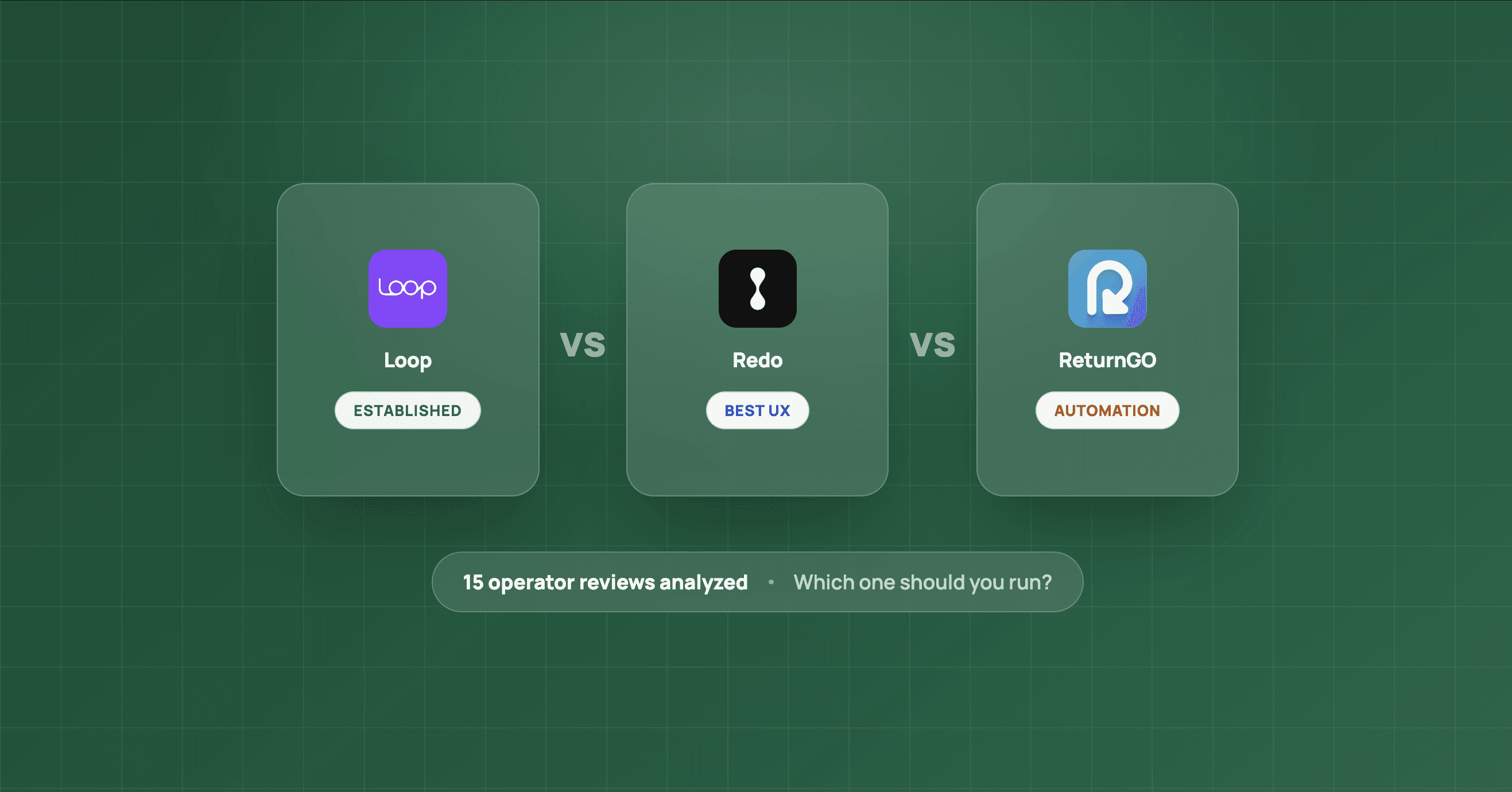
Short version: Loop if you want the established, full-featured returns platform, Redo if you want the fast-moving innovator with the best UX and a returns-protection revenue model, and ReturnGO if automation depth is your priority. Since Shopify has no native returns function, any of these is a real upgrade.
Loop vs Redo vs ReturnGO at a glance
Loop | Redo | ReturnGO | |
|---|---|---|---|
Best for | Established, full-featured returns | Modern UX + returns-as-revenue | Automation depth |
Standout | Integrations, hands-off automation | Returns-protection revenue model | Configurable portal |
Price | Premium | Protection model (model the math) | Mid |
Sample | Solid (8) | Solid (5) | Small (directional) |
Watch out for | Slow support when down | Dashboard learning curve | Integration gaps |
Is Loop the best returns app for Shopify?
The established leader: all 8 still use it, 6 Very Satisfied.
The hands-off automation "saved us so much customer interaction time."
Shopify has no native returns, so Loop "expanded our service offering greatly."
Two honest complaints: it's "high compared to their competitors," and when there's downtime, "absolutely awful dealing with their support team." Full breakdown on our Loop Returns review page.
Is Redo better than Loop?
On experience and momentum, operators increasingly think so, and the strongest signal is that Loop is now copying Redo's features.
A Loop user said "they did copy Redo and now have Checkout+."
"Excellent UX/UI, both for team members and customers," and the returns-protection add-ons are starting to "replace our other tools."
The honest caveat: one operator flagged the revenue model as "extremely profitable" for Redo "but not for us." Model the economics first. Full picture on our Redo review page.
When is ReturnGO the right pick?
When automation depth and a configurable portal matter most. Small sample (2), directional.
A smooth, automated return experience with dynamic email variables.
The honest limits: customization has "a lot of hidden buttons," and integrations can be gappy. Validate the specific integrations you need. Full detail on our ReturnGO review page.
So which returns app should you choose?
If you are... | Choose |
|---|---|
Want the established, full-featured platform | Loop |
Want modern UX + returns-as-revenue | Redo |
Want deep automation + configurable portal | ReturnGO |
One rule regardless: returns tools should reduce returns, not just process them. The happiest operators credited fewer out-of-policy returns and lower support volume, not just a slick portal. A smoother return flow that doesn't lower your return rate is just a nicer way to lose margin.
Returns hit margin and retention. Our return rate benchmarks guide covers where yours should sit.
Run returns on one of these? Your take is worth money. This comparison came from operators sharing which returns tool actually cut their support load and return rate. Shopify app teams pay $50 to $500 per call to hear it firsthand, and you get early access to the tools you help shape. Get paid for the opinion you already have. Join as a brand →
Operator statistics and quotes are from verified app reviews collected inside the app store research network, July 2026. ReturnGO sample is small and noted as directional. App pricing and features change; confirm current details on the Shopify App Store before purchasing.

Reviewed by
Filip Djokic
Product Designer at appstoreresearch.com
Filip is a Product and UI/UX Designer with over 10 years of experience in digital product design. With a strong background in the Shopify ecosystem, he focuses on improving user experiences and turning merchant insights into better product decisions at appstoreresearch..