Get Paid for App Testing: Influence Shopify Apps
/


Author
Jonathan Kennedy
Founder at appstoreresearch
Jonathan Kennedy is the founder of app store research and shopexperts, platforms that connect operators, founders, and experts across the Shopify ecosystem to drive better decisions, product development, and growth.
Most Shopify operators already know the feeling. A new app category starts heating up, inboxes fill with demos, peers mention tools that weren't on the radar last quarter, and the App Store keeps getting harder to scan with any confidence. The problem isn't access to options. It's too many options, too much noise, and too little time to figure out which tools are worth adding to the stack.
That's why “get paid for app testing” matters more than most merchants think. For Shopify teams, paid testing isn't just a small side-income channel. It can be a practical way to discover emerging apps early, pressure-test product quality before committing budget, and build direct relationships with the people shaping the tools that run the store.
Table of Contents
Beyond Side Income Why App Testing Is a Strategic Move
Why crowded app stacks create bad decisions
Why paid testing changes the dynamic
Finding and Qualifying for High-Value Testing Gigs
Where strong opportunities usually come from
How to look valuable before the first call
Mastering the Session How to Provide Feedback Developers Crave
What developers actually want from a session
How to make feedback more useful than opinions
Understanding the Real Value Beyond the Payout
What the cash actually looks like
Where the bigger return usually comes from
Turn Your Expertise into Influence with app store research
Why Shopify-specific conversations matter more
A better use of operator knowledge
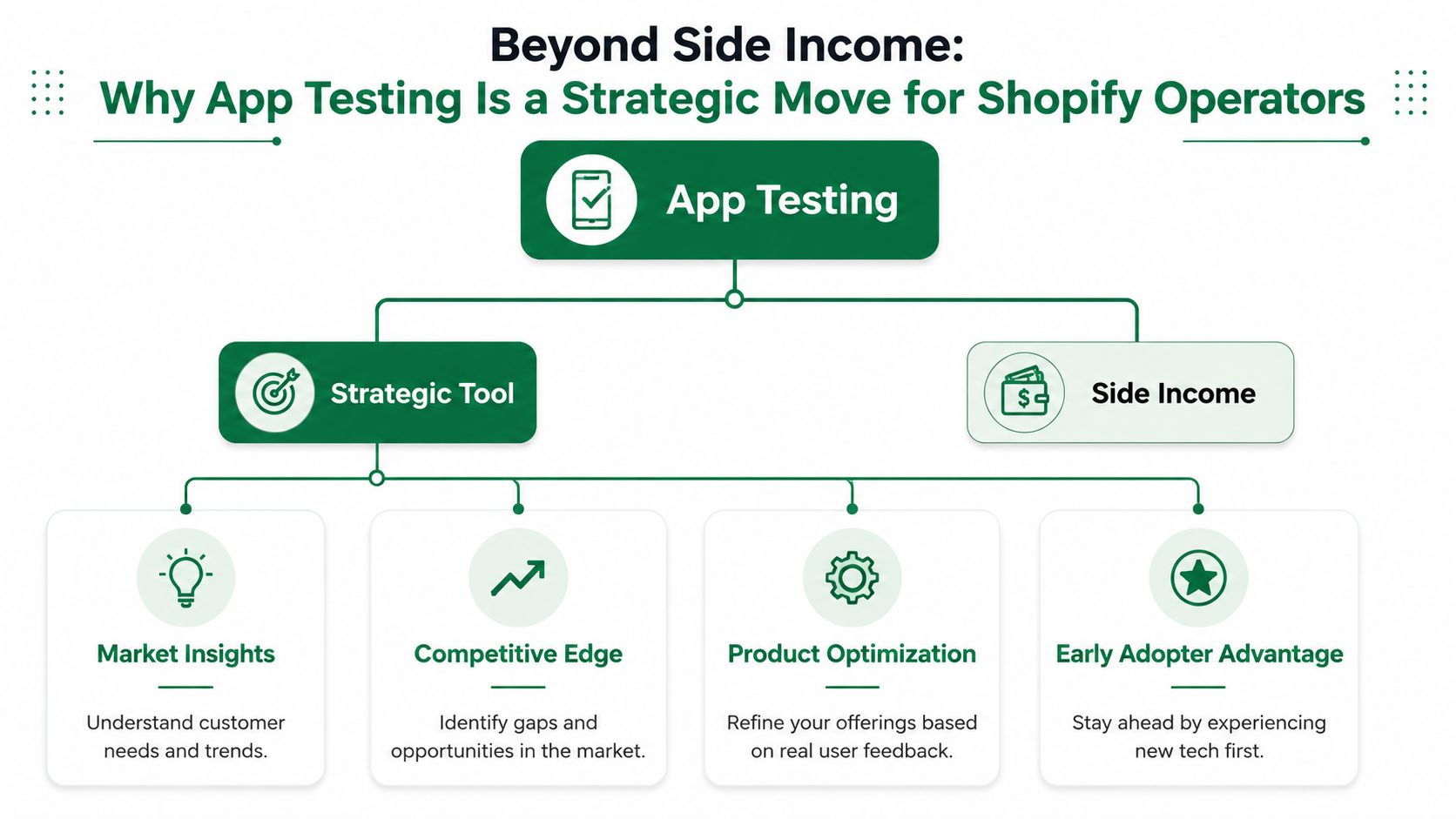
Beyond Side Income Why App Testing Is a Strategic Move
A lot of content about getting paid for app testing treats it like pocket money. That misses the more useful angle for Shopify operators. The main upside is access.
When a merchant joins a paid feedback session, that merchant often gets a closer look at an app than a standard sales demo would ever provide. There's less polished positioning, more product reality, and usually a clearer view of how the team thinks about onboarding, pricing, workflow friction, and roadmap gaps. That's valuable when app costs keep stacking up and every new subscription has to justify itself.
Why crowded app stacks create bad decisions
The Shopify ecosystem rewards speed, but rushed app decisions are expensive. Teams install too early, keep tools too long, or buy based on category buzz instead of operational fit. Most merchants don't need more app recommendations. They need better ways to evaluate relevance before another monthly charge lands on the P&L.
Paid testing creates a cleaner setting for that evaluation. The operator isn't entering as a lead getting pushed through a funnel. The operator is there because the product team wants honest task-based feedback. That changes the tone of the conversation.
Practical rule: A testing session is often more useful than a generic demo when the goal is to understand product fit, not just feature breadth.
Recent platform messaging around paid testing points to a broader opportunity than simple usability tasks. The more useful angle for Shopify operators is using those sessions to reduce app-spend risk, discover newer tools earlier, and create direct feedback loops with founders, as noted by UserTesting's overview of getting paid to test.
Why paid testing changes the dynamic
There are two kinds of value in these sessions. The obvious one is the incentive. The less obvious one is influence.
A strong operator can point out where a returns app creates support debt, where a subscription app breaks merchandising logic, or where a post-purchase upsell tool adds one more fragile dependency. Those comments matter because app teams often run small, targeted studies instead of waiting for broad launch feedback. That means a merchant's input can shape features before they harden into the product.
The strategic gains usually show up in a few ways:
Better app discovery: Merchants see products before they become heavily promoted across the ecosystem.
Lower selection risk: It's easier to spot weak onboarding, shallow functionality, or bad workflow assumptions before buying.
Stronger vendor relationships: Good conversations can turn into direct founder access, faster support, or future research invites.
More relevant product changes: Operators can push for fixes tied to actual store constraints, not generic requests.
Some merchants still think app testing sounds too small to matter. In practice, it can become a quiet edge. The operator gets paid for time, but the sharper benefit is getting closer to product decisions in a market where most app interactions come through outbound noise, affiliate content, or hurried demos.
Finding and Qualifying for High-Value Testing Gigs
The market for paid testing is no longer niche. One industry analysis projects the global mobile app testing services market will reach $13,585.73 million by 2026, and platforms commonly list incentives in the $10 to $50 per study range, which shows that paid testing is a standardized research channel rather than an occasional side offer, according to Testlio's app testing market overview.
That matters because it changes how Shopify operators should search. The goal isn't to chase every open test. The goal is to find the channels where merchant expertise is treated as high-signal input.
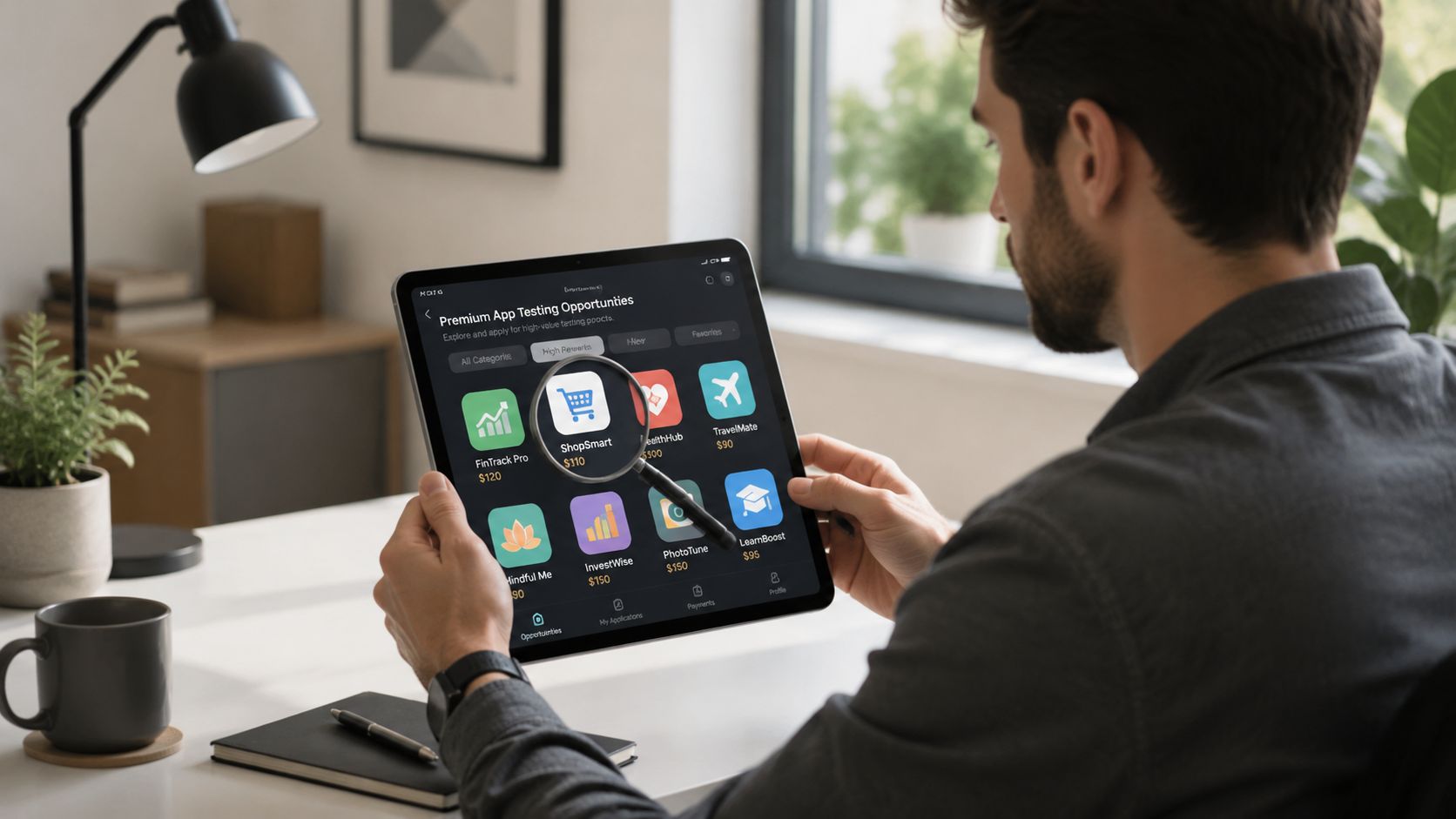
Where strong opportunities usually come from
General user-testing platforms still have value. They're broad, active, and useful for getting used to research formats. But they also attract a wider mix of participants, which means qualification can be less predictable and many studies won't be Shopify-specific.
For operators who want more relevant calls, this comparison is more useful than a generic list:
Channel | Best use | Trade-off |
|---|---|---|
General testing marketplaces | Build familiarity with recorded tasks, interviews, and prototype reviews | More screening friction, less Shopify context |
Bug testing platforms | Better fit for technical testers and QA-minded participants | Often less relevant for merchant workflow feedback |
Ecosystem-specific research networks | Higher chance of merchant-fit conversations with serious product teams | Fewer total invites, but stronger relevance |
A Shopify operator should usually prefer fewer, better-matched sessions over a high volume of generic tests.
The best testing gig isn't always the one with the fastest payout. It's the one where the operator's business context actually matters.
How to look valuable before the first call
Most qualification happens before anyone speaks. Profiles that say “ecommerce user” blend into the pile. Profiles that describe operational reality get shortlisted.
A stronger participant profile should signal role, context, and judgment. That usually means being specific about the store or client environment without turning the profile into a resume dump.
Useful details to include:
Operational role: Are they the founder, ecommerce manager, retention lead, agency strategist, or product owner?
Store complexity: Mention themes, subscriptions, bundles, loyalty, search, reviews, B2B, international storefronts, or ERP-related constraints where relevant.
Decision exposure: Clarify whether they evaluate apps, approve spend, implement tools, or own performance outcomes.
Pain points: Explain recurring problems such as app overlap, attribution confusion, checkout friction, merchandising limitations, or support burden.
Short answers usually outperform polished ones if they sound real. “Evaluates retention and post-purchase apps for a growing brand with a crowded stack” is more useful than “passionate ecommerce professional with deep platform knowledge.”
For operators who want a direct route into paid studies, this participant guide from App Store Research explains how its network works. It's a platform that connects Shopify merchants with paid product research interviews with app developers and UX teams.
A good rule is simple. Apply like an operator, not like a tester. Product teams don't just want someone who can click through a prototype. They want someone who understands what happens when a new app touches acquisition, operations, support, and margin all at once.
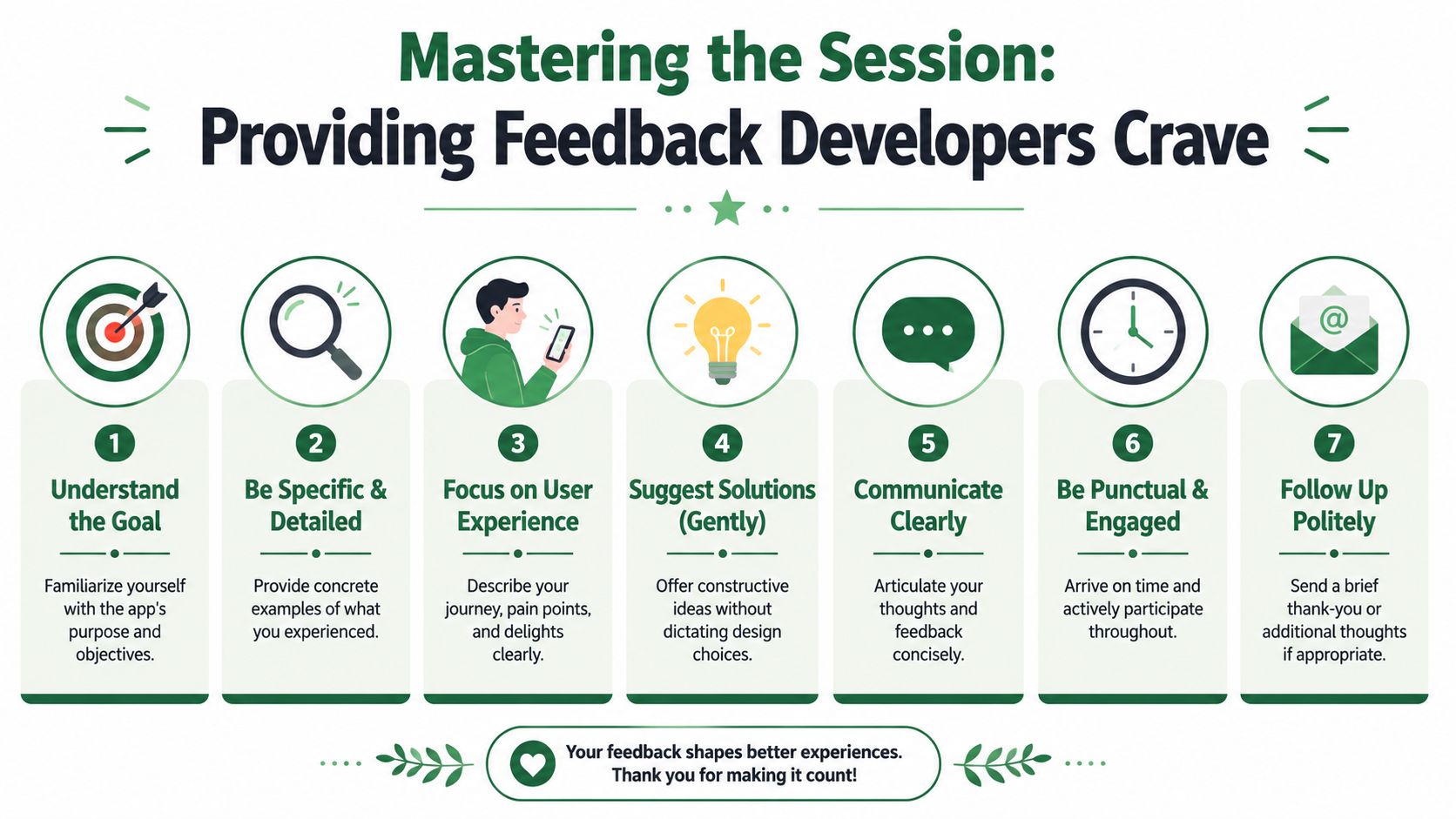
Mastering the Session How to Provide Feedback Developers Crave
Once a merchant gets accepted, the work changes. Selection gets the invitation. Useful feedback gets repeat invitations.
Shopify operators have an advantage here because developers usually aren't looking for vague reactions. They want signal. NN/g recommends 3 to 5 users per study for cost-effective discovery and notes that broader discovery across iterations may require about 15 users, which is why a tightly matched merchant profile can matter more than a large random panel, as explained in NN/g's guidance on small-sample usability testing.
What developers actually want from a session
Most product teams want three things from a paid testing call.
First, they want to know whether the operator understood the value proposition quickly enough. If the app promises faster merchandising, cleaner retention flows, or simpler returns logic, the participant should say whether that came through without coaching.
Second, they want to see where task completion breaks. A merchant who gets stuck while creating a bundle, configuring shipping rules, or interpreting analytics is far more useful than a participant who says “looks good” and moves on.
Third, they want business context. The sharpest feedback connects experience to consequences.
That kind of feedback sounds like this:
On onboarding: “The setup assumes one person owns email, promos, and theme edits. That won't hold in a larger team.”
On navigation: “This label makes sense to product, but a merchant will look for this under discounts or offers.”
On pricing perception: “The feature set is promising, but it's hard to justify if the merchant can't estimate value before installation.”
How to make feedback more useful than opinions
The best participants narrate decisions, not just preferences. They explain what they expected, what they saw, what they tried next, and why that gap matters. That gives the team something it can act on.
A simple structure works well:
State the moment of friction. Name the exact step or screen.
Explain the expectation. Say what a merchant would assume should happen.
Tie it to a workflow. Show where the issue affects setup, reporting, support, or revenue operations.
Offer a light suggestion. Don't redesign the app. Point to the missing clarity.
Useful framing: “A merchant won't care that this field exists. A merchant will care whether it changes campaign setup time or introduces one more thing to maintain.”
This is also where broader UX discipline helps. Teams that want to sharpen how they observe behavior, structure tasks, and separate opinions from actual usability issues can review 10 practical mobile app UX testing for useful testing patterns that apply well to app and prototype feedback sessions.
There's another habit that separates average participants from strong ones. They don't overclaim from one pass through a product. They describe what happened in their session and flag whether the issue feels likely, repeated, or situational. That keeps the feedback credible.
A developer will usually trust “this confused this operator in this task flow” more than “all merchants will hate this.” Precision wins.
Understanding the Real Value Beyond the Payout
The payout matters, but it's rarely the whole story. Merchants who enter paid testing only for cash usually misread the economics. Availability varies, screening matters, and not every profile qualifies at the same rate.
Public guidance on testing platforms often shows pay around $10 for a 20-minute test, while also stressing that earnings depend heavily on qualification rates and test volume rather than the headline amount, as summarized in SideHusl's review of UserTesting economics.
What the cash actually looks like
The practical takeaway is that app testing works better as selective paid expertise than as predictable income. Some sessions are quick. Some require matching a narrow merchant profile. Some never reach the scheduling stage because the study fills first.
That doesn't make the channel weak. It just means operators should set the right expectation.
A simple way to judge a session is to ask two questions:
Question | Why it matters |
|---|---|
Does this conversation match the operator's actual stack and decision area? | Relevance usually predicts both payout quality and strategic value |
Will this expose the operator to a tool, founder, or product category worth understanding? | The upside often extends beyond the incentive |
Where the bigger return usually comes from
For Shopify teams, the hidden return is often more valuable than the fee.
An early conversation with an app team can reveal whether the product is maturing in the right direction. It can also create a future contact inside the company. That matters when a merchant later wants implementation clarity, a roadmap answer, or context before switching tools.
Some operators also use testing calls to improve procurement judgment. A short research session can reveal more about an app's assumptions than several marketing pages. If the product team struggles to explain the core workflow, ignores real merchant constraints, or treats edge cases as rare when they're common, that's useful information before a subscription starts.
The payment closes the session. The real value often starts after the session, when the operator knows which vendors deserve more attention and which ones don't.
If a platform supports cash incentives, merchants should still understand how payout logistics work before spending time in the network. This payout help page from App Store Research is worth reviewing for that reason.
Operators who get the most from paid testing don't chase volume. They look for sessions that improve vendor judgment, expose product direction early, and create better conversations than the average sales process allows.
Turn Your Expertise into Influence with app store research
Paid app testing is already a mature category. On Test IO, active testers may see at least five opportunities every day, and critical bugs can pay up to $50, which shows how established paid testing has become as a channel for compensated product feedback, according to Test IO's tester overview.
For Shopify operators, though, the highest-value version of this model isn't broad consumer testing. It's merchant-specific research tied to real app decisions.
Why Shopify-specific conversations matter more
A general testing panel can tell a team whether a screen is confusing. A Shopify operator can tell that same team why the confusion will block onboarding, create support tickets, or keep a multi-app workflow from ever getting implemented properly.
That distinction matters because the best merchant feedback combines usability with commercial reality. It doesn't stop at “the interface is unclear.” It goes further and explains whether the tool fits the way a brand evaluates app spend, operational ownership, and implementation risk.
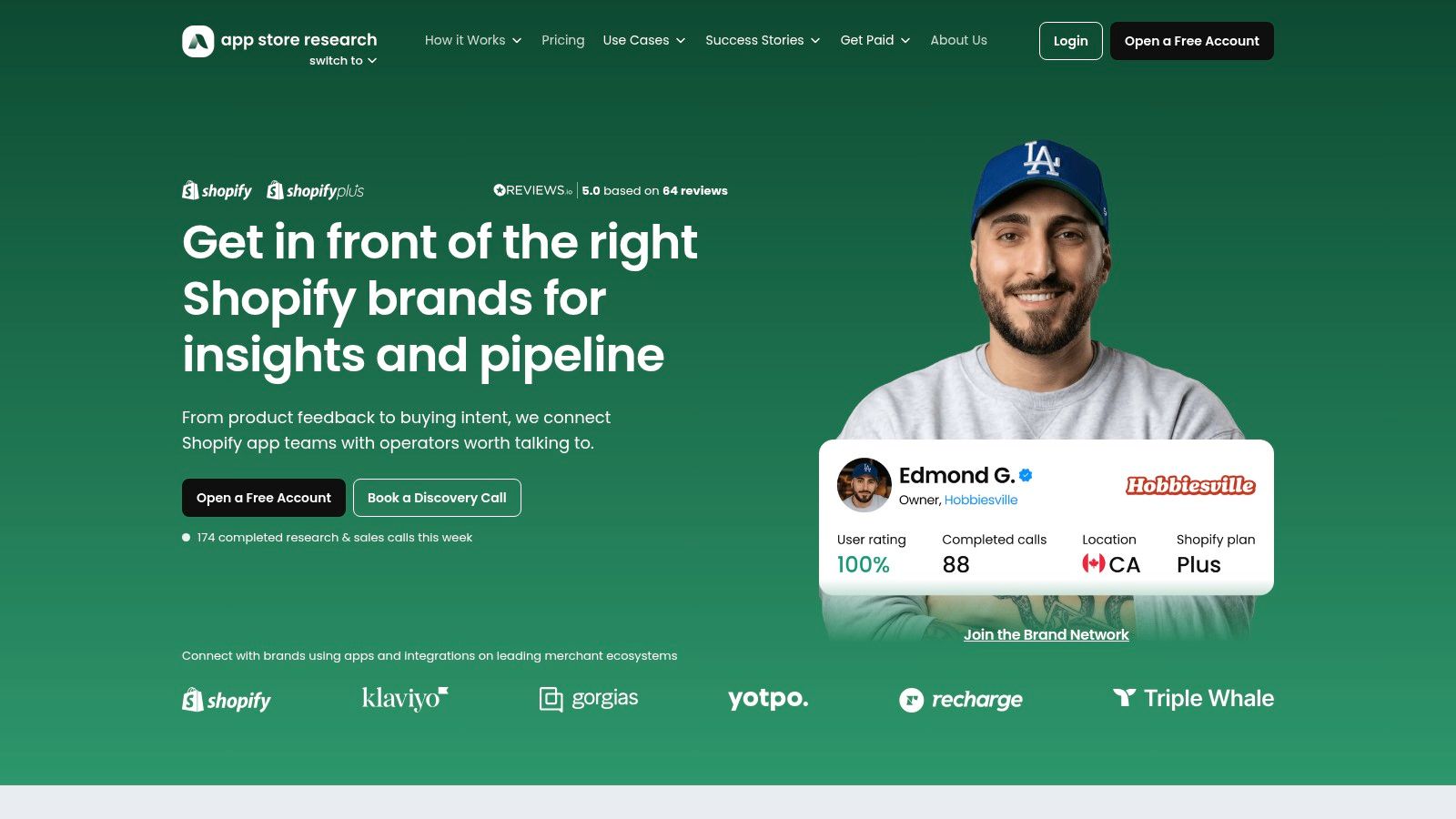
In this regard, a focused network is more useful than a broad panel. App store research for Shopify apps is built around those merchant and agency conversations, rather than generic task testing.
A better use of operator knowledge
Most Shopify teams already carry useful product knowledge. They know which apps create duplicate logic. They know where reporting breaks trust. They know when onboarding asks for too much too soon. In most cases, that knowledge stays trapped inside day-to-day execution.
A paid research network gives that expertise a second use. It lets operators turn practical store knowledge into compensated feedback, early product exposure, and better vendor access.
The publisher's platform has already paid out over $1M in incentives to a network of over 3,000 Shopify operators. That matters less as a headline than as proof that merchant expertise can be organized into a repeatable research channel, not just occasional one-off calls.
For the right operator, getting paid for app testing isn't really about becoming a tester. It's about becoming the kind of merchant voice product teams want in the room before they ship.
If paid research conversations sound more useful than another cold app pitch, app store research is a practical place to join. It connects Shopify merchants, agencies, and operators with paid interviews with app developers and UX teams, so experience from the store floor can directly shape better tools while earning incentives for the time.

Reviewed by
Filip Djokic
Product Designer at appstoreresearch.com
Filip is a Product and UI/UX Designer with over 10 years of experience in digital product design. With a strong background in the Shopify ecosystem, he focuses on improving user experiences and turning merchant insights into better product decisions at appstoreresearch..