Shopify Conversion Rate Optimization: A Stage-Based Playbook
/
Shopify Conversion Rate Optimization: A Stage-Based Playbook
Most Shopify conversion rate optimization advice is written for nobody in particular. That's why so much of it is useless.
A brand doing low six figures a year doesn't need a testing backlog full of button experiments. A mature Shopify Plus operator doesn't need another reminder to “add reviews” or “improve trust.” The job is different at each stage. Traffic volume changes. Customer intent changes. Team capacity changes. The kinds of mistakes that hurt conversion also change.
Benchmarks back that up. Most Shopify CRO content treats conversion as a page-level optimization problem, but benchmarks show that winners separate themselves through ongoing optimization and systematic barrier removal tied to their stage, not one-off fixes, as noted in Enavi's benchmark analysis. The practical failure is simple. Operators copy tactics from brands with very different scale, then wonder why nothing compounds.
That's also obvious in operator mix. Internal app store research data includes 2,100 brands at $10–50K, 500+ at $50–200K, and 240+ at $500K+. Those operators do not have the same CRO problems. Treating them like they do is lazy.
Table of Contents
Why Most Shopify CRO Advice Is Wrong for Your Stage

Most stores diagnose the wrong problem
Most bad Shopify CRO work starts with a false assumption. The store sees a weak conversion rate and assumes the page is the problem. Often it isn't.
A smaller brand usually has an offer problem, a pricing problem, a merchandising problem, or a traffic-quality problem. A larger brand usually has hidden friction spread across mobile PDPs, checkout flow, navigation, and post-purchase monetization. Same symptom. Different root cause.
That's why the mistake of superficial A/B testing keeps repeating. Teams test small visual elements before they've earned the right to test them. They change button copy on a weak offer. They move reviews around on a page with poor product-market fit. They celebrate tiny uplifts that never survive the next traffic swing.
Most operators don't need more tests. They need better problem selection.
What stage-aware Shopify CRO looks like
A serious operator starts with business maturity, not with a list of tactics. Revenue stage is the cleanest proxy because it usually reflects traffic, repeat purchase behavior, operational discipline, and whether the store has enough signal to support structured experimentation.
The practical split looks like this:
Stage | What usually hurts conversion | What deserves attention |
|---|---|---|
$10K to $100K MRR | weak offer clarity, confusing shipping, mismatched traffic | positioning, pricing, policy clarity, customer feedback |
$100K to $500K MRR | page friction, mobile UX gaps, weak merchandising | PDP tests, navigation, collection logic, CTA hierarchy |
$500K+ MRR | checkout friction, slow mobile flow, post-purchase leakage | checkout, payment flow, funnel analysis, upsell architecture |
For operators who want a benchmark lens before making changes, app store research's ecommerce conversion rate benchmarks guide is useful because it frames conversion by context instead of pretending one number tells the whole story.
CRO at $10K–100K MRR Focus on the Offer Not the Page

Offer clarity beats design polish
At this stage, most brands don't have enough clean volume for endless testing. They need sharper commercial judgment.
A widely cited Shopify benchmark puts the platform-wide average conversion rate around 1.4%, with a typical range of 1% to 4%, and notes that even small gains can matter materially for stores near that baseline, especially when the fix is something basic like clearer offer communication or shipping policy clarity, according to SalesHunter Themes. That's the right lens here. Early gains usually come from making the purchase decision easier, not from redesigning the page every month.
A product page can be visually clean and still convert poorly because the customer can't answer basic questions fast enough. What is this? Why this brand? Why this price? How fast does it ship? What happens if it doesn't work?
What to fix first at this stage
The fastest path is qualitative. Support logs, customer emails, post-purchase surveys, live chat transcripts, and direct buyer interviews will expose more truth than a shallow test queue.
The highest-value checks are usually these:
Headline and first-screen clarity: The hero section and product title area should explain the offer in plain English. Clever branding can wait.
Pricing logic: If the product is premium, the page needs to justify that premium immediately. If the price is accessible, the page should stop overexplaining and sell momentum.
Shipping and returns visibility: Hidden shipping thresholds or vague return language kill intent because they create uncertainty at the wrong moment.
Offer packaging: Bundles, starter kits, subscription framing, or trial language can matter more than any visual tweak when the base offer is underdeveloped.
Practical rule: If support keeps answering the same pre-purchase question, that answer belongs on the page.
This is also the stage where founders waste money on heavy CRO tooling. A lightweight stack is enough. Heatmaps, recordings, survey prompts, and customer calls will surface the actual blockers. If five potential buyers hesitate for the same reason, that signal is strong enough to act on.
CRO at $100K–500K MRR Page-Level Testing Now Matters
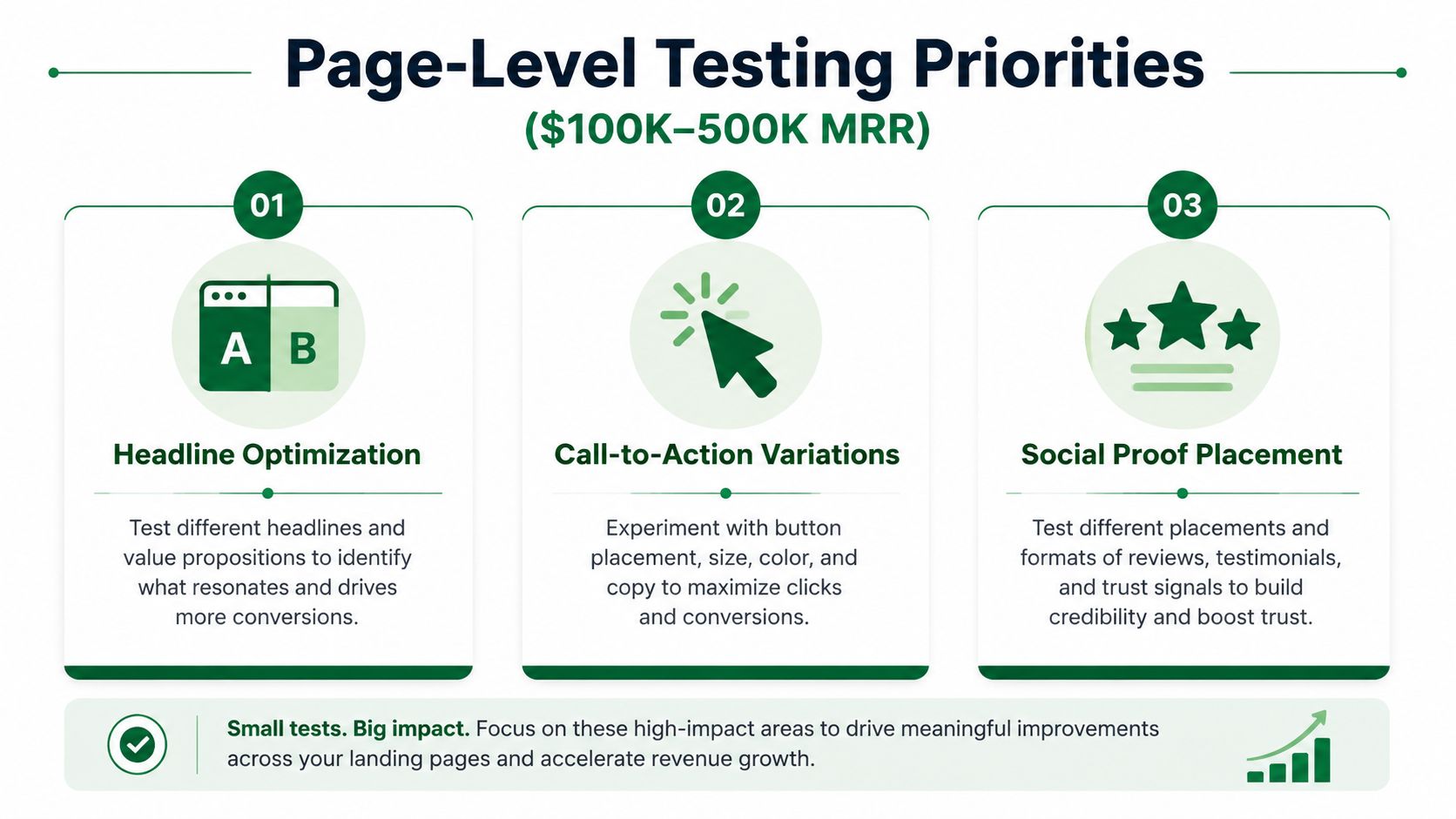
Once a store has a validated offer and enough traffic consistency, page-level testing starts paying rent. At this stage, Shopify conversion rate optimization becomes operational, not aspirational.
Where page-level tests actually pay off
The best tests at this stage are not random. They target pages and elements that shape buying confidence.
Industry guidance estimates +10% to +20% for streamlined checkout, +5% to +15% for improved navigation, and +10% to +30% for mobile-first design, which is why A/B validation becomes a high-impact move once the store has enough signal, as summarized by CartBoss. That doesn't mean every store gets those outcomes. It means these areas are worth disciplined attention.
The best testing targets are usually concentrated in four places:
Page area | What to test | Why it matters |
|---|---|---|
PDP | headline framing, image order, benefit blocks, social proof placement | purchase intent is formed here |
Collection pages | filters, sort logic, badge hierarchy, card information density | category friction kills browsing momentum |
Site navigation | menu labels, path depth, search prominence | weak orientation lowers product discovery |
Mobile CTA flow | sticky add-to-cart, spacing, thumb-friendly interactions | mobile friction compounds fast |
A good hypothesis has a reason behind it. “Move reviews above the fold” is weak. “Mobile users aren't reaching proof content before they bounce, so moving credibility elements closer to the CTA should reduce hesitation” is usable.
For operators dealing with late-stage drop-offs, the patterns in this cart abandonment guide for Shopify are often more actionable than another generic CRO checklist.
Research before rollout
Not every winning test should be deployed blindly across the site. Some wins are segment-specific. Some only work on one product family. Some improve one metric while hurting another.
That's where deeper UX work matters. A team like OpenUX is relevant in this middle stage because it helps explain user behavior before the team scales changes across the storefront. Analytics shows the drop. Session review and interviews explain the hesitation.
A store at this stage doesn't need more opinions from Slack. It needs a repeatable testing rhythm tied to a clear hypothesis backlog.
The operators who improve steadily at this level do three things well. They document tests. They group findings by pattern instead of by page. And they stop shipping “best practices” that haven't been validated on their traffic mix.
CRO at $500K+ MRR The Funnel and Post-Purchase Flow
At scale, page optimization still matters, but it stops being the main event. The true competitive advantage sits in the full funnel. Checkout. Payment choice. Mobile speed. Post-purchase monetization. Retention entry points.
Checkout friction becomes expensive
For larger stores, small technical issues create outsized revenue leakage because the volume is already there. Shopify's own educational guidance notes that a one-second improvement in mobile load time can increase conversions by up to 27%, which is why technical performance across the funnel, especially mobile checkout, becomes a top priority at scale, as cited by Blend Commerce.
That should reframe the work. A $500K+ operator shouldn't obsess over homepage cosmetics while mobile checkout lags, payment options feel buried, or form flow creates hesitation.
Baymard Institute's checkout research is useful here for structure, not for copying blindly. The broad lesson is consistent. Fewer interruptions, cleaner field logic, and payment clarity matter more than decorative redesign.
Post-purchase is part of Shopify conversion optimization
Too many teams treat conversion as “order placed.” That leaves money on the table.
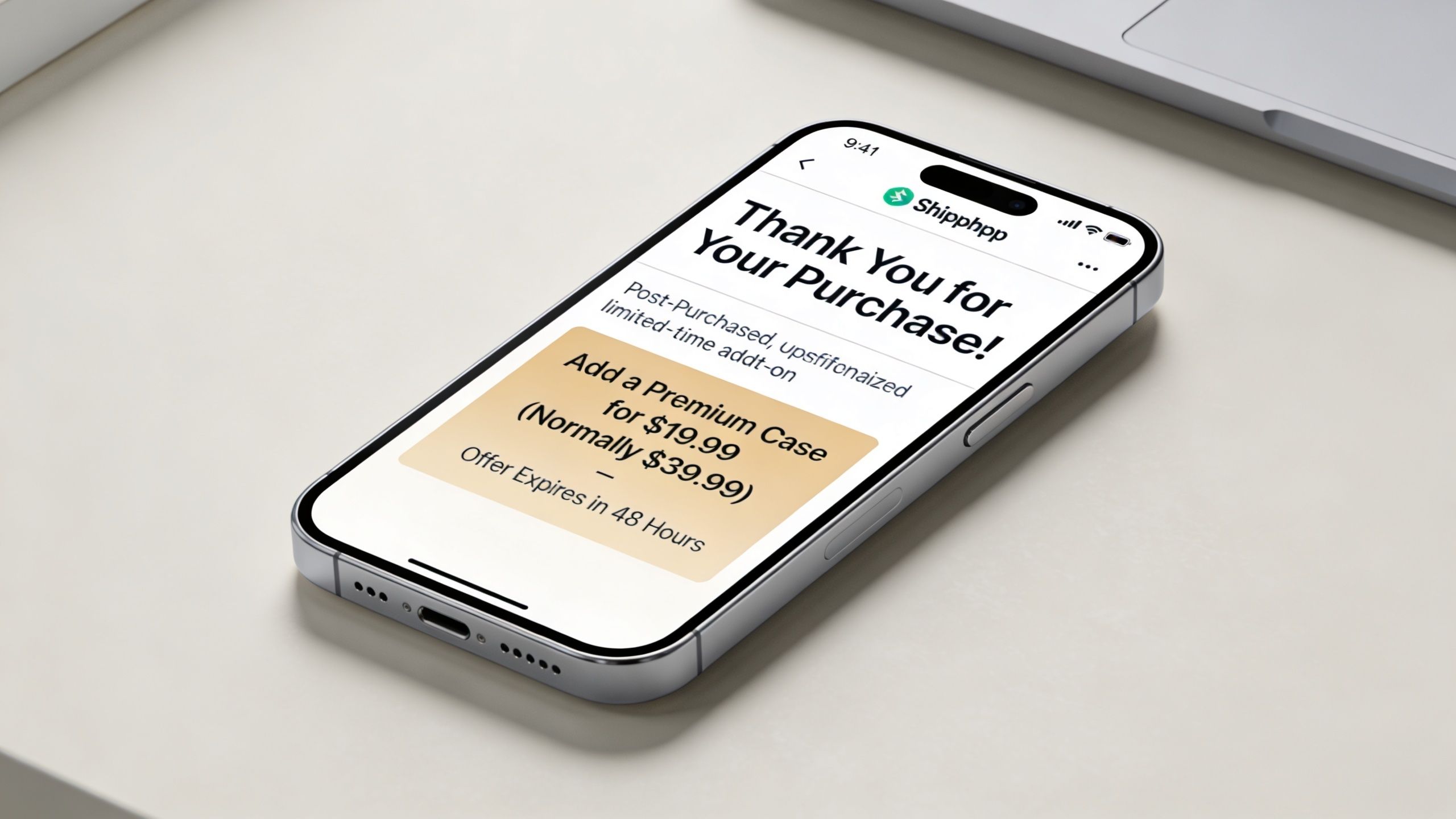
A mature CRO program includes what happens immediately after purchase. One-click upsells, replenishment prompts, warranty or subscription attachment, and better thank-you page sequencing are not side projects. They're core monetization mechanics.
Consider this practical approach:
Checkout optimization protects the sale already in motion.
Post-purchase optimization increases order value without creating pre-purchase friction.
Lifecycle entry points set up the second order, which makes acquisition spend more efficient later.
For operators evaluating post-purchase and upsell strategy, ConvertWise is a relevant example because it focuses on that part of the funnel rather than pretending all CRO happens before checkout.
The bigger the store gets, the less useful “page CRO” becomes as a standalone discipline. Funnel design takes over.
What Testing Infrastructure to Use
The wrong stack creates as much friction as the wrong page layout. That's a common Shopify problem.
A right-sized stack by stage
The app market keeps pushing operators toward tool sprawl. But the fundamental challenge isn't a shortage of CRO tactics. It's app ecosystem overload, rising costs, and vendor spam, which makes tool selection harder than most best-practice lists admit, as described by Bloomreach.
The stack should match the store's stage, not the vendor's sales deck.
Stage | Core need | Good tool categories |
|---|---|---|
$10K to $100K MRR | understand hesitation | heatmaps, recordings, onsite surveys, support tagging, interview workflows |
$100K to $500K MRR | validate page changes | analytics, test platform, session review, research repository |
$500K+ MRR | unify funnel insight | experimentation, warehouse or BI layer, checkout analytics, post-purchase tracking |
For smaller brands, Hotjar-style behavior tools and direct customer interviews are enough. For middle-stage brands, VWO-style testing and cleaner analytics discipline start to matter. At the upper end, the question isn't “which app adds a popup?” It's whether the team can trust its funnel data across storefront, checkout, post-purchase, and retention surfaces.
Don't let the app stack become the problem
A bloated CRO stack usually signals weak prioritization. If the team installs a search app, a quiz app, a personalization app, a bundles app, and three analytics layers without a clear diagnosis, the stack starts creating the friction it was supposed to remove.
That's why periodic stack review matters. This Shopify app stack audit framework is useful because it forces the team to justify each tool against a real operational need.
In the same category, app store research fits as a different kind of input. It's a platform that connects Shopify merchants with paid product research interviews with app developers and UX teams. For operators comparing tools or trying to influence roadmap decisions before adding more software, direct conversations can be more valuable than another sales demo.
Common 'CRO Wins' That Don't Actually Compound
Many celebrated CRO wins represent superficial progress. They generate activity without adding true momentum.
The traps operators keep repeating
The first trap is testing things that don't matter yet. Button color tests on low-signal stores are the classic example, but the deeper issue is weak diagnosis. Teams act like any experiment is useful. It isn't.
The second trap is copying “best practices” from brands with different economics, traffic quality, and customer intent. A luxury brand, a replenishment brand, and a promo-heavy impulse brand shouldn't run the same conversion playbook.
Other non-compounding wins show up in familiar forms:
Vanity metric lifts: More clicks to cart doesn't matter if completed orders or order value don't improve.
One-off redesign spikes: A fresh layout can create temporary curiosity without improving underlying buying confidence.
Developer-heavy tinkering with no prioritization: Teams sometimes pull in full-stack developers to implement a long backlog of storefront changes before proving which changes deserve engineering time.
What compounding work looks like instead
Compounding CRO work produces reusable knowledge. It teaches the team something durable about buyers.
That usually means a clearer message hierarchy, a better merchandising structure, a simpler checkout path, stronger mobile behavior, or a post-purchase sequence that keeps working across campaigns. Those gains hold because they solve recurring friction.
A useful filter is simple. If the win can't be turned into a repeatable rule, it probably wasn't a real CRO win.
How to Prioritize Your Next Move
Most operators don't need a bigger backlog. They need a harder filter.
A simple stage-based filter
The fastest way to prioritize shopify conversion optimization is to ask one question first. Where is the store constrained?
If the brand is in the $10K to $100K MRR range, the answer is usually offer clarity. Tighten positioning. Make pricing logic obvious. Put shipping and returns where hesitant shoppers can see them. Stop pretending a prettier page fixes a confusing purchase decision.
If the brand is in the $100K to $500K MRR range, page-level friction is usually worth the effort. Build a testing rhythm around PDPs, collection flow, navigation, and mobile CTA hierarchy. Keep hypotheses specific. Document what's learned.
If the brand is past $500K MRR, zoom out. Checkout flow, mobile speed, payment friction, and post-purchase monetization usually matter more than another homepage experiment.
The right CRO move is the one that removes the most expensive friction at the current stage.
The real advantage is better conversations
The strongest operators don't just optimize pages. They shape the tools they use. They push vendors for roadmap clarity, pressure-test app claims, and talk directly to founders when a product affects revenue.
That matters more now because the Shopify app ecosystem is crowded, costs keep rising, and operators are buried in outreach. Direct access is worth more than another newsletter about “proven tactics.”
For operators who want that kind of access, join the network. app store research is where serious Shopify operators get paid to speak directly with the founders, product teams, and UX teams building the tools they use every day. The advantage is the point. Better visibility into what's being built, more influence over roadmap decisions, and stronger vendor relationships. The incentive is part of the exchange.

Author
Jonathan Kennedy
Jonathan Kennedy is the founder of app store research and shopexperts, platforms that connect operators, founders, and experts across the Shopify ecosystem to drive better decisions, product development, and growth.