Shopify Customer Retention: Category Strategies for LTV
/

Author
Jonathan Kennedy
Founder at appstoreresearch
Jonathan Kennedy is the founder of app store research and shopexperts, platforms that connect operators, founders, and experts across the Shopify ecosystem to drive better decisions, product development, and growth.
Most Shopify retention advice is built for the wrong store.
It treats a coffee subscription, a skincare replenishment brand, a fashion label, and a furniture merchant like they have the same customer behavior. They don't. A customer who buys every few weeks needs a very different post-purchase system from a customer who might not buy again for a year, or may never buy the same item twice.
That mismatch is why a lot of Shopify customer retention work feels busy but unproductive. The flows are live. The loyalty app is installed. SMS is running. Revenue still doesn't move in a meaningful way because the retention model doesn't fit the catalog.
Shopify's own guidance makes the category gap clear. A good ecommerce retention rate typically ranges from 20% to 40%, subscription-based ecommerce often reaches 30% to 45%, and online retailers average a 28.2% repeat customer rate, while more relationship-driven categories in other industries can land much higher at 70% to 80% according to Shopify's ecommerce customer retention guide. The point isn't to chase someone else's benchmark. It's to build the right system for the purchase cycle in front of the customer.
Why Most Shopify Retention Advice Misses the Mark
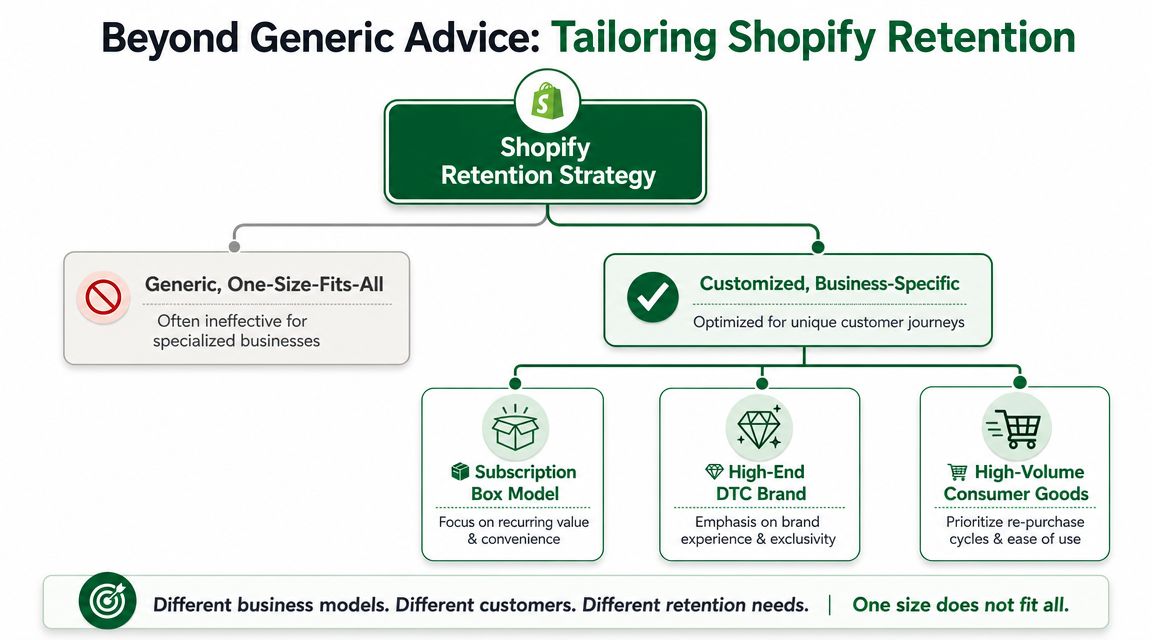
A mattress brand doesn't have the same retention problem as a coffee brand. One is trying to stay relevant between long purchase cycles. The other is trying to remove friction from the next order. Yet most advice throws both into the same pile of email, SMS, loyalty points, and discount nudges.
Category changes the economics
For Shopify customer retention, category dictates what "good" even means. Replenishable products can support reminder timing, subscriptions, reorder UX, and bundle expansion. Considered purchases need trust, education, and accessory logic. Fashion sits in the middle, where repeat behavior is driven by newness, fit confidence, and brand affinity more than pure replenishment.
That makes generic retention advice expensive. Operators end up buying tools designed for someone else's business model.
Practical rule: Match retention tactics to purchase cadence first. Match apps second.
A lot of operator writing gets this right in a practical way, even when it isn't benchmark-heavy. The Saaspa.ge blog is one example of category-aware ecommerce thinking that tends to be more useful than broad retention listicles.
The common mistake
The usual failure mode is simple. Teams install more software before they're clear on what kind of repeat behavior the store can realistically produce.
A CPG brand may need to improve first-to-second order conversion. A furniture brand may need to improve service follow-up, warranty confidence, and accessory attach. A fashion brand may need to reduce fit anxiety and make launch communication sharper. Those are different jobs.
A serious operator should rank retention work by the shape of demand:
Business model | Main retention goal | Common bad tactic | Better approach |
|---|---|---|---|
Subscription and CPG | Make reordering easier | Overusing discount campaigns | Build reminder timing, account flexibility, add-on logic |
Considered purchase | Extend relationship between purchases | Forcing fast repurchase | Education, ownership content, accessory paths |
Apparel and fashion | Create reasons to come back | Constant sitewide promotions | Drops, fit confidence, exchanges, segmented loyalty |
The Playbook for Subscription and CPG
If a store sells consumables, supplements, skincare, pet products, or routine household goods, retention is mostly a systems problem. Customers often don't need persuasion as much as they need timing, convenience, and control.
Retention is really reorder design
This category wins when the brand makes the next order feel obvious. The customer shouldn't have to remember, search, log in, and rebuild the cart every time. That friction kills repeat purchase before price becomes the issue.
The strongest setups usually combine subscription infrastructure with non-subscription reorder support. Not every customer wants a formal subscription, but many do want a low-effort path back to the same product.
What actually helps
Several tactics matter more than broad "engagement":
Replenishment timing: Trigger reorder prompts based on likely consumption windows, not arbitrary calendar dates.
Subscription flexibility: Let customers skip, swap, delay, and edit without talking to support.
Post-purchase education: Remind customers how to use the product correctly so the first order delivers its promised value.
Add-on logic: Use the reorder moment to attach complementary products, not random cross-sells.
Segmented lifecycle flows: Separate new customers, active subscribers, one-time repeat buyers, and lapse-risk cohorts.
Klaviyo is often in the center of this work because email and SMS flows still handle a lot of the execution layer for Shopify retention strategies. The useful question isn't whether to send more messages. It's whether the flow maps to a real replenishment event.
If the product runs out before the message lands, the brand is late. If the message lands too early, the customer ignores it.
What doesn't work as well is treating churn like a copy problem. Better subject lines can help, but subscription churn usually comes from product fit, pricing sensitivity, inventory mismatch, or inflexible account controls. Operators should fix the experience before scaling reminders.
The Playbook for Considered Purchases
Low-frequency categories need a different definition of retention. If the product is furniture, electronics, fitness equipment, or another considered purchase, the brand may not earn a fast repeat order. That doesn't mean retention is weak. It means the relationship has to carry more weight between transactions.
The second purchase is not the only win
A narrow focus on repeat order rate can misread this category. The valuable asset is whether the customer stays connected to the brand long enough to buy accessories, refer others, come back later, or trust the brand for adjacent products.
That changes post-purchase priorities. The best retention work here often looks like customer success, not traditional campaign marketing.
What the relationship should do
Operators in considered purchase categories usually get better results from a few moves:
Ownership onboarding
Teach setup, care, maintenance, and best practices right after purchase. That lowers regret and increases perceived value.Accessory pathways
Build natural follow-on offers around protection, upgrades, refills, compatible components, or room-by-room expansion.Content with utility
Send care guides, planning tools, comparison advice, or how-to material that helps the customer get more from the original purchase.Service moments that build trust
Warranty communication, proactive support check-ins, and clear replacement policies keep the brand credible.
A considered purchase brand shouldn't copy a supplement store's retention calendar. Aggressive short-window discounting can even damage trust if the customer just made an expensive decision and then gets flooded with urgency emails.
Retention in considered purchase categories is often about staying top of mind without acting desperate.
Community can help too, if it's built around usage and identity rather than just promotion. A home brand can build around inspiration and care. A technical product can build around expertise and ownership confidence.
The Playbook for Apparel and Fashion
Fashion has a brutal version of the retention problem. Customers may like the brand and still not return if fit is inconsistent, launches feel irrelevant, or the store trains them to wait for promos.
Independent Shopify-focused benchmarks suggest ecommerce businesses average about a 30% retention rate, online retailers commonly see a 28.2% repeat purchase rate, and a good 12-month retention range is 30% to 40%, with major variation by category according to Rivo's Shopify retention benchmarks. Apparel operators should read those numbers carefully. Fashion doesn't behave like consumer staples.
Newness and fit drive return behavior
For apparel, repeat purchase usually depends on three things:
Driver | Why it matters | What breaks it |
|---|---|---|
Newness | Gives customers a reason to revisit | Predictable, stale merchandising |
Fit confidence | Reduces hesitation on the next order | High return friction, poor sizing guidance |
Identity | Makes the brand part of self-expression | Generic communication, weak point of view |
This is why loyalty in fashion often underperforms when it's built only around spend. If the program ignores style participation, reviews, referrals, content creation, and early access, it misses what customers value.
What works better than blanket discounting
Apparel brands usually get more from sharp segmentation than from larger promo volume.
Launch-based campaigns: Target customers based on prior category or silhouette affinity.
Exchange-first returns: Make exchanges easier than refunds when size or fit is the issue.
Loyalty that rewards advocacy: Points for reviews, UGC, referrals, and launch engagement can matter more than points for spend alone.
Fit memory: Save size preferences and prior purchase context anywhere possible.
Loyalty platforms like LoyaltyLion often enter this stack for program design, but the program only works if it supports the brand's merchandising rhythm. A loyalty layer won't save weak product drops.
Operators looking at acquisition and retention loops in fashion may also find useful adjacent thinking in this guide to scalable growth for clothing affiliates, especially where creator advocacy overlaps with repeat demand.
Retention Metrics That Actually Matter
It's common to watch the wrong number.
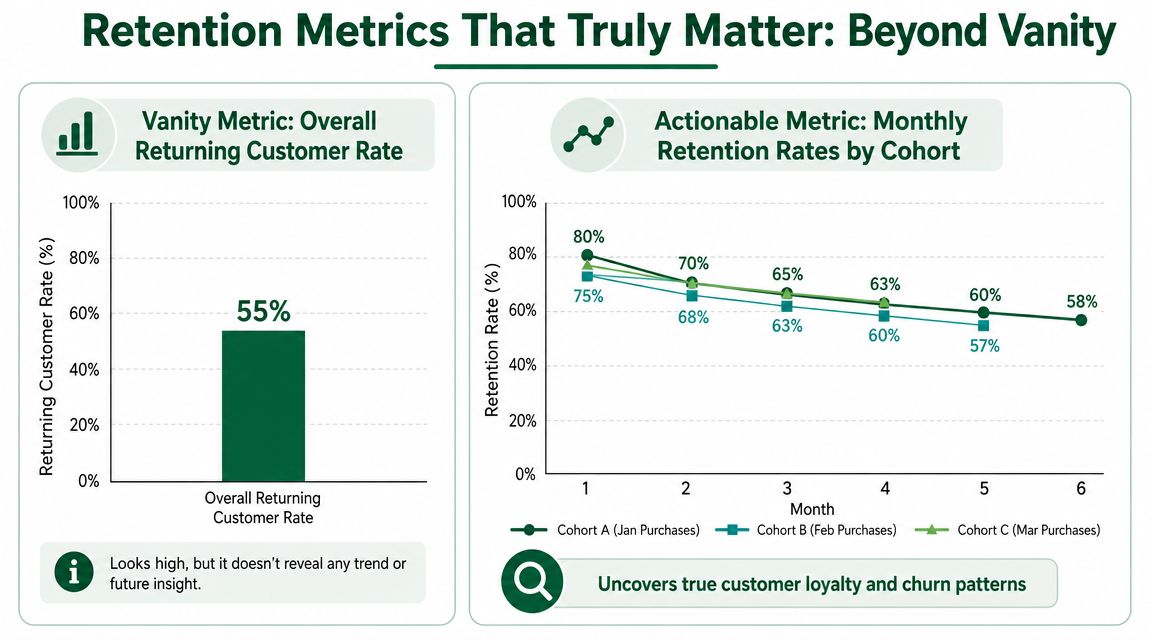
Storewide returning customer rate looks clean in a dashboard, but it hides too much. It mixes old cohorts with new ones, acquisition shifts with retention quality, and seasonal noise with real behavior change.
Why storewide repeat rate hides problems
Shopify's own guidance points operators toward cohort analysis because it tracks customers by first-purchase date and shows how retention changes over time across acquisition cohorts in Shopify's loyalty analytics guide. That matters because the store can look stable at the top level while newer cohorts are getting worse.
Shopify also defines repeat purchase rate as (number of customers who've made more than one purchase / total customers) × 100 in that same guide. This is useful, but it answers a different question from cohort retention.
A practical reading looks like this:
Repeat purchase rate improves, cohort retention flat: existing retained customers may be buying more often.
Cohort retention improves, repeat purchase rate flat: more customers may be making it to another purchase, but not increasing cadence yet.
Storewide retention looks stable, newer cohorts deteriorate: acquisition quality, onboarding, or product fit may be weakening.
What to watch instead
A real metric stack should separate at least three layers:
Metric | What it answers | Why operators need it |
|---|---|---|
Cohort retention | Are newer customers sticking over time? | Shows whether the business is improving or decaying |
Repeat purchase rate | Are customers getting to order two or more? | Useful for first retention milestone |
Purchase cadence by category or SKU | How long between orders? | Helps set realistic flow timing |
For deeper cohort analysis, tools built around Shopify lifecycle analytics can help. Tresl on App Store Research is relevant here because it points to a concrete use case: cohort analytics that helps operators see whether retention changes are real or just blended reporting noise.
A retention chart should help diagnose decisions. If it only reports a number, it isn't enough.
One more point matters. The retention formula itself should stay clean: ((customers at end of period – new customers acquired during the period) / customers at start of period) × 100), as cited in the earlier Rivo benchmark section. Without that separation, acquisition can disguise weak loyalty.
Tools That Genuinely Move the Needle
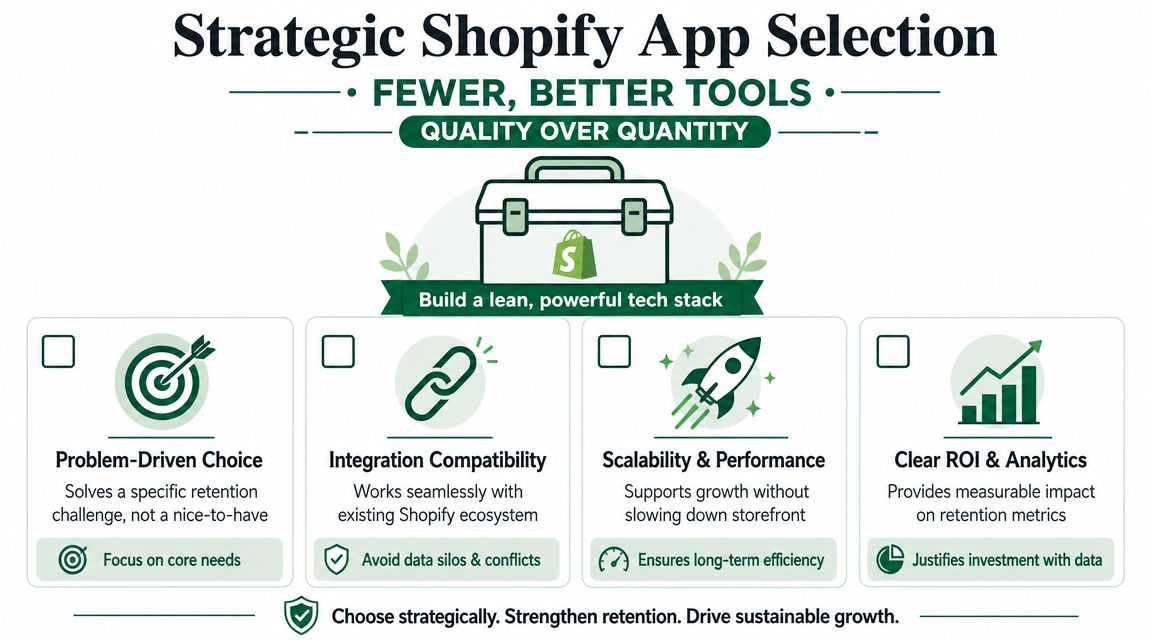
The biggest retention mistake in Shopify isn't always missing a tactic. It's stacking too many apps that all claim to solve retention from different angles.
Shopify App Store guidance and adjacent retention coverage keep surfacing segmentation, loyalty, subscriptions, and personalized recommendations, but the harder operator problem is app sprawl, overlapping features, and fragmented data, as discussed in Shopify's customer retention app guide. More tools can create more work without improving LTV.
Fewer tools usually win
A lean retention stack usually performs better than a crowded one because ownership is clearer. Data has fewer places to break. Teams can audit results.
Most stores need coverage across four functions, not four separate categories of app spending forever:
Function | Job to be done | Common stack problem |
|---|---|---|
Analytics | Cohorts, repeat behavior, merchandising impact | Data spread across multiple dashboards |
Communication | Email, SMS, on-site messaging | Too many overlapping triggers |
Commerce layer | Subscription, reorder, account controls | Friction between storefront and account experience |
Loyalty or advocacy | Rewards, referrals, reviews | Program complexity with weak customer relevance |
Email remains central, but only if deliverability is healthy. This guide to Email Deliverability Best Practices is a useful operator reference because retention flows don't matter if messages stop landing.
A practical audit for the current stack
A blunt audit usually reveals waste fast:
List every retention app by job: If two tools segment the same audience or trigger similar campaigns, one may be redundant.
Trace data ownership: Customer properties, consent status, and order events should have a clear source of truth.
Match cost to a metric: Each tool should support a named retention outcome, not a vague promise.
Check native alternatives: Some functions can live inside Shopify or a broader platform already in use.
Ask whether the app reduces work: A retention app that adds manual cleanup is often a net drag.
For operators evaluating SMS tooling specifically, this comparison of best SMS marketing apps for Shopify can be a practical starting point.
One option in the broader decision process is app store research, a platform that connects Shopify merchants with paid product research interviews with app developers and UX teams. In practice, that can help operators pressure-test whether a retention app's roadmap, positioning, and actual use cases match the store before adding another tool.
Good retention software removes complexity. Bad retention software asks the team to manage another layer of it.
How to Sequence Your Retention Investments
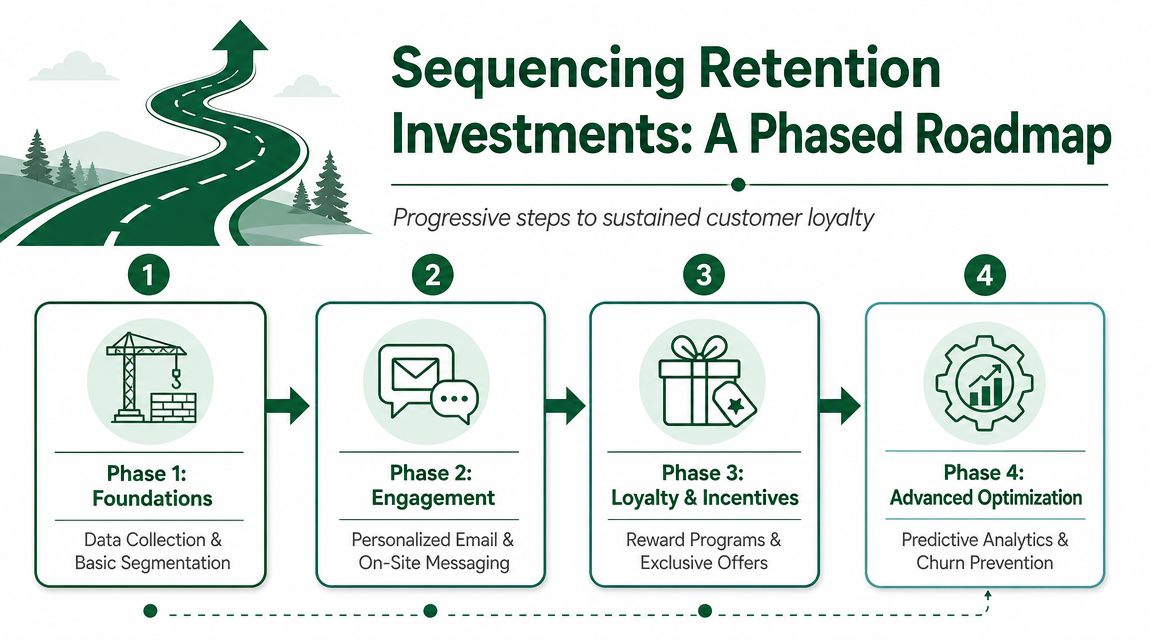
Teams often buy loyalty or subscription tooling before they've built measurement discipline. That's backwards.
Current Shopify-focused guidance keeps emphasizing email, SMS, loyalty, referrals, and subscriptions, while the broader shift is toward first-party data, lifecycle automation, and owned communication channels in a harder attribution environment, as noted in Okendo's Shopify retention strategies overview. The sequence matters more than the channel list.
Phase one measure
Start with clean reporting. Cohorts, repeat purchase behavior, and category-level cadence should be visible before any major app expansion. Operators making stack decisions can use this framework on how to evaluate Shopify apps to avoid buying blind.
Phase two automate
Build the essential post-purchase flows next. This includes onboarding, reorder prompts where relevant, service messaging, and segmented lifecycle communication. Permissioned channels usually outperform broad paid re-engagement once the basics are in place.
Phase three scale
Only after the first two phases are stable should the store add loyalty mechanics, subscriptions, referrals, or more advanced optimization. At that point, the business can tell whether the new layer improves an existing funnel or just increases message volume.
Get Direct Access to App Founders
The Shopify app market is crowded, and operators get pitched constantly. Most of that outreach doesn't provide an advantage. Direct conversations do.
When operators talk to founders and product teams, they can ask sharper questions. What problem is the app really built for. Which workflows does it replace. Where is the roadmap going. What won't it do well. Those conversations are often more useful than another demo deck.
That access also changes the power dynamic. Instead of passively buying into app messaging, operators can influence feature requests, challenge pricing logic, and get earlier visibility into new products. The brands doing this well usually build direct relationships with the vendors in their stack, which is exactly why this piece on why 8-figure Shopify brands build direct relationships with app founders is worth reading.
Serious operators don't need more noise. They need access, influence, and better information. App store research is the network where Shopify operators get paid to talk directly with the app founders and product teams building the tools they use every day. A key benefit is a seat at the table and early visibility into what's being built. The incentive is recognition for useful expertise. If that fits, join the network.

Reviewed by
Filip Djokic
Product Designer at appstoreresearch.com
Filip is a Product and UI/UX Designer with over 10 years of experience in digital product design. With a strong background in the Shopify ecosystem, he focuses on improving user experiences and turning merchant insights into better product decisions at appstoreresearch..