
Author
Jonathan Kennedy
Founder at appstoreresearch
Jonathan Kennedy is the founder of app store research and shopexperts, platforms that connect operators, founders, and experts across the Shopify ecosystem to drive better decisions, product development, and growth.
Rising acquisition costs make weak basket economics harder to hide. Many Shopify teams already have traffic, email, and paid media under control, but the order itself is still under-monetized.
That's usually where the main AOV work starts. Not with a giant redesign. With tighter merchandising across the funnel, better threshold logic, and offers that feel relevant instead of noisy. For operators searching how to increase AOV Shopify, the practical answer isn't one tactic. It's knowing which tactic should fire before add-to-cart, inside the cart, and after the order is already placed.
Pre-Purchase AOV Strategies
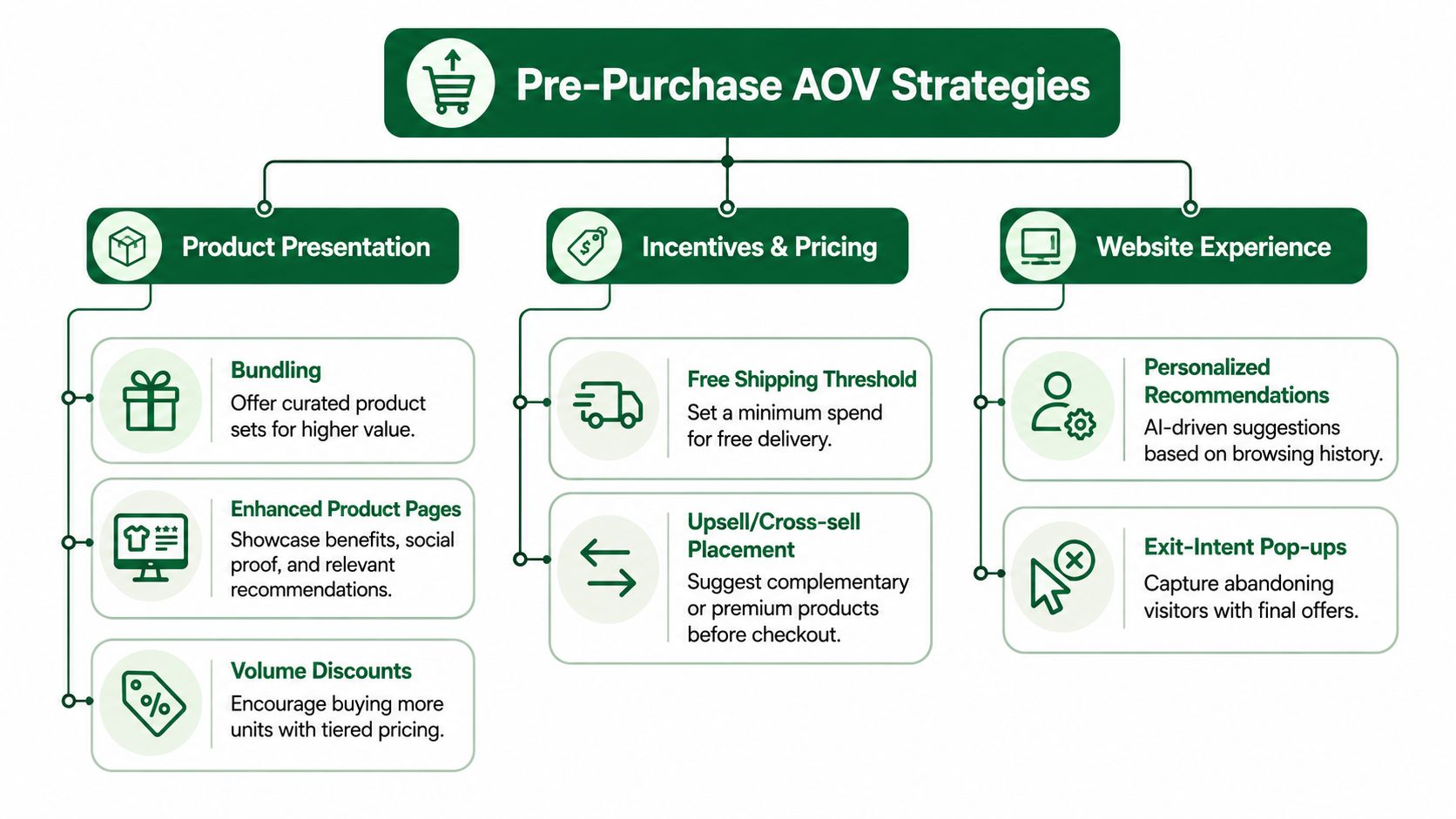
A shopper lands on a product page planning to buy one item. This is the stage where AOV can move without adding checkout friction, but only if the offer fits the moment. Pre-purchase tactics work best when they help the customer choose a better configuration, a stronger pack size, or a more complete solution before the cart is even in play.
Bundle logic beats random grouping
Bundles raise AOV before the cart only when the logic is obvious. If the set answers a real buying job, conversion usually holds. If it looks like leftover inventory taped together, shoppers hesitate and many just buy the hero SKU alone.
The strongest bundle structures on Shopify tend to be:
Routine bundles built from products customers already use together
Starter bundles for first-time buyers who want a safe default
Refill packs that improve economics on replenishable items
Gift sets where convenience is part of the value
The practical test is simple. A shopper should understand the bundle in a few seconds.
Execution matters as much as concept. Native product bundles can work for straightforward packs, but many stores need an app that lets them control discount logic, inventory sync, and how the bundle appears on the PDP. I usually want bundle offers to live above the fold on mobile, show per-item value clearly, and avoid forcing variant choices across too many SKUs. Too many decisions kill the lift.
For merchants reviewing how recommendation blocks and merchandising widgets affect buying behavior, the ConvertWise customer example is a useful reference because it shows how app teams refine modules through merchant feedback instead of broad assumptions.
Thresholds need calibration
Threshold offers are pre-purchase AOV tools when they appear early enough on collection pages, product pages, and sticky bars. They give shoppers a target before the cart becomes the decision point.
The mistake is setting the target from margin goals alone. A threshold has to feel reachable from the product mix a customer is already considering. If a store sells many items in the same accessory range, a higher threshold can work. If the catalog has wide price jumps, the same threshold can feel like a tax.
A clean setup usually includes:
One incentive, such as free shipping or a gift, not three stacked promos
Gap-closing products with low evaluation friction
Consistent messaging across PDPs, collection pages, and the cart drawer
Visible progress cues before checkout starts
This is also where on-site assistance can improve AOV without turning the store into a pop-up trap. Spur's guide to AI chatbots for Shopify is useful for teams that want product-finding help tied to intent, not generic interruption. Stores tightening merchandising and message hierarchy before they test thresholds should also review this Shopify conversion rate optimization guide.
Tier framing changes how shoppers compare value
Tiered pricing works on the product page because it changes the comparison set. Instead of deciding whether to buy, the shopper decides which quantity or package makes the most sense.
This is why pre-purchase tiering often works better than a late upsell for consumables, supplements, beauty, coffee, pet care, and accessory-led catalogs. The product already has intent. The job is to frame the larger option as the rational purchase, while keeping margin intact after discount and shipping costs.
Two rules keep tiered pricing from backfiring:
Keep the math obvious. Shoppers should see the per-unit gain immediately.
Limit the number of choices. Two or three tiers usually beat a long pricing ladder.
On Shopify, that often means testing quantity breaks, bundle builders, or variant-level messaging directly on the PDP. Watch contribution margin, not just AOV. A higher order value that comes from over-discounting can look good in a dashboard and still make the store less profitable.
In-Cart AOV Strategies
By the time a shopper reaches the cart, intent is already there. The job changes from persuasion to removal of friction. Good in-cart AOV modules help complete the order. Bad ones interrupt it.
Cart page upsells versus slide-cart add-ons
A traditional cart page gives more space for explanation, comparison, and merchandising blocks. A slide cart is lighter and faster. It keeps the customer in context, which is why many operators prefer it for accessories, travel sizes, gift wrap, warranty-style add-ons, or single complementary items.
The distinction matters:
Format | Best use case | Main risk |
|---|---|---|
Cart page upsell | Products that need a little context or visual explanation | Adds another full-page decision point |
Slide-cart add-on | Low-friction accessories and threshold-bridging products | Becomes cluttered fast on mobile |
The winning copy is usually simple. “Add the matching refill.” “Complete the set.” “You're close to free shipping, add this.” Not “customers who bought this also loved...” unless the recommendation is tight.
What belongs in the cart and what does not
The cart is not the place for a premium product leap, a category detour, or five competing offers. It's the place for relevant, low-resistance additions.
Useful cart offers tend to share three traits:
They're complementary to the item already chosen
They don't require much evaluation
They don't create shipping, sizing, or compatibility confusion
The cart module should answer one question: “What small addition makes this order more complete?”
This is also where app quality shows up fast. Merchants comparing cart and recommendation apps often don't just care about features. They care about how the module behaves on mobile, how often it misfires, and whether the logic can be tuned by collection, product type, or cohort. That's why app teams often lean on direct operator feedback instead of product analytics alone. For broader stack evaluation, this roundup of best new Shopify apps is a useful companion read.
Post-Purchase AOV Strategies
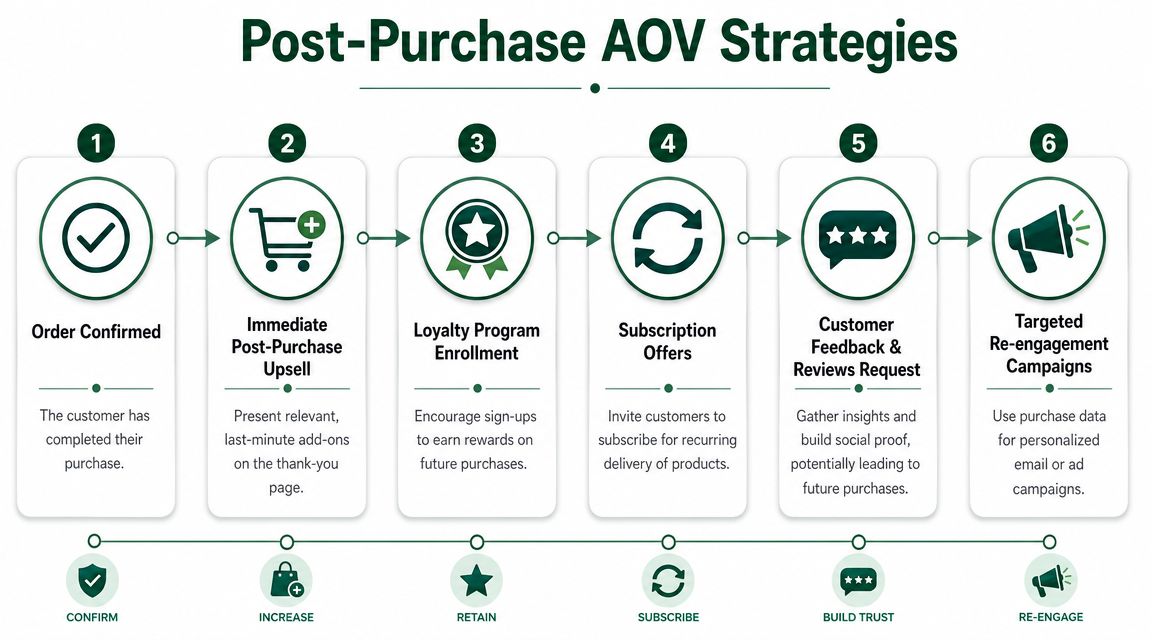
The order confirmation doesn't end the revenue opportunity. It changes the psychology. The customer has already committed, trust is higher, and the next offer can be accepted without sending them back through a full shopping flow.
Why post-purchase offers work
Post-purchase one-click upsells are effective because they remove most of the friction that kills pre-purchase add-ons. The payment step is already complete. The offer is narrower. The customer doesn't have to rebuild the cart.
That changes what should be offered. The best post-purchase products are usually:
A logical accessory tied to the just-purchased item
A lower-commitment variant such as a smaller format or add-on
A practical extension like extra consumable units
A digital or lightweight extra that doesn't create fulfillment complexity
What usually fails is offering a second major decision right after checkout. If the first order was a commitment, the upsell shouldn't feel like restarting the buying journey.
Operator note: Post-purchase offers should feel like order completion, not buyer's remorse in disguise.
Subscription nudges after checkout
Subscriptions can raise order value and improve repeat economics, but the placement matters. The post-purchase flow is often better for the nudge than the product page, especially when the customer hasn't yet tried the product.
A clean subscription prompt usually works better when it frames convenience and continuity instead of savings alone. The same logic applies to follow-up messaging. Teams refining retention flows often pair the immediate post-purchase offer with thoughtful SMS or lifecycle sequences. For that part of the funnel, YipSMS has a practical guide to successful campaigns that's worth reviewing before turning post-purchase into another generic blast channel.
Realistic Lift Benchmarks by Tactic
AOV benchmarks get misleading fast when merchants treat every tactic like it should produce the same lift. It will not. A pre-purchase threshold changes intent before the cart is built. An in-cart add-on works on convenience. A post-purchase upsell depends on trust that already exists after payment. Those mechanics are different, so the lift range and the risk profile are different too.
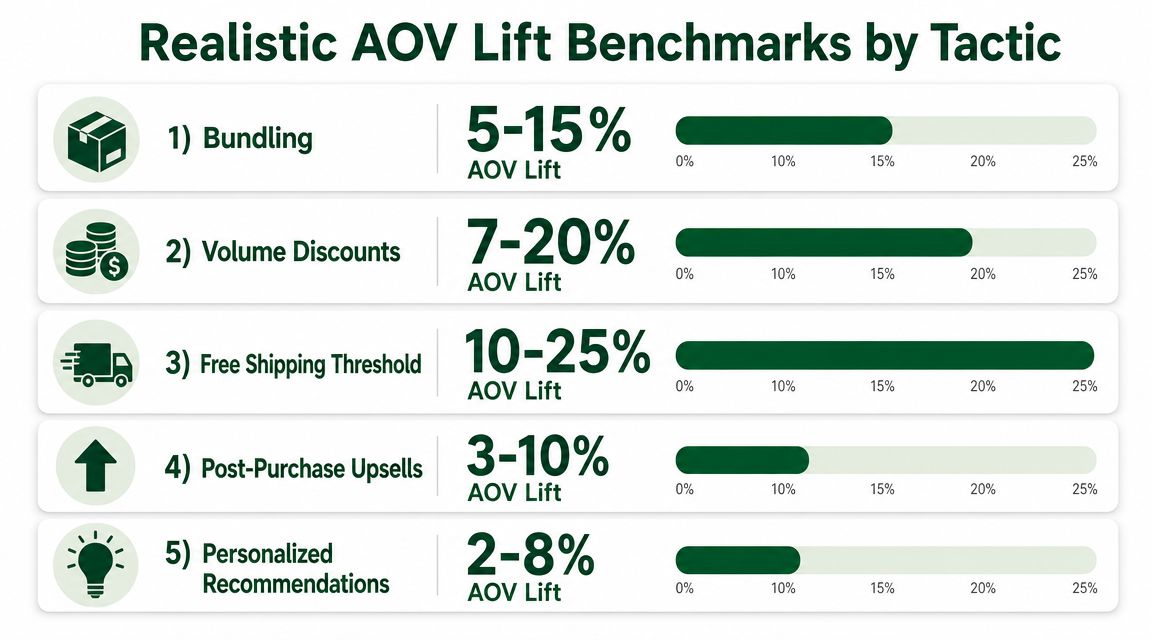
The clean way to read benchmarks is by customer journey stage. Pre-purchase tactics usually influence more sessions, but they can also hurt conversion if the offer is too aggressive. In-cart tactics tend to produce steadier gains because the customer has already shown purchase intent. Post-purchase offers can lift revenue efficiently, but only if the SKU match is tight and support complexity stays low.
What to expect from each lever
Threshold offers are still one of the safer places to start. A practical rule is to set the target just above your current buying pattern, not so high that customers abandon the order and not so low that you give away margin for behavior that would have happened anyway. Shopify's own guidance on calculating and improving average order value is useful here because the math forces the right question: did the larger basket improve contribution profit, or did it just add discounted revenue?
That trade-off matters more than any headline lift claim.
Bundles usually create the strongest upside when the products already belong together in the customer's mind. In my experience, merchants overestimate how much “curated” bundles can manufacture demand. If the pairing is obvious, bundle tests can move fast. If the pairing needs explanation, the lift often disappears into lower conversion or heavier discounting.
In-cart add-ons and post-purchase offers usually have lower creative overhead than full bundle builds, but they are less forgiving on relevance. A cart drawer offer for a low-cost accessory can work with simple Shopify app logic. A post-purchase offer often needs stricter rules around inventory, fulfillment, and exclusions. Revenue looks good on a dashboard until the ops team starts cleaning up split shipments and avoidable support tickets.
AOV tactic comparison
Tactic | Typical AOV impact | Implementation complexity | Primary risk |
|---|---|---|---|
Free shipping threshold | Moderate when the target sits just above current cart behavior | Low to medium | Lower conversion if the threshold feels out of reach |
Product bundling | High when SKUs are naturally complementary and margins can absorb the offer | Medium | Forced bundles create confusion or train discount dependency |
Volume discounts | Moderate to high for replenishable, giftable, or multi-unit products | Medium | Margin erosion when shoppers would have bought at full price anyway |
In-cart add-ons | Low to moderate, usually more consistent than flashy | Medium | Mobile friction, clutter, and weak attach rates from poor matching |
Post-purchase upsells | Moderate to high when the offer feels like order completion | Medium to high | Irrelevant offers create regret, refunds, or support load |
Personalized recommendations | Moderate if recommendation logic is strong and catalog data is clean | Medium to high | Noise from weak merchandising rules |
Use the table as a sequencing tool, not a promise sheet. Start with the tactic that matches the stage where you have the clearest friction point. If product pages already convert well, test in-cart and post-purchase first. If carts are small before checkout even begins, fix pre-purchase merchandising and thresholds before adding more apps to the cart.
What Kills AOV
AOV usually doesn't collapse because a team forgot to install one more app. It gets damaged by incentives that are too broad, too cheap, or too disconnected from profitability.
Over-discounting is the usual culprit
The biggest mistake is chasing larger carts without tracking margin. SplitBase recommends a structured testing process that combines analytics review, customer research, and hypothesis generation instead of guessing, and it also flags a common pitfall: merchants optimize basket size without measuring profitability. That's where over-incentivizing AOV can backfire if margin impact is ignored (SplitBase on increasing AOV).
A few patterns create that problem fast:
Sitewide couponing that trains shoppers to delay purchase
Stacked promotions that make attribution messy and profitability worse
Large tier discounts applied to products that already have thin contribution margin
“Free” offers that add fulfillment cost without enough basket expansion
Revenue per order without contribution margin is an incomplete metric.
Bad mobile execution ruins otherwise good ideas
Even a good offer can fail if the interface is clumsy. Cart drawers that cover the checkout button, sticky bars that overlap with payment options, and oversized recommendation modules often hit mobile hardest.
The same applies to relevance. A cross-sell that makes sense on desktop can look chaotic on a small screen if the customer can't evaluate it in a few seconds. When AOV rises but mobile checkout completion falls, the store hasn't identified an effective strategy. It has just moved friction.
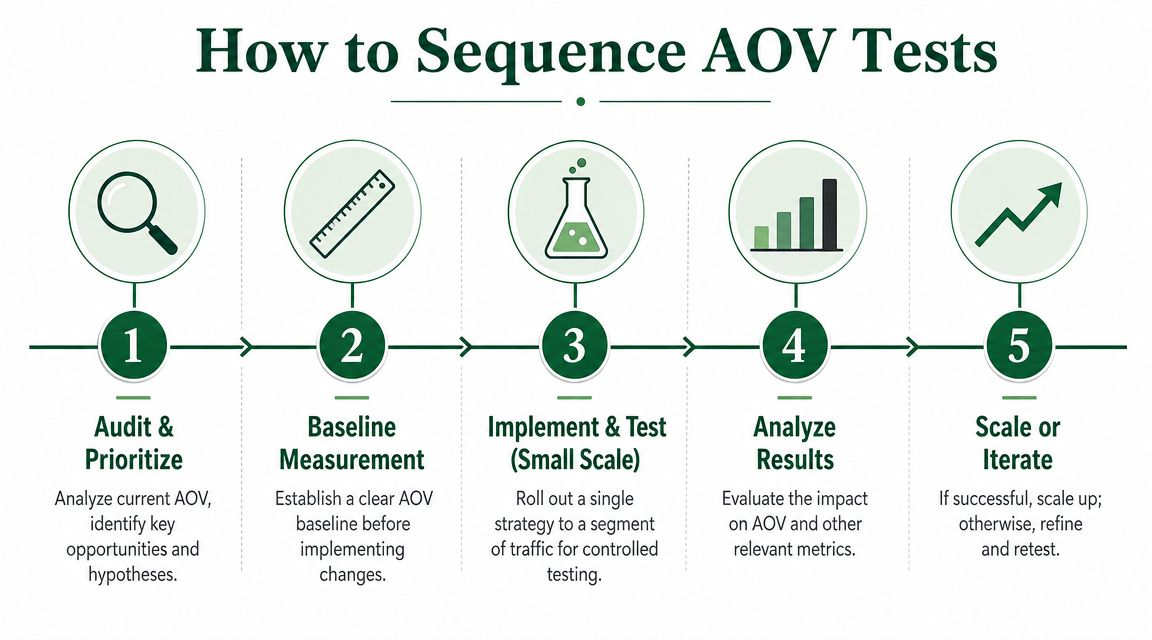
How to Sequence AOV Tests
Many understand the menu of Shopify AOV strategies. The harder question is what to test first, and which tactic belongs to which customer segment. That gap matters because, as Lebesgue notes, the underserved angle isn't just what tactic to use, but how to choose the right one by customer segment and baseline AOV (Lebesgue on AOV strategy selection).
Start with the least disruptive levers
A clean sequence usually looks like this:
Set or recalibrate thresholds first, because they affect broad traffic without requiring major product logic.
Add complementary in-cart offers second, limited to product groups where the relationship is obvious.
Test bundles on specific PDPs where order data already suggests natural pairing.
Introduce post-purchase offers after the pre-purchase and cart experience is stable.
Layer segmentation only after the store has a stable baseline and enough signal to compare cohorts.
That order matters because it keeps measurement cleaner. If a team launches bundles, cart upsells, free shipping messaging, and post-purchase offers all at once, nobody knows what really moved.
Measure by segment, not store average alone
The right scorecard is tighter than top-line AOV. The test should be attached to:
AOV by cohort or campaign
Add-on click-through
Checkout drop-off
Contribution margin
Mobile versus desktop behavior
Some tactics work better for first-time buyers. Others are better reserved for repeat customers or specific acquisition channels. That's why serious teams don't ask only “did AOV go up?” They ask which audience accepted the offer, which audience ignored it, and whether the added revenue survived shipping, discounting, and returns.
Gain Influence Over the Tools You Use
The app stack shapes a lot of this work. Cart drawers, bundling logic, recommendation modules, post-purchase flows, analytics overlays. When those tools don't match the operating reality of a store, the team feels it immediately.
The stronger move isn't just switching apps faster. It's getting access to the people building them. Operators who speak directly with founders and product teams often get more influence than operators who only submit support tickets. They see new tooling earlier, push on roadmap gaps, and sometimes influence features that affect merchandising, reporting, or pricing decisions.
For cleaner measurement, it also helps to tighten analytics discipline. This practical guide to actionable GA4 data for Shopify stores is worth reviewing if AOV tests are being judged on noisy event setups or incomplete attribution. And for merchants comparing vendors more rigorously, this framework on how to evaluate Shopify apps is useful before committing more of the funnel to one tool.
app store research is a platform that connects Shopify merchants with paid product research interviews with app developers and UX teams. For operators, that means direct conversations with the people building the stack used every day, plus a chance to influence what gets shipped next.
The strongest operators don't just buy apps. They shape them. If direct access to app founders, early visibility into upcoming tools, and paid conversations with product teams sound useful, join the network. The cash is a byproduct. The core value is influence, access, and better control over the software that affects revenue.

Reviewed by
Filip Djokic
Product Designer at appstoreresearch.com
Filip is a Product and UI/UX Designer with over 10 years of experience in digital product design. With a strong background in the Shopify ecosystem, he focuses on improving user experiences and turning merchant insights into better product decisions at appstoreresearch..