How to Grow a Shopify Store the Right Way at Every Stage
/
Most advice on how to grow a Shopify store fails for one reason. It treats every store like it's solving the same problem.
A store trying to move from $10K to $50K MRR doesn't need the same playbook as a store pushing toward $1M MRR. Early on, the constraint is usually offer clarity and one repeatable acquisition channel. Later, the bottleneck shifts to retention, operations, hiring, and brand. Applying the wrong advice at the wrong stage burns cash, adds complexity, and slows momentum.
That matters even more inside Shopify because the market is crowded. Estimates of active Shopify stores in 2026 range from 2.89 million to over 5.6 million, depending on methodology and definition, as summarized in this Shopify ecosystem breakdown. More stores means more competition for attention, more app choices, and more vendor noise. It also means small improvements compound fast when a store has real volume.
This article breaks growth into the transition that matters. Not abstract “scale faster” advice. The practical levers that tend to move a store from one revenue band to the next.
Table of Contents
Why Most Shopify Growth Advice Fails
Different stages break for different reasons
The channel advice problem
$10K to $50K MRR Nailing the Offer and Acquisition Channel
The offer has to do the heavy lifting
Pick one channel and stay with it long enough
$50K to $200K MRR Building Retention and Ops Systems
Retention stops paid acquisition from getting more expensive than it should be
Operations start showing up in the P&L
$200K to $1M MRR Scaling Your Team and Brand
The founder becomes the bottleneck
Brand starts carrying part of acquisition
Common Stalls at Each Growth Transition
What the stall usually looks like
How to diagnose the primary constraint
What to NOT Invest in at Each Stage
Premature investments to avoid by MRR stage
Gain Your Edge Through Direct Access
Why Most Shopify Growth Advice Fails
A lot of Shopify advice fails because it treats growth like one long checklist. It tells a $12K MRR store to work on the same mix of SEO, paid social, influencer seeding, CRO, email, SMS, loyalty, subscriptions, and upsells that a $300K MRR store should be running. That is how founders get busy without getting traction.

Different stages break for different reasons
The constraint changes with revenue.
From $10K to $50K MRR, the job is usually to tighten the offer and find one acquisition channel that can bring in customers at a sane payback period. From $50K to $200K MRR, stores usually stop growing because repeat purchase, inventory flow, fulfillment, and reporting are weak. From $200K to $1M MRR, the founder often becomes the operating bottleneck. Team structure, decision speed, and brand strength start to matter as much as campaign execution.
I have seen the same mistake at every tier. Operators copy tactics from stores two stages ahead of them. Early brands install retention stacks before they have enough first-time buyers to retain. Mid-stage brands keep acting like scrappy test-and-learn startups when they need process. Larger brands keep every decision with the founder and then wonder why growth slows.
That is why broad advice underperforms. The right move depends on the revenue band, the current bottleneck, and the trade-off attached to fixing it.
The channel advice problem
Channel advice gets distorted because the Shopify market is crowded and noisy. Published estimates vary widely, and some projections for 2026 put active Shopify stores somewhere between roughly 2.9 million and 5.6 million. Whether the actual number lands at the low end or high end, the operating reality is the same. Competition for attention is expensive, app discovery is messy, and founders get pitched on too many tactics at once.
The app store research network shows the same pattern in practice. There are far more operators in earlier revenue tiers than in the upper bands, and each jump up the ladder filters out stores that never solved the next operational problem. That is less about vanity milestones and more about changing requirements. What helps you attract customers to your store at $20K MRR is not enough to carry the business to $200K if retention and execution are weak.
A useful rule is simple. Judge advice by stage fit first, channel second.
Hiring is a good example. A $15K MRR store that hires a full team too early usually adds burn before it adds output. A $400K MRR store that refuses to hire keeps the founder buried in approvals, customer issues, and campaign reviews. Same category of decision. Different answer because the constraint changed.
$10K to $50K MRR Nailing the Offer and Acquisition Channel
At this stage, most stores don't have a scaling problem. They have a focus problem.
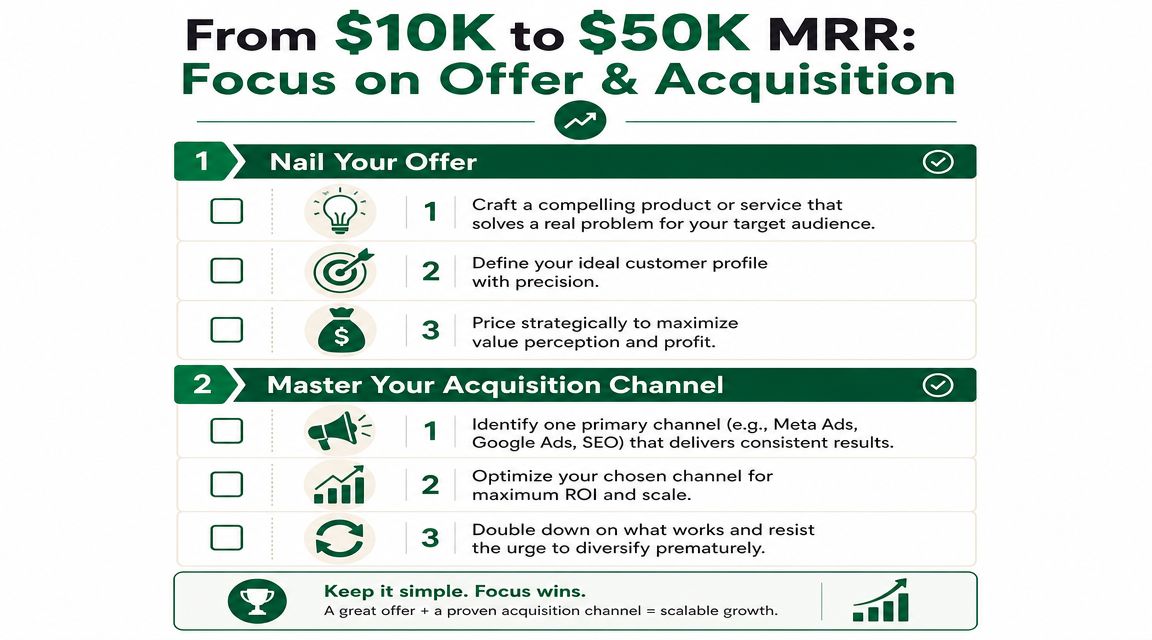
The offer has to do the heavy lifting
If the store needs endless persuasion to make a sale, the offer isn't there yet. That doesn't always mean the product is wrong. Often the problem is weaker than expected positioning, poor merchandising, confusing bundles, unclear use cases, or pricing that doesn't match perceived value.
A practical sequence is to start with market research, define the target buyer, set KPIs, launch, then iterate based on user feedback and performance signals. That flow aligns with the lifecycle recommended in this Shopify development guide. Early growth gets cleaner when a store knows exactly who it's for and what job the product is doing.
The strongest early operators simplify aggressively:
One core promise: the product page should answer what problem this solves and for whom.
One primary buyer: broad targeting usually produces weak creative and weak merchandising.
One pricing story: avoid stacking discounts, bundles, subscriptions, and tiering before the store knows what buyers prefer.
A weak offer makes every channel look expensive.
Stores at this level also tend to underinvest in the product page. Generic “optimize for mobile” advice isn't enough. Mobile buyers need tighter navigation, less friction, stronger product-page persuasion, and checkout flows designed for smaller screens, which is a gap highlighted in this discussion of Shopify growth tactics.
Pick one channel and stay with it long enough
Most growth content pushes channel diversification too early. That's usually a mistake. Broad advice recommends social, influencers, paid ads, email, and more. But crowded acquisition channels and audience fatigue make random testing expensive. Early-stage diversification is often fatal, while single-channel dependence becomes a later problem, as discussed in this DTC growth conversation.
That means the job from $10K to $50K MRR is usually this:
Choose one acquisition channel that matches the product and team skill set.
Build a repeatable creative and landing page loop around it.
Hold it long enough to see whether the channel can produce consistency.
For some stores, that's Meta. For others, it's Google Shopping, content-led SEO, creators, or niche communities. What doesn't work is dabbling in five channels with no operating rhythm. Operators looking for practical acquisition ideas beyond the usual surface-level list can review this guide on how to attract customers to your store, then cut the list down to one channel worth committing to.
A useful checkpoint at this stage is simple. If a store can't explain, in one sentence, why a customer buys and where that customer reliably comes from, it isn't ready for complexity.
$50K to $200K MRR Building Retention and Ops Systems
More traffic stops fixing the problem around $50K MRR. Stores at this stage usually have enough demand to grow. Revenue stalls because the business cannot convert, retain, and fulfill demand with consistency.
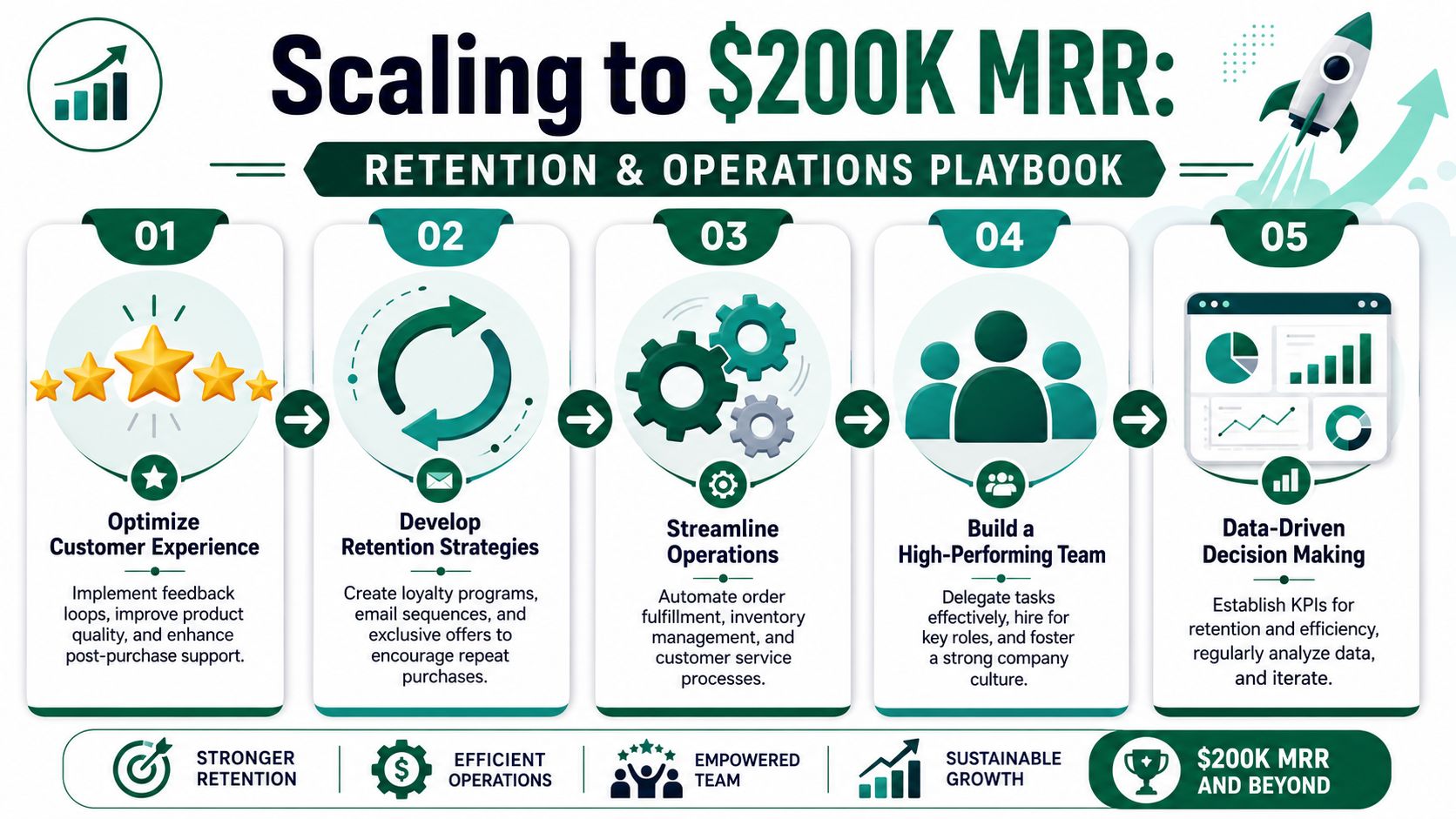
Retention stops paid acquisition from getting more expensive than it should be
Between $50K and $200K MRR, the fastest path to growth is often increasing revenue per customer and purchase frequency. That changes the math on every acquisition channel. A store that gets a second order in 30 to 60 days can afford higher CAC than a store that has to recover all ad spend on order one.
The work here is less glamorous than top-of-funnel testing, but it pays better.
Start with the systems that affect repeat purchase behavior:
Post-purchase email and SMS flows: replenishment reminders, onboarding for the product, review requests, win-back sequences, and cross-sells tied to what the customer bought.
Support standards: response time targets, macros for recurring issues, and clear rules for refunds, replacements, and escalation.
Merchandising built for repeat orders: bundles, subscribe-and-save where it fits the product, replenishable variants, and cart offers that increase second-order likelihood instead of padding AOV with random add-ons.
Teams trying to improve this area can borrow useful ideas from broader strategies to reduce churn, then translate them into ecommerce metrics such as repeat purchase rate, time to second order, and refund rate.
Retention work looks operational because it is operational. It shows up in margin, payback period, and cash flow.
For a more store-specific playbook, this guide on Shopify customer retention is a useful reference.
Operations start showing up in the P&L
At this tier, weak operations stop being an annoyance and start taxing growth every week. Slow support increases refunds. Poor QA raises return rates. Inventory mistakes force winning SKUs out of stock. Too many apps create duplicate workflows, slower storefronts, and reporting nobody trusts.
I have seen stores blame creative fatigue when the underlying problem was operational drag. Paid traffic was still working. The business just could not capture the value because shipping times slipped, customer communication was inconsistent, and the best-selling variant kept going unavailable.
This is also the point where tool decisions need more discipline. App selection should follow workflow, margin, and team capacity. A cheaper app that needs constant manual cleanup often costs more than a higher-priced tool with cleaner implementation. Stores with increasing complexity in checkout, automation, and backend workflows should review when to upgrade to Shopify Plus before adding more patchwork systems.
One practical resource here is app store research, a platform that connects Shopify merchants with paid product research interviews with app developers and UX teams. For operators, that can mean direct conversations with the teams building tools already in the stack, along with better visibility into roadmap direction and implementation trade-offs before another migration.
A practical operator at this stage should be asking:
Focus area | What good looks like | What usually goes wrong |
|---|---|---|
Email and SMS | Lifecycle flows tied to real purchase behavior | Too many campaigns, weak segmentation |
CRO | Clear test queue tied to friction points | Random homepage tweaks |
Support | Fast, documented handling of common issues | Founder trapped in the inbox |
App stack | Fewer tools with clear owners and purpose | Redundant apps and workflow overlap |
$200K to $1M MRR Scaling Your Team and Brand
At this level, the store often isn't constrained by ideas. It's constrained by the founder's span of control.
The founder becomes the bottleneck
A founder can carry a store to real scale through force of will. That stops working when every decision still routes through one person. Paid media approvals, inventory calls, retention campaigns, support exceptions, product launches, vendor management, and hiring all start competing for the same attention.
The shift here is from heroic execution to system ownership. That usually means giving real authority to operators who can own outcomes across marketing, operations, and customer experience. Not assistants. Owners.
A simple way to see whether this is broken is to look at recurring meetings and approvals. If campaign launches stall waiting for founder input, if app evaluations never get completed, or if support trends aren't reviewed until complaints pile up, the store has a management problem, not a tactic problem.
The next stage usually doesn't need more founder effort. It needs fewer founder dependencies.
For brands preparing for more complexity in checkout, automation, and wholesale operational needs, this piece on when to upgrade to Shopify Plus is useful because the platform choice starts affecting workflow design at this tier.
Brand starts carrying part of acquisition
A larger store can't rely only on performance marketing mechanics. Over time, the brand has to reduce friction before the click happens. That includes better product naming, clearer category architecture, stronger repeatable creative angles, better retention language, and a point of view customers can recognize without seeing the logo.
This isn't a cosmetic rebrand project. It's a coordination issue across product, merchandising, creative, support, and retention. The brand becomes stronger when those teams say the same thing in different places.
Stores that reach this level cleanly usually have a few common traits:
Role clarity: everyone knows who owns revenue, margin, CX, and delivery.
Decision speed: routine calls don't wait for founder review.
Message consistency: paid ads, product pages, emails, and support all describe the value in the same language.
Vendor influence: the team doesn't just buy software. It pushes vendors on roadmap, pricing, and implementation fit.
Common Stalls at Each Growth Transition
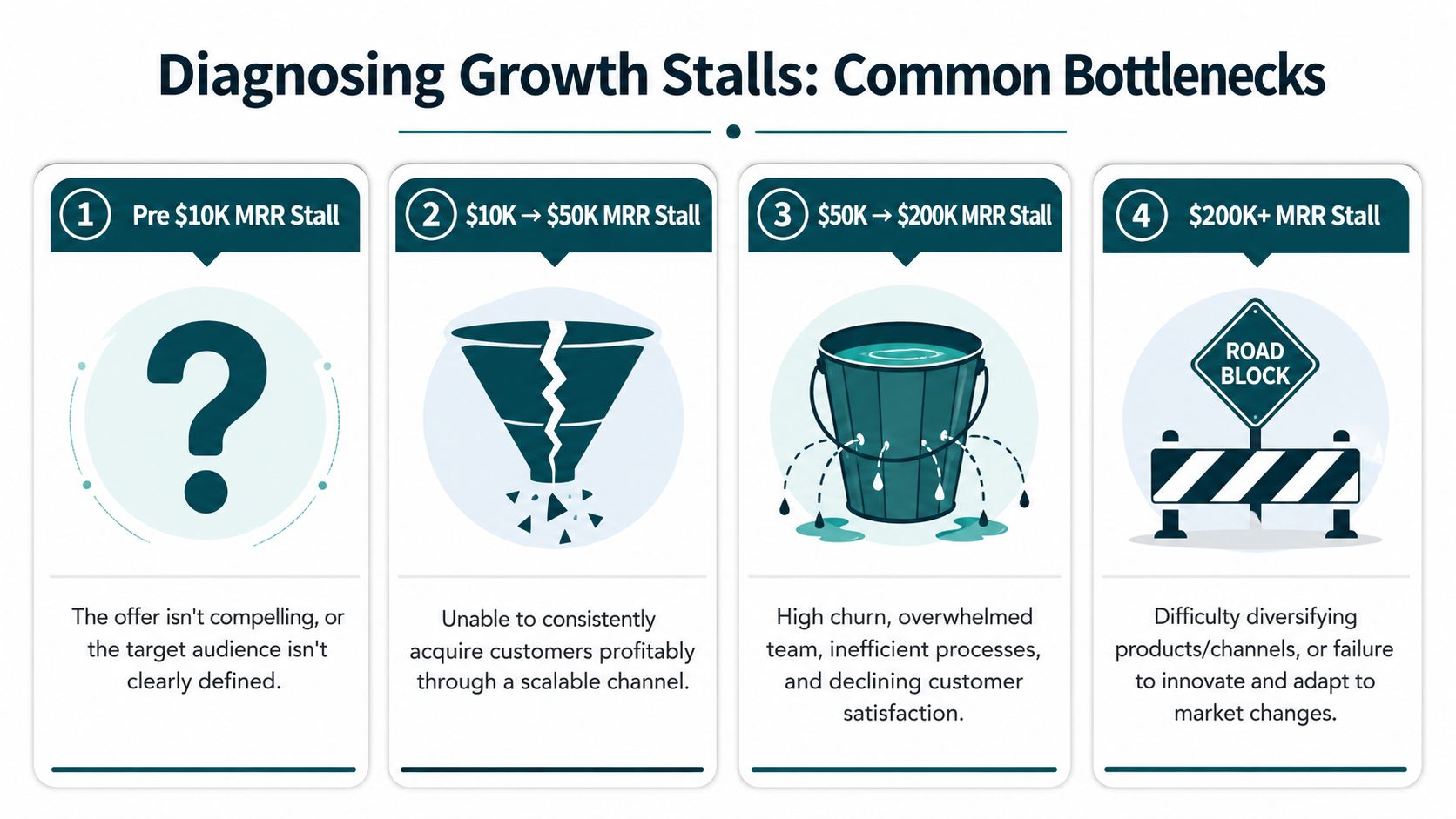
Growth usually stalls because the store keeps improving the visible symptom while the stage-specific bottleneck stays untouched.
What the stall usually looks like
From $10K to $50K MRR, the stall rarely looks dramatic. It looks busy. Sales come in, one ad angle works for a week, then CAC rises and the founder starts rotating variables too fast. Product page changes, influencer tests, discount experiments, SEO tasks, new bundles. The store stays active but learns almost nothing because no offer or channel gets enough clean reps.
From $50K to $200K MRR, the problem shifts. Demand exists, but the business cannot hold onto it well enough. Returning customer rate is soft, support quality slips during spikes, merchandising gets messy, and fulfillment issues start bleeding into reviews and repeat purchase behavior. Revenue is no longer the hard part. Stability is.
From $200K to $1M MRR, the stall becomes structural. The store can still produce revenue, but execution gets uneven across teams and channels. Paid creative says one thing, product pages say another, email pushes a third angle, and no one is making trade-offs fast enough. At this tier, inconsistency is expensive.
How to diagnose the primary constraint
Each revenue band has a common failure pattern.
$10K to $50K MRR: If acquisition keeps breaking, check offer clarity and channel fit first. Stores at this stage often blame ad platforms when the product promise is still vague or too broad.
$50K to $200K MRR: If every growth push fades after a promo, retention and merchandising usually need work. Discounting can create temporary volume while hiding weak reorder behavior.
$200K to $1M MRR: If projects stall waiting on founder approval, the issue is management structure and ownership. Strong operators still fail in weak decision systems.
Any stage: If the app stack keeps changing, the problem is usually poor selection discipline and messy implementation. A tighter process for evaluating Shopify apps before adding complexity prevents a lot of self-inflicted drag.
I have seen founders misread these stalls because the most visible problem is rarely the one holding back the next tier. New channels are visible. Rebuilding lifecycle flows is not. Fresh ad concepts are visible. Fixing collection structure, subscription logic, or post-purchase experience is not. The store grows faster when the team names the underlying constraint correctly and ignores the noise around it.
That diagnosis changes by tier. A $20K MRR brand usually needs tighter positioning and one reliable acquisition motion. A $120K MRR brand usually needs stronger retention and cleaner operations. A $500K MRR brand usually needs better leadership cadence, clearer ownership, and message consistency across the business.
What to NOT Invest in at Each Stage
Bad spending decisions usually come from copying stores in a different phase.
A store trying to force the appearance of scale buys complexity it hasn't earned yet. A larger store trying to “stay lean” often underbuilds the systems and team it now needs. Both mistakes are expensive.
Premature investments to avoid by MRR stage
MRR stage | Common mistake investment to avoid | Why it's a mistake | What to do instead |
|---|---|---|---|
$10K to $50K | Full rebrand, expensive agency retainers, broad channel testing, large team hires | The store still needs clarity on offer and one repeatable acquisition motion | Tighten product pages, sharpen positioning, and commit to one channel long enough to learn |
$50K to $200K | Too many new SKUs, international expansion before systems are stable, constant app swapping | More complexity exposes weak retention and messy operations | Build lifecycle marketing, support processes, cleaner reporting, and app discipline |
$200K to $1M | Vanity projects, founder-only decision making, scattered experiments with no clear owner | Scale starts breaking because execution quality and accountability drop | Hire leaders, define ownership, and invest in brand and operational consistency |
The app layer deserves special caution. A bigger stack can feel like progress because it creates the appearance of sophistication. In reality, each added app creates another implementation surface, another cost center, and another process someone has to own. This guide on how to evaluate Shopify apps is worth using before the store adds more tooling just to feel proactive.
Buying software before defining the workflow usually creates more work, not less.
The same logic applies to analytics. Most stores don't need a more elaborate dashboard as urgently as they need cleaner decision-making. If the team can't name the current bottleneck and what action follows from the data, another reporting layer won't fix it.
Gain Your Edge Through Direct Access
At every revenue tier, the stores that keep compounding usually make better decisions faster. They hear about product changes earlier, pressure-test their stack with people who build it, and avoid expensive guesses on tools, workflows, and implementation.
That edge matters more as MRR rises.
At $10K to $50K MRR, one bad app choice or sloppy setup can distract the founder from the only two problems that matter: offer strength and one acquisition channel that can scale. At $50K to $200K MRR, direct access helps the team fix retention and operational friction before they start leaking margin. At $200K to $1M MRR, it becomes more strategic. The cost of weak tooling decisions is higher, the org has more handoffs, and vendor responsiveness starts affecting execution speed across marketing, support, and finance.
Shopify's investor materials report that merchants generated hundreds of billions in annual GMV, that the platform has surpassed more than $1 trillion in cumulative GMV, and that a large share of ecommerce businesses use Shopify (Shopify Investor Relations). In a market that big, the advantage rarely comes from having access to more apps. It comes from choosing better ones, setting them up well, and shaping your stack before competitors do.
The app store research platform has paid out over $1,000,000 in incentives to more than 3,000 vetted Shopify operators who participate in paid research interviews. For experienced operators, the payment is usually secondary. The primary value is getting into the room early, seeing where vendors are headed, and influencing decisions that affect conversion, retention, support load, and margin.
The stores that scale cleanly treat vendor access as an operating advantage, not a side perk.
If that is relevant, join the network to take part in paid conversations with the app founders and product teams building the tools Shopify brands use every day.

Author
Jonathan Kennedy
Jonathan Kennedy is the founder of app store research and shopexperts, platforms that connect operators, founders, and experts across the Shopify ecosystem to drive better decisions, product development, and growth.