Best Shopify Email Marketing Apps: 2026 Cost Guide
/
A Shopify store hits 50,000 subscribers, email revenue is healthy, and nobody questions the ESP bill. At 100,000, the monthly cost starts getting board-level attention. At 250,000, the wrong platform choice can eat into margin every single month.
That is why this comparison starts with pricing pressure, not feature checklists. Klaviyo is still the default for many operators because its Shopify data model, segmentation, and flow builder are strong. But the premium gets harder to justify as lists grow, especially for teams that use the core automations well and ignore the more advanced tooling they are still paying for.
I have seen this decision shift from a setup question to a cost versus capability question. A smaller store can overpay for a while and barely feel it. A larger store with a lean retention team cannot. At that point, the best Shopify email marketing app is usually the one that keeps core revenue flows running, gives the team enough segmentation control, and does not turn scale into a tax.
That is the angle here. Not a generic roundup of newsletter tools, and not another feature table that treats every store the same. The core question is where the crossover points sit, especially around 50K, 100K, and 250K subscribers, and which alternative truly holds up once you factor in automation depth, SMS needs, deliverability discipline, and migration pain.
1. Klaviyo when it's worth the premium
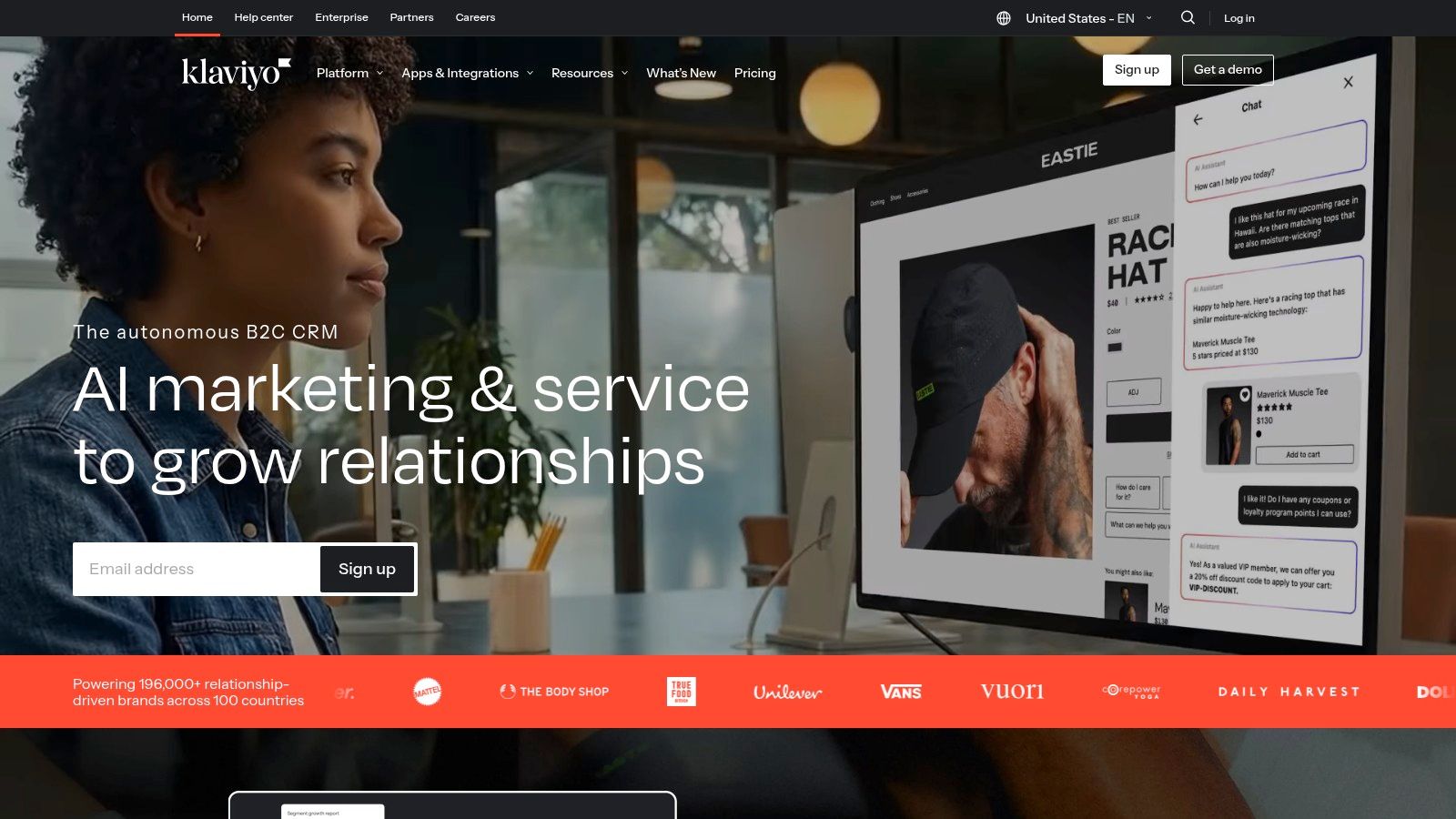
Klaviyo is still the benchmark Shopify ESP. There's a reason it keeps showing up at the top of merchant consideration sets. In the Shopify App Store's email marketing category, Klaviyo is listed with a 4.6 rating from 2,742 reviews, which makes it one of the most operationally validated options in the category according to the Shopify email marketing category listings.
That matters because most bigger teams are not buying an ESP for campaign templates. They're buying event depth, segmentation logic, and reporting they can trust when they need to explain retention revenue to leadership.
Why operators still default to Klaviyo
Klaviyo makes sense when the brand is actively using Shopify behavior data, not just storing it. Teams that care about purchase history, browsing behavior, and predictive metrics usually end up here because the product is built around those signals.
The practical advantage isn't “more features.” It's tighter control over who gets what message, and when.
Segmentation depth: Klaviyo is repeatedly described in third-party comparisons as the most data-rich option for growing stores, especially for behavior-based lifecycle work.
Native Shopify fit: Customer, catalog, and event data are central to the setup, not an afterthought.
Revenue visibility: It's easier to justify expensive flows when the platform makes attribution clearer.
Practical rule: Klaviyo earns its keep when the team can actually use advanced segmentation. If the program is still mostly batch sends plus a few default automations, the premium gets harder to defend.
Where the premium is justified
The best use case is a brand with enough traffic, order volume, and team maturity to exploit the data model. If a small improvement in targeting meaningfully changes revenue, paying more for the shopify email app can still be rational.
It's less attractive when the business has one marketer, limited experimentation bandwidth, and a simple catalog. In that case, Klaviyo often becomes a very expensive way to run flows that another platform can already handle well enough.
2. Omnisend when it isn't
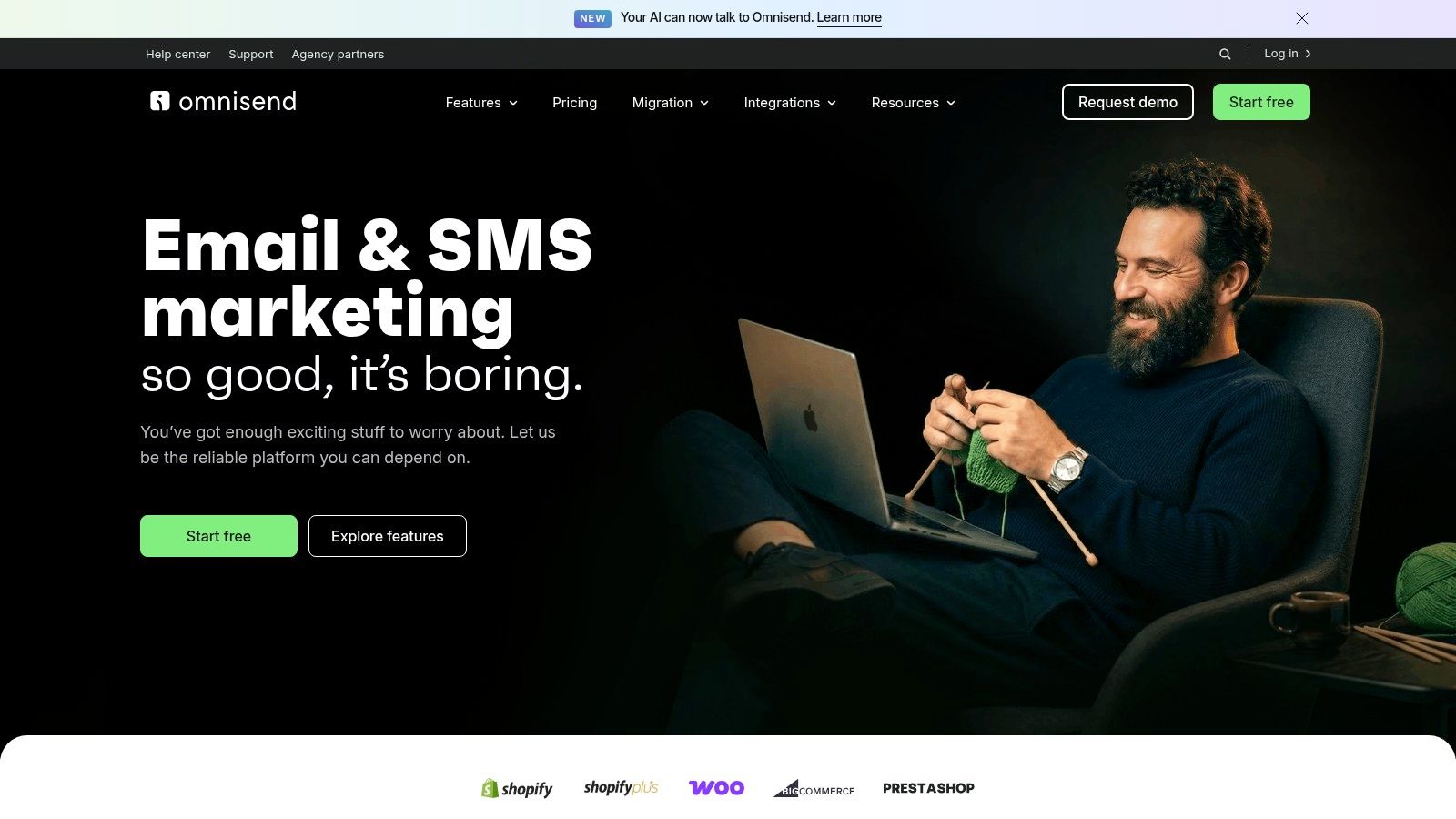
For a lot of brands, Omnisend is the answer to a simple question. How much of Klaviyo's capability does the team need to keep retention moving?
In current 2026 comparisons, Omnisend is often positioned as the ecommerce-first choice. EmailTooltester ranks Omnisend first for ecommerce and highlights automated workflows for browse abandonment, cart abandonment, order confirmations, and conversion mechanics like gift boxes and scratch cards in its 2026 Shopify ESP review.
Why Omnisend keeps winning comparisons
Omnisend is often the strongest klaviyo alternative for operators who want an ecommerce-native stack without enterprise-level complexity. It's built around the workflows most Shopify brands already know they need.
That usually means faster implementation and less internal overhead.
Pre-built ecommerce flows: Good coverage of the standard retention motions that matter.
Cross-channel setup: Email, SMS, and push live in one place.
Merchant validation: Omnisend appears in major rankings and also has one of the highest review counts in the Shopify category.
A separate 2026 comparison also names Omnisend “Built for Ecommerce,” which is useful shorthand for what buyers are really seeing in the market. They don't want a generic ESP. They want a shopify ESP that already understands carts, products, and post-purchase behavior.
Where Omnisend gives up ground
Omnisend is usually the better buy when the brand wants strong automation without endless customization. The trade-off is that teams doing highly granular segmentation or more complex reporting may still feel the ceiling.
Omnisend is strongest when the retention program needs to be effective, not endlessly configurable.
That distinction matters. Plenty of teams don't need the absolute maximum number of branching options. They need flows live, popups connected, and lifecycle revenue tracked without a specialist babysitting the system.
3. Sendlane strongest for SMS + email + retention bundle
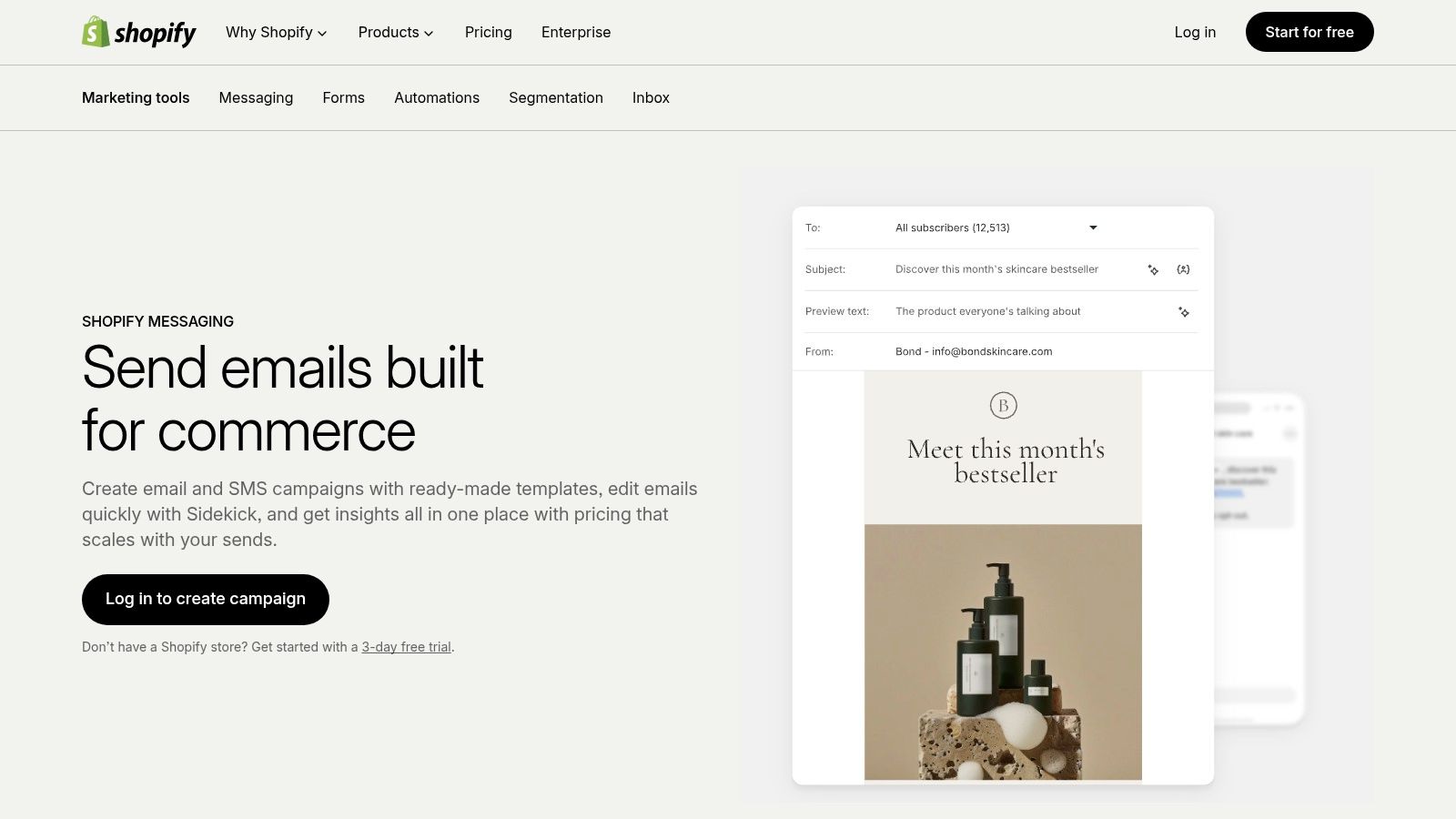
Sendlane is less about winning a pure email comparison and more about reducing stack sprawl. For brands that already believe retention should be run across email and SMS together, that bundled approach is attractive.
This category shift is real. Bloomreach's 2026 Shopify email review describes modern platforms as being able to orchestrate email across 13+ channels and notes standard implementations can be completed in 90 days in its enterprise Shopify email platform review. That doesn't mean every Shopify brand needs enterprise orchestration. It does show where the category has moved.
Best fit for bundled retention
Sendlane fits teams that want customer communication organized around the lifecycle, not split across separate vendors. If SMS is already a meaningful revenue and service channel, a bundled platform can simplify execution.
That's especially relevant for brands comparing all-in-one retention stacks against separate tools. Operators evaluating blended SMS and email setups often also compare dedicated options such as Recart merchant feedback and product research conversations and adjacent tooling in broader guides like best SMS marketing apps for Shopify.
Bundled workflows: Better fit when SMS isn't treated as a side channel.
Fewer integration seams: Less syncing friction between vendors.
Retention-first posture: More appealing when the team wants one control center.
Where the bundle can become a tax
The weakness of bundled platforms is predictable. If a team only uses part of the bundle, it's paying for convenience more than depth. Some operators prefer to keep email best-in-class and bolt SMS on separately.
That's the core trade-off. Consolidation helps when the team is lean and channel coordination matters. It hurts when one part of the bundle becomes dead weight.
4. Mailchimp when it still makes sense and when it doesn't
Mailchimp still has a place. It's just narrower than it used to be.
For operators running a Shopify-first business, the core question is whether a generalist platform is still good enough. Sometimes it is. Sometimes it clearly isn't.
The case for staying on Mailchimp
Mailchimp still works for teams that already know the product, have non-Shopify properties in the mix, or don't need deep ecommerce automation. Familiarity counts. A stable tool with a trained team can outperform a more powerful tool that nobody really owns.
It can also make sense when the business values broader marketing features more than Shopify-native depth.
A related ecosystem has grown around patching gaps, including add-ons and workflows like SMS text messages for Mailchimp. That tells the story pretty clearly. Mailchimp can be extended, but it often needs help to feel native in ecommerce.
Why Shopify-first teams usually outgrow it
The problem isn't that Mailchimp is bad. The problem is that Shopify specialists now exist, and they're usually better aligned with how ecommerce teams work.
A lot of modern lifecycle marketing depends on fast product data sync, event-triggered automations, and clearer revenue attribution. That's where Mailchimp tends to lose ground against tools built specifically for stores.
A legacy platform is fine until the retention program starts depending on product views, cart behavior, and post-purchase branching. Then “good enough” gets expensive.
For large Shopify operators, Mailchimp often stays in place because moving is painful, not because it's the strongest option.
5. Cost at scale 50K 100K and 250K subscribers
Most comparisons of the best Shopify email marketing apps fall short right here. They name entry plans, mention a free tier, and stop before the actual bill shows up.
The more useful frame is total cost of ownership. Venture Harbour's review points out the gap directly. Merchants often care less about headline pricing than about what happens once contact-based pricing, automation limits, SMS add-ons, and deliverability issues start changing the true cost of the tool in its Shopify email pricing analysis.
What actually changes at higher list sizes
At 50K, 100K, and 250K subscribers, the decision usually stops being theoretical. Two brands can have the same list size and very different economics depending on list hygiene, send frequency, SMS usage, and how many platform features they utilize.
That's why public “starting at” pricing rarely helps serious buyers. It tells almost nothing about the cost crossover point that matters in actual business.
Clean lists pay less: Deadweight contacts raise bills without helping revenue.
Complexity has a labor cost: A premium platform may also require more specialist time.
Bundles distort comparisons: SMS and retention extras can make a cheaper tool more expensive.
For operators trying to control software creep, this is the same conversation behind broader efforts to reduce Shopify app costs across the stack.
How serious teams model ESP cost
The cleanest way to evaluate a shopify ESP is to model three scenarios. Current list size, expected growth, and a worst-case version where inactive contacts are not cleaned fast enough. Then compare that against actual feature usage.
That method is more honest than comparing brochure pricing. It forces the team to ask whether it's paying for advanced reporting and segmentation because they're valuable, or just because Klaviyo became the default years ago.
6. Deliverability and list health
Most deliverability problems get blamed on the platform too early. The software matters, but the sending behavior matters more.
A crowded Shopify email market has pushed merchants toward tools that promise better infrastructure and stronger automation. That's useful. It doesn't remove the need for list discipline, authentication setup, and sane segmentation.
The platform matters less than the sending discipline
The strongest platforms invest in deliverability, but none of them can save a sender that keeps blasting disengaged contacts. Bad list hygiene raises cost and weakens results at the same time.
This is also why review volume can be misleading if it's used alone. High-adoption tools set the baseline for feature parity and implementation maturity, but operators still have to execute well to get inbox placement.
Field note: If campaign performance drops after a platform switch, the first check shouldn't be the template. It should be engagement quality, authentication, and the warm-up sequence.
What to clean before blaming the ESP
When a brand migrates or scales, the safest move is usually to send to engaged segments first and widen from there. That keeps sender reputation steadier and gives the team cleaner signals.
Useful hygiene work includes:
Authentication first: Check domain setup before larger sends. A practical reference is this guide on how to prevent emails from going to spam.
Inactive segments: Stop paying to carry subscribers who no longer engage.
Flow review: Old automations often keep firing into low-quality segments long after they should've been retired.
Deliverability isn't just an ESP feature. It's an operating discipline.
7. Migration playbook
A brand decides Klaviyo has become too expensive at 100,000 subscribers, signs with a cheaper alternative, exports the list on Friday, and expects normal revenue by Monday. That is how migrations go sideways.
Failure points are usually tedious and costly. They include missing events, broken signup forms, duplicate suppression lists, automations rebuilt in the wrong order, and DNS configuration left until the very end. Switching platforms is the easy part. Preserving revenue during that transition is the actual task.
This matters more now because changing ESPs often means changing how the retention team works day to day. Klaviyo still sets the default for many Shopify brands, but once pricing crosses the line at 50K, 100K, or 250K subscribers, teams start accepting trade-offs they would have rejected earlier. The migration decision is rarely about features alone. It is usually about which capabilities you can afford to keep, and which ones you can live without.
What breaks during rushed migrations
Contact import and template rebuild are the visible tasks. The actual risk sits underneath: event mapping, historical data quality, popup replacement, exclusion logic, coupon logic, sender domain setup, and warm-up sequencing.
I have seen brands move to a lower-cost tool and save meaningfully on software, then give half of it back because browse abandonment stopped firing for two weeks. That is the trade-off to keep in view. A cheaper ESP is only cheaper if your revenue-critical flows survive the move.
DNS setup is another place teams lose time because it depends on records, access, and coordination across providers. If the team needs a technical reference before cutover, the Robotomail DNS for email guide is a useful starting point.
What a controlled migration looks like
Good migrations follow revenue priority.
Start with the flows that recover or protect sales: welcome, cart abandonment, checkout abandonment if the app supports it, post-purchase, and winback or sunset logic. Then move forms, campaigns, and lower-value segments. Design refinements can wait. Revenue logic cannot.
A practical sequence looks like this:
Map Shopify events before importing anything: Confirm browse, add-to-cart, checkout, purchase, refund, and customer tag behavior.
Move suppressions and consent status early: Unsubscribes, hard bounces, and SMS consent mistakes create problems fast.
Rebuild top-earning flows first: Use recent revenue contribution, not gut feel, to decide order.
QA forms and onsite triggers: Test popups, embedded forms, coupon delivery, and list routing on mobile and desktop.
Warm the new sender with engaged segments: Start with recent openers, clickers, and purchasers, then widen carefully.
Run both systems briefly if needed: For larger stores, a short overlap period can reduce risk if ownership and send rules are clear.
One rule helps: do not migrate everything at once just because the contract start date says you can.
The best migrations are slightly boring. Clear owner, clear checklist, clear rollback plan. That is how a brand moves off Klaviyo to cut software spend, or moves onto Klaviyo to gain better segmentation, without turning the transition into a revenue dip.
Top 7 Shopify Email Marketing Apps Comparison
Product / Topic | Core strength | Trade-offs / limits | Ideal brands / use cases | How AppStoreResearch helps (soft CTA) |
|---|---|---|---|---|
Klaviyo, When It's Worth the Premium | Best-in-class Shopify sync, advanced segmentation & revenue attribution | Premium price; steep learning curve; needs dedicated owner | Data-driven DTC & high‑AOV brands that squeeze marginal gains | Join AppStoreResearch to take paid calls with app founders, request features, and explore cost-saving deals (3,000 operators, $1M+ paid) |
Omnisend, When It Isn't | Fast setup, ecommerce-focused automations, strong value at mid/low tiers | Less granular analytics than Klaviyo; some advanced features behind tiers | Lean teams seeking quick ROI and lower TCO | Connect with merchants and devs via paid sessions to validate fit and surface dev feedback |
Sendlane, Strongest for SMS + Email + Retention Bundle | True multi-channel workflows (SMS first-class), retention tools bundled | Can be pricier if SMS underused; busier UI; some features less deep individually | Brands with SMS-centric journeys and retention-led growth | Influence roadmap and negotiate bundles by joining merchant panels and dev calls on AppStoreResearch |
Mailchimp, When It Still Makes Sense (and When It Doesn't) | Familiar UI, broad marketing tools, good for mixed-platform/multi‑brand setups | Weaker Shopify event depth; pricing can be poor at scale; fewer ecommerce automations | Legacy users, multi‑brand orgs, or non‑Shopify properties | Test alternatives, earn incentives for feedback, and get migration advice from vetted operators |
Cost at Scale: 50K / 100K / 250K subscribers | Quick pricing benchmark for planning growth milestones | Estimates only (Q1 2026; email‑only); SMS bundles change totals | Brands budgeting for scaling & vendor selection | Validate pricing with real merchants and app teams through paid calls, see real-world cost trade-offs |
Deliverability and List Health | Practical guidance on hygiene, domain/IP warming, and sender reputation | Requires ongoing maintenance; migration must be warmed & staged | Brands sending at scale or migrating ESPs | Book expert sessions to review deliverability, list-cleaning tactics, and migration warming plans |
Migration Playbook | Step-by-step checklist (audit, export, rebuild flows, warm domain, run parallel) | Multi-week project; needs data mapping and resource ownership | Stores planning ESP switches or consolidation | Run discovery calls and pilot sessions with merchants and devs via AppStoreResearch to de-risk migration and capture feature requests |
Influence your tools, don't just use them
Choosing an ESP is only part of the job. Serious operators don't just buy software and adapt around it. They push vendors on roadmap gaps, ask hard pricing questions, compare switching risk, and try to get in front of products before the market gets saturated with copycat offers.
That's one reason app selection has gotten harder. The Shopify app ecosystem is crowded, top categories carry heavy review volume, and vendors compete aggressively for attention. For merchants, agencies, and Shopify Plus operators, direct access matters more than another listicle. A conversation with the founder or product lead of a tool under evaluation can surface more useful truth than weeks of sales collateral.
That's the case for app store research. It's a network where Shopify operators get paid to have direct conversations with the app founders and product teams building the tools they rely on. The value isn't just the incentive. It's access, influence, and early visibility into what vendors are shipping next.
The network includes over 3,000 operators. It has paid out over $1M in incentives to merchants for their expertise. The incentive range is $150 to $250 per hour. Those numbers matter, but they're secondary to what advanced operators want: greater bargaining power with vendors, more influence over product direction, and clearer visibility into alternatives before the inbox fills up with generic outreach.
For teams wrestling with rising ESP costs, crowded app categories, or unclear trade-offs between tools like Klaviyo, Omnisend, Sendlane, and Mailchimp, those conversations can materially improve the next stack decision. They also create a better kind of relationship with vendors. Not just buyer and seller. Operator and builder.
app store research is where Shopify operators, agencies, and Plus teams get paid to speak directly with the founders and product teams behind the apps they use every day. That access creates influence over roadmaps, early visibility into emerging tools, and better bargaining power when evaluating a crowded stack. If that kind of access is useful, join the network.

Author
Jonathan Kennedy
Jonathan Kennedy is the founder of app store research and shopexperts, platforms that connect operators, founders, and experts across the Shopify ecosystem to drive better decisions, product development, and growth.