Best Shopify Customer Service Apps (2026 Operator's Guide)
/
Choosing among the best Shopify customer service apps in 2026 isn't really about inbox features anymore. It's a stack decision that affects staffing, response quality, margin, and how much operational drag support creates across the business. The category has split into clear camps: Shopify-native helpdesks, AI-first tools built around deflection, broader enterprise support suites, and lower-cost platforms that cover the basics well enough.
That split matters because the wrong tool usually fails in one of two ways. Either it's too shallow and forces agents back into Shopify tabs all day, or it's too expensive and overbuilt for the ticket volume the team has. The right choice depends less on feature lists and more on whether the platform saves time inside real workflows.
This guide is written for operators replacing a support stack or setting one up with scale in mind. It focuses on practical trade-offs, not vendor messaging. For a broader look at automation tooling around support, it's also useful to compare features of top customer service bots.
The 2026 CS app landscape
Monday after a big promo is where the category split shows up fast. One team is clearing simple WISMO and order-edit tickets inside a basic inbox. Another is trying to cut ticket volume outright with AI. A third has already accepted that support is tied to finance, retention, and operations, so they need tighter controls than a chat tool can offer.
That matters because the baseline is higher now. Shopify Inbox made “free and already connected to the store” the default expectation for smaller merchants. Paid support apps do not win on inbox features alone anymore. They need to save agent time, reduce avoidable tickets, or give your team better control over order-related work.
The practical question is no longer, “Which app has the nicest interface?” It is, “What happens to handle time, resolution rate, and staffing when volume spikes?”
What changed in this market
A few years ago, support software was mostly judged on channel coverage, macros, and SLA reporting. That still matters, but it does not decide the shortlist for serious operators.
Now the split is operational. Established helpdesks still win when you need mature workflows, broad channel support, and admin controls. AI-first platforms win attention when a lean team needs to keep headcount flat while order volume grows. Those are different bets. One improves queue management. The other tries to prevent the queue from growing in the first place.
That is also why vendor evaluation got harder. AI demos can look impressive while doing very little to change outcomes. If a tool cannot resolve common requests, suggest accurate actions from store context, or safely hand off edge cases, you are buying assistive copy, not real automation.
The comparison serious Shopify teams are actually making
For most operators, the category breaks into four practical options:
Native baseline: Shopify Inbox covers live chat and basic support without adding software spend.
Shopify-centric helpdesk: Gorgias is usually the reference point when support agents need store context and order actions close at hand.
AI-first platform: Supermoon and similar tools are aimed at teams that care more about tickets avoided than tickets organized.
Broader service platform: Zendesk makes more sense once support extends well beyond a single Shopify store, or needs governance that ecommerce-first tools still handle less well.
There is also a business stage issue here. Teams considering a larger systems shift often hit the same threshold that triggers a platform review elsewhere. If you are already asking when it makes sense to upgrade to Shopify Plus, you are usually close to the point where support tooling needs a more deliberate decision too.
One operator note that gets missed in a lot of roundups. Newer vendors will often move faster on roadmap requests, shared Slack channels, and custom workflow tweaks. Established vendors usually give you more predictability, but less influence unless your contract is large enough to matter. If support is a cost center for you, buy stability. If support is tightly tied to conversion, retention, or post-purchase ops, it is worth pushing vendors on pilot terms, usage caps, and feature commitments before you sign.
Gorgias strongest for native Shopify integration depth
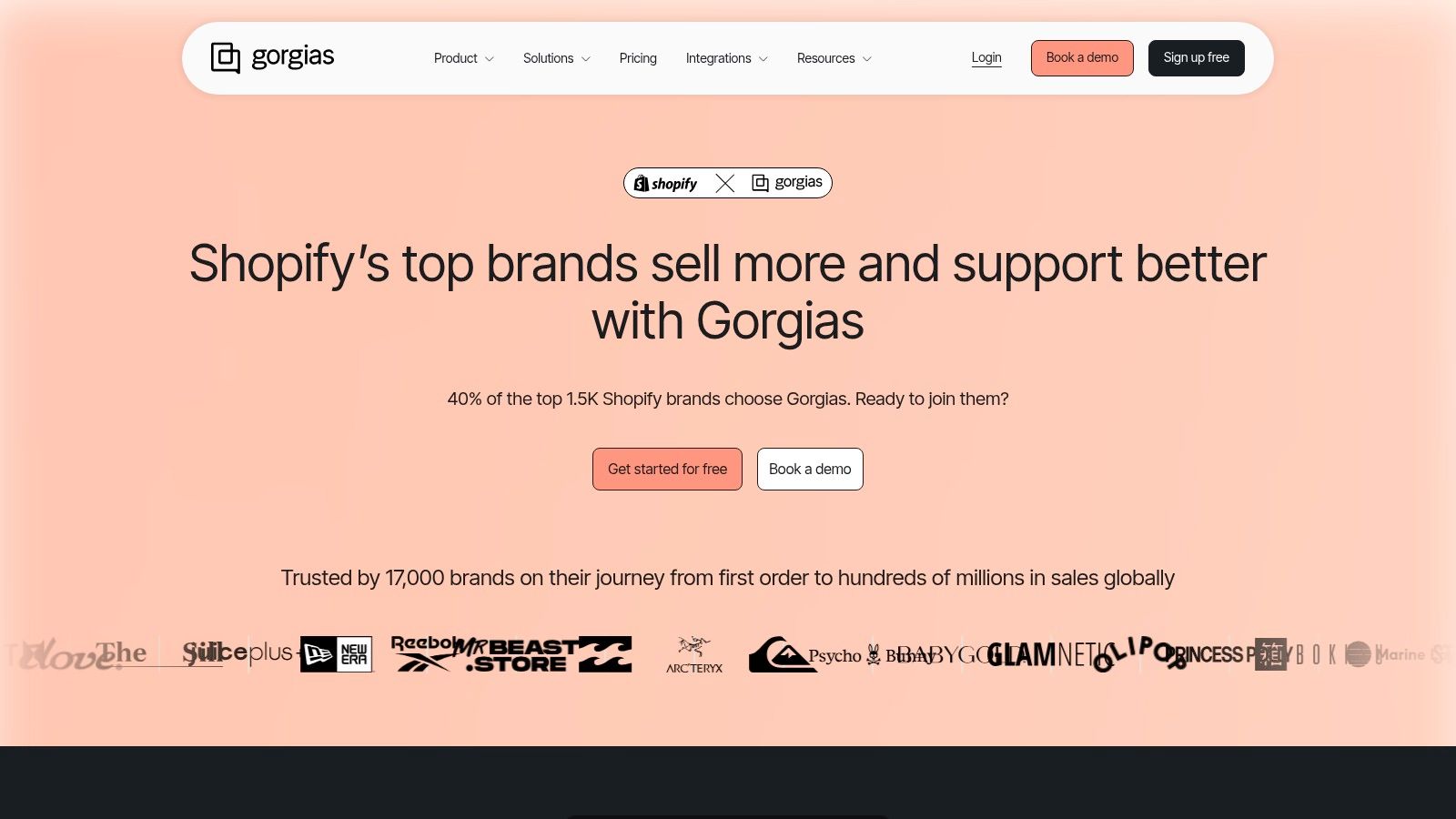
Gorgias remains the default short-list app for a lot of serious Shopify operators because it was built around ecommerce support, not retrofitted into it. The practical advantage is simple. Agents can work tickets with store context already present, instead of stitching together customer history from multiple tools.
For teams handling order edits, cancellations, refunds, pre-purchase product questions, and channel sprawl in one place, that depth usually matters more than polished AI copy. Gorgias is available through its Shopify app page.
Where Gorgias earns its place
The best part of Gorgias is workflow compression. Agents can see order and customer context in the support view and handle common commerce tasks without bouncing back and forth between the helpdesk and Shopify admin. That lowers friction in a way many broader platforms still don't.
It also fits how growing DTC brands operate. Email, chat, social, and other support channels tend to blur together during promos, launches, and shipping issues. Gorgias handles that kind of ecommerce mess better than generic enterprise tools.
A useful lens here is operational fit, not feature count. For teams evaluating tools more rigorously, this guide on how to evaluate Shopify apps is closer to the right buying approach than a simple feature checklist.
Gorgias usually wins when support and storefront operations are tightly linked. It's less compelling when the support org is broader than Shopify itself.
Where teams get surprised
The trade-off is pricing complexity. One 2026 comparison notes Gorgias uses tiered ticket plans, and another warns merchants to budget for AI agent per-resolution pricing when automation is turned on. That's where the product can shift from obvious productivity win to cost-control problem.
A separate 2026 roundup also cites Gorgias AI agent pricing at $0.90 per resolution, which is exactly the kind of usage-based logic operators need to model before rollout. The app can absolutely save time, but savings and spend don't always scale in the same direction.
That doesn't make Gorgias a bad fit. It just means the buying conversation should include total cost of ownership under real ticket volume, not just a vendor walkthrough of automations and macros.
Supermoon strongest AI-first option for lean teams
Supermoon fits a different operating model. This isn't the classic “shared inbox plus some automations” pitch. It's an AI-first support approach aimed at reducing the amount of work that ever reaches a human.
That's attractive for lean teams with repetitive support patterns. If the brand gets the same shipping, order status, return-policy, and product questions all day, an AI-first tool can be more relevant than a heavier incumbent helpdesk. Operators can review Supermoon here.
Why AI-first can work
The strongest case for this model is optimized personnel utilization. A traditional helpdesk often improves throughput per agent. An AI-first tool tries to remove some of the work before staffing becomes the answer.
That category shift is showing up across the market. Recent comparison content highlights that Tidio's Lyro AI can automate up to 67% of support tasks, which is a useful benchmark for what operators now expect from “AI” in Shopify customer support software. Even if one platform's exact performance won't carry over to another, the evaluation standard has changed.
Where the risk sits
The risk is maturity. AI-first tools can be strong when ticket types are predictable and the team is willing to tune workflows, but they can feel thin if the brand needs broad integrations, complex permissions, or unusually nuanced support handling.
They also require a different buying mindset. The question isn't “does it have AI?” It's “which tickets disappear, which still need humans, and what setup work is required before that happens?”
The most useful AI support tools don't replace judgment. They remove repetitive work so human agents spend time where nuance actually matters.
Supermoon is also relevant for another reason. CS leads at scaling brands are already part of the operator network that gets on product research calls with the teams building these tools. That gives serious operators a direct path to influence roadmap decisions rather than just filing support requests after purchase.
Zendesk strongest if youre multi-channel beyond Shopify
Zendesk is still the grown-up option when support operations are bigger than a single storefront. If the team is handling multiple brands, non-Shopify channels, marketplace complexity, or heavier admin requirements, Zendesk often makes more sense than forcing a Shopify-first tool to become something it isn't.
Its Shopify partner page is the right starting point if the business needs broad omnichannel support with formal admin structure.
When Zendesk is the right call
Zendesk works best when governance matters as much as agent speed. Large teams often care about routing logic, permissions, workflow control, reporting layers, and consistency across channels that don't all run through Shopify.
That's especially true once the business starts to look more like an operating group than a single store. Teams planning around broader operational complexity often hit the same inflection point discussed in this piece on when to upgrade to Shopify Plus. Support architecture usually changes around the same time.
Where it loses to Shopify-native tools
Zendesk's main weakness in a pure Shopify context is that it isn't Shopify-native in the same way Gorgias is. The integration gives agents useful context, but it typically doesn't feel as embedded in day-to-day commerce workflows.
For brands that live mostly inside one Shopify environment, that gap matters. Agents notice every extra click. Managers notice every time process complexity starts to outweigh software sophistication.
This is why Zendesk often wins on organizational breadth, not on ecommerce intimacy. If support is one department in a larger service operation, it fits. If support is tightly interwoven with retention, fulfillment exceptions, and conversion-oriented chat, a Shopify-centric system often feels faster.
Re:amaze strongest for SMB pricing
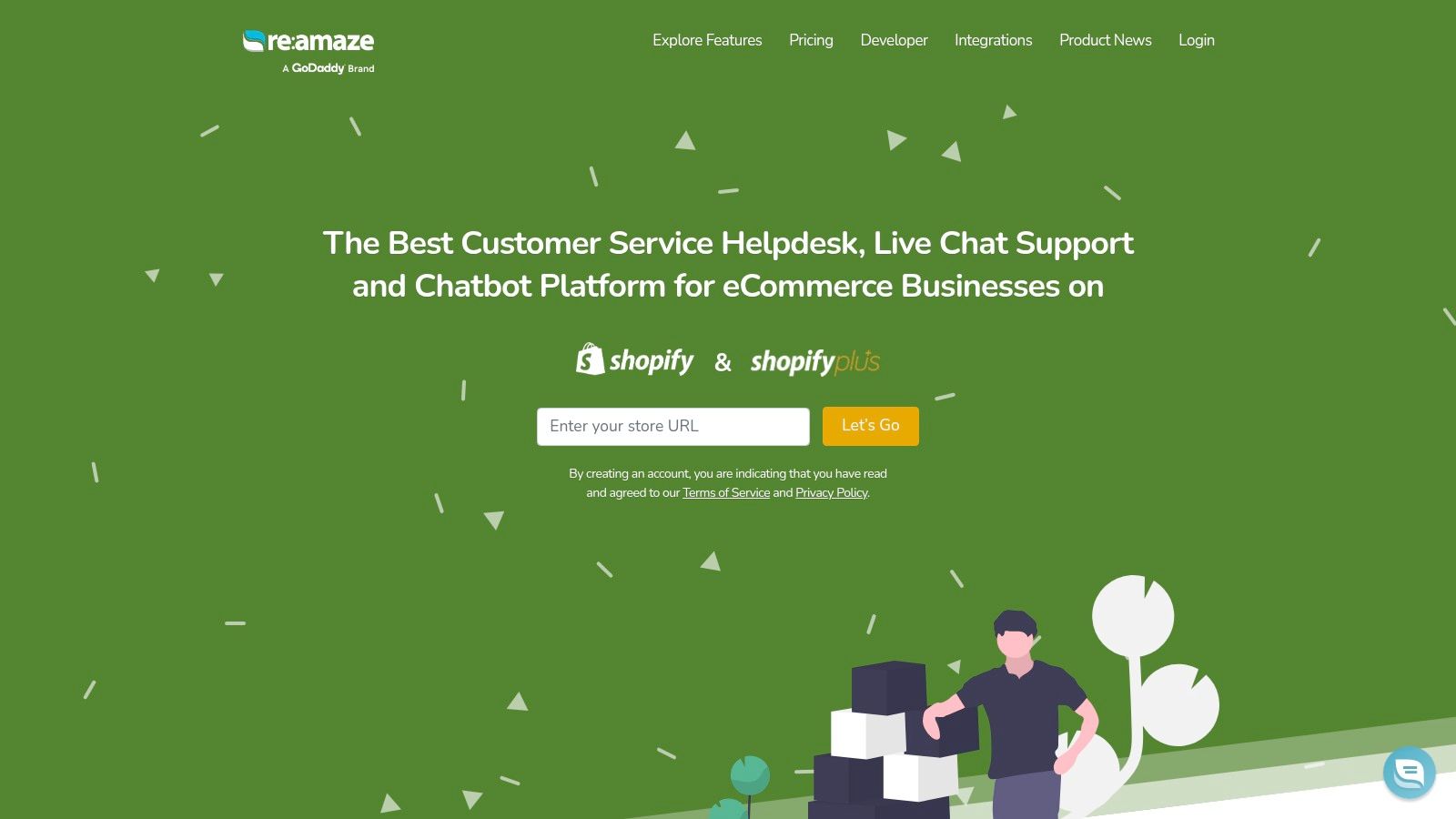
Re:amaze stays in the conversation because it usually solves the practical middle-ground problem. A growing store needs more than Shopify Inbox, doesn't want enterprise bloat, and isn't ready for aggressive usage-based economics. Re:amaze often lands well in that gap.
Its Shopify app page shows the broad shape of the product. Shared inbox, chat, chatbot features, FAQ tooling, and multi-store support in one platform.
Why Reamaze stays relevant
For smaller teams, forecastable spend matters almost as much as functionality. Re:amaze tends to appeal because it feels like software a support lead can budget for and roll out without a bigger systems project behind it.
It also works well for stores that want one tool to handle common channels and basic self-service content without paying for deep enterprise admin layers. That makes it a practical Shopify helpdesk choice for SMB teams that need coverage, not complexity.
A lot of operators miss this during procurement. They compare feature breadth, then ignore stack creep. This is exactly why reducing software overhead matters, and this article on how to reduce Shopify app costs is the right reminder before signing another support contract.
Its ceiling is real
Re:amaze is not the strongest option for teams that need deep Shopify actions, advanced governance, or a strong AI-first operating model. That doesn't make it weak. It just means the product has a clearer ceiling.
For many stores, that ceiling is fine. The problem starts when a team expects Re:amaze to behave like Gorgias inside Shopify or like Zendesk across a broader enterprise support environment. It usually won't.
Re:amaze is often the right answer when the team wants competence, simplicity, and predictable spend. It's usually the wrong answer when support has become operational infrastructure.
Top 4 Shopify Customer Service Apps, Strengths & Fit
App (Core strength) | Key features (brief) | User experience / quality | Value & pricing | Why join AppStoreResearch (soft CTA) |
|---|---|---|---|---|
Gorgias, Native Shopify depth | Shopify sidebar, native actions (refund/cancel/edit), AI intent, multichannel chat | Fast agent workflows; strong automation; reduces context switching | Ecommerce-focused power; usage-based pricing (can grow with volume); add‑ons extra | Join paid calls with app devs to request features, get deals/consulting, and test integrations. 3,000 operators on platform · $1M+ in incentives · Apply to participate |
Supermoon, AI-first for lean teams | AI agent for automated resolutions, unified inbox, Shopify context, automation metrics | High automation rate; ideal for predictable high-volume queries; evolving roadmap | Low cost-per-resolution potential; newer product, fewer integrations | Influence AI roadmap directly, get paid sessions with founders, discover upcoming apps and exclusive offers, join 3,000 operators |
Zendesk, Enterprise multi-channel | Official Shopify sync, omnichannel routing, enterprise analytics, admin controls | Scalable and reliable for complex orgs; advanced governance and SLAs | Seat-based enterprise pricing; modular add-ons can raise cost | Provide enterprise feedback, access high-level consulting or vendor deals via calls; paid participation available |
Re:amaze, SMB value and simplicity | Unified inbox (email/chat/social/SMS), Shopify context, chatbots, knowledge base | Simple to adopt; good performance for growing stores; fewer enterprise analytics | Transparent, competitive plans; best value for SMBs | Discover new apps without noise, earn incentives for calls, influence product features, join the network to participate |
AI features real automation vs marketing copy
Every vendor now says they have AI. That claim is almost meaningless until the team sees what the tool does with messy customer language, partial order context, and edge cases that don't match a clean demo.
The useful distinction is between workflow automation and actual AI behavior. Rules, macros, and triggers are still valuable, but they aren't the same thing as a system that can detect intent, summarize context, route correctly, or resolve repetitive inquiries with enough accuracy to remove human work.
What to test in a demo
Ask the vendor to show ambiguous requests, not ideal ones. A real support queue isn't full of perfect customer phrasing. It's full of rushed messages, missing order details, emotion, and mixed intent.
Three questions usually expose the truth fast:
How does it handle ambiguity: Ask for a demo with a vague order issue or a blended refund-and-shipping question.
What requires manual tuning: If the AI only works after extensive rule writing, it's still mostly a workflow tool.
Can it complete actions or only draft replies: Drafting can help, but actionability is where labor savings become more real.
One 2026 roundup frames this well by arguing that merchants increasingly need to measure support deflection, not just faster replies, and that the more relevant question is which app reduces human workload rather than merely organizing tickets better. That's the right standard for evaluating the best Shopify customer service apps in this cycle.
Pricing comparison by ticket volume
Pricing in this category has become a structural decision, not a line-item detail. Free tools, seat-based plans, ticket-based pricing, and per-resolution AI charges all push teams toward very different cost curves as support volume grows.
The basic baseline is still useful. Shopify Inbox is free, while more advanced tools add cost in exchange for deeper workflows, automation, or broader channel handling. One 2026 cost-focused comparison also highlights eesel AI starting at $10 per month for 50 tickets with no per-resolution fees, which is a good example of how flat-rate models are being used to challenge incumbent helpdesk economics.
What changes as volume rises
At low ticket volume, simplicity usually wins. A smaller team is often better off with predictable pricing and a tool that doesn't require much setup.
In the middle range, the conversation changes. The right question becomes whether the software saves enough agent time to avoid another hire, or whether automation meaningfully reduces repetitive work before it reaches the queue.
At high volume, finance starts caring. Usage-based models can become expensive if automation pricing stacks on top of core helpdesk costs, while seat-heavy enterprise tools can look more predictable if the org needs broad governance anyway.
Pricing should be modeled against ticket mix, not just ticket count. Repetitive support behaves very differently from complex support.
How to choose by team size
The best Shopify customer service apps depend less on who has the longest feature page and more on what kind of team is running the queue. Support software should match operating shape.
A practical selection framework
For a solo operator or very small team, the smartest move is usually restraint. Shopify Inbox sets a credible free baseline, especially since Shopify positions it as a native support layer with real-time chat, cart visibility, discount sharing, automated messages, and sales influence tracking inside admin, as noted earlier. If more structure is needed, Re:amaze often makes more sense than jumping straight to a heavy platform.
For growing teams, Gorgias becomes more compelling because the Shopify context starts saving enough time to matter across multiple agents. This is the range where workflow compression can beat a cheaper but shallower tool.
For lean but high-volume teams with repetitive queries, AI-first tools deserve a harder look. The right setup can reduce how much work reaches a human. The wrong one creates a second system to supervise.
For larger or more distributed support organizations, Zendesk enters the frame because team governance, channel breadth, and admin control start mattering as much as ecommerce depth.
Get direct access to the builders
Buying software is only part of the job. Serious operators also shape the products they rely on. That matters even more now because AI roadmaps are moving fast, and product teams need direct feedback from the people managing queues every day.
App store research is one of the few places where that relationship is structured properly. It's a platform that connects Shopify merchants with paid product research interviews with app developers and UX teams. For CS leads, that means direct conversations with founders and product teams building the tools in this stack, including AI-first platforms that are still refining how automation should work in ecommerce operations.
The value isn't just the incentive. It's access, influence over roadmap decisions, early visibility into emerging tools, and occasionally an advantage in vendor relationships that most operators otherwise never get.
For a separate lens on customer-side measurement, it can also help to analyze brand engagement KPIs. Support decisions rarely stay confined to the support team.
The strongest operators don't just buy software and hope the roadmap goes their way. They get in the room with the people building it. If that's relevant, join the network at app store research. CS leads at scaling brands often use these paid conversations to influence AI workflows, push for better support operations, and get earlier visibility into what vendors are building next.

Author
Jonathan Kennedy
Jonathan Kennedy is the founder of app store research and shopexperts, platforms that connect operators, founders, and experts across the Shopify ecosystem to drive better decisions, product development, and growth.