Best Shopify B2B Apps: A Guide for Operators in 2026
/
Your B2B channel is growing. What started with a few manual invoices is now a real operating layer, maybe close to a third of the business. The spreadsheets, one-off discount codes, and customer-tag workarounds don't hold up once buyers expect account-based pricing, payment terms, reorder speed, and cleaner internal controls.
This changes the core question. The issue isn't merely which of the best Shopify B2B apps has the longest feature list. The issue is whether Shopify's native B2B features are now enough for how the business sells, or whether the team needs a dedicated app stack around quoting, wholesale pricing, catalog control, and buyer workflow.
That distinction matters more because the Shopify App Store has grown to 17,165+ apps, which turns app selection into a marketplace-scale filtering problem. In B2B, that noise is worse because buyers rarely need one app. They need a stack that works with accounting, inventory, approvals, and the storefront.
Operators working through that decision should also think about visibility and positioning, not just merchandising. The same discipline used in understanding Shopify AI visibility now applies to app selection too. Clear workflows win.
Table of Contents
Native Shopify B2B in 2026 what it now does well (and doesn't)
Where native B2B is strong
Where native B2B still leaves gaps
SparkLayer, strongest for net terms + price lists
Where SparkLayer fits
Where it gets heavier
Wholesale Gorilla, strongest for SMB wholesale add-on
Best use case
Trade-offs to watch
B2B Wave, strongest for catalog complexity
Why complex catalogs change the decision
What to confirm before rollout
Tiered pricing & customer-specific catalogs
What works
What usually breaks
Net terms & PO workflows
What serious operators need
Where native plus apps becomes necessary
When B2B changes your tech stack
The threshold that matters
What the stack usually adds next
Top 10 Shopify B2B Apps, Features & Pricing
Get Paid for Your Expertise Shape the Future of B2B Apps
Native Shopify B2B in 2026 what it now does well (and doesn't)
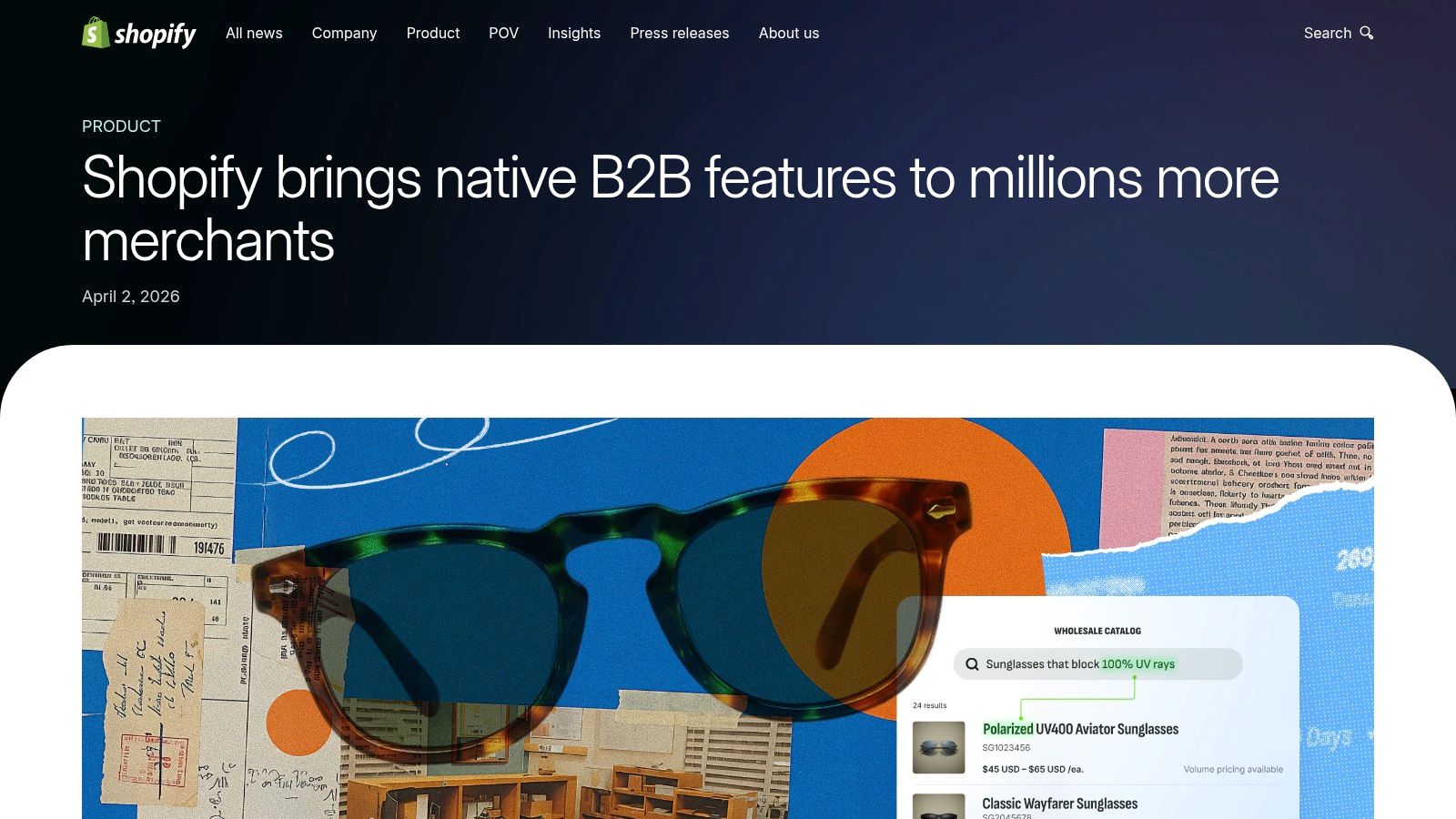
Shopify's native B2B stack is much better than the old workaround era. For brands selling DTC and B2B from the same admin, the appeal is obvious. Company accounts, catalogs, pricing, buyer identity, and core order data stay in one operating system instead of being split across an app-built layer and a storefront hack.
A serious operator should start here first, not because native is always enough, but because extra apps create operational drag. The cleaner the base model, the easier it is to judge where the actual gaps are. Teams comparing options usually benefit from a tighter evaluation process like this guide to how to evaluate Shopify apps.
Where native B2B is strong
Native Shopify B2B works best when the business wants a single source of truth and the workflow isn't heavily negotiated. If the team needs company profiles, controlled pricing, and payment-term support inside Shopify's own logic, native usually gives the lowest-friction setup.
Shopify's ecosystem also already includes 11 apps compatible with B2B across workflows like quote requests, buyer roles, loyalty, shopping lists, and ERP connections. That's the practical clue. B2B on Shopify already behaves like a composable system, not a single product.
Practical rule: Use native first when the business mostly needs account structure, pricing control, and operational simplicity.
Where native B2B still leaves gaps
The biggest weakness isn't raw capability. It's coverage across the full sales cycle. Once the team needs richer quoting, more flexible sales-agent workflows, specialized quick ordering, or more layered account experiences, native usually needs help from apps.
In this context, Shopify platform strategy and engineering also becomes relevant. The more the stack relies on custom storefront behavior, the more teams should think about maintainability before adding one more B2B layer.
SparkLayer, strongest for net terms + price lists
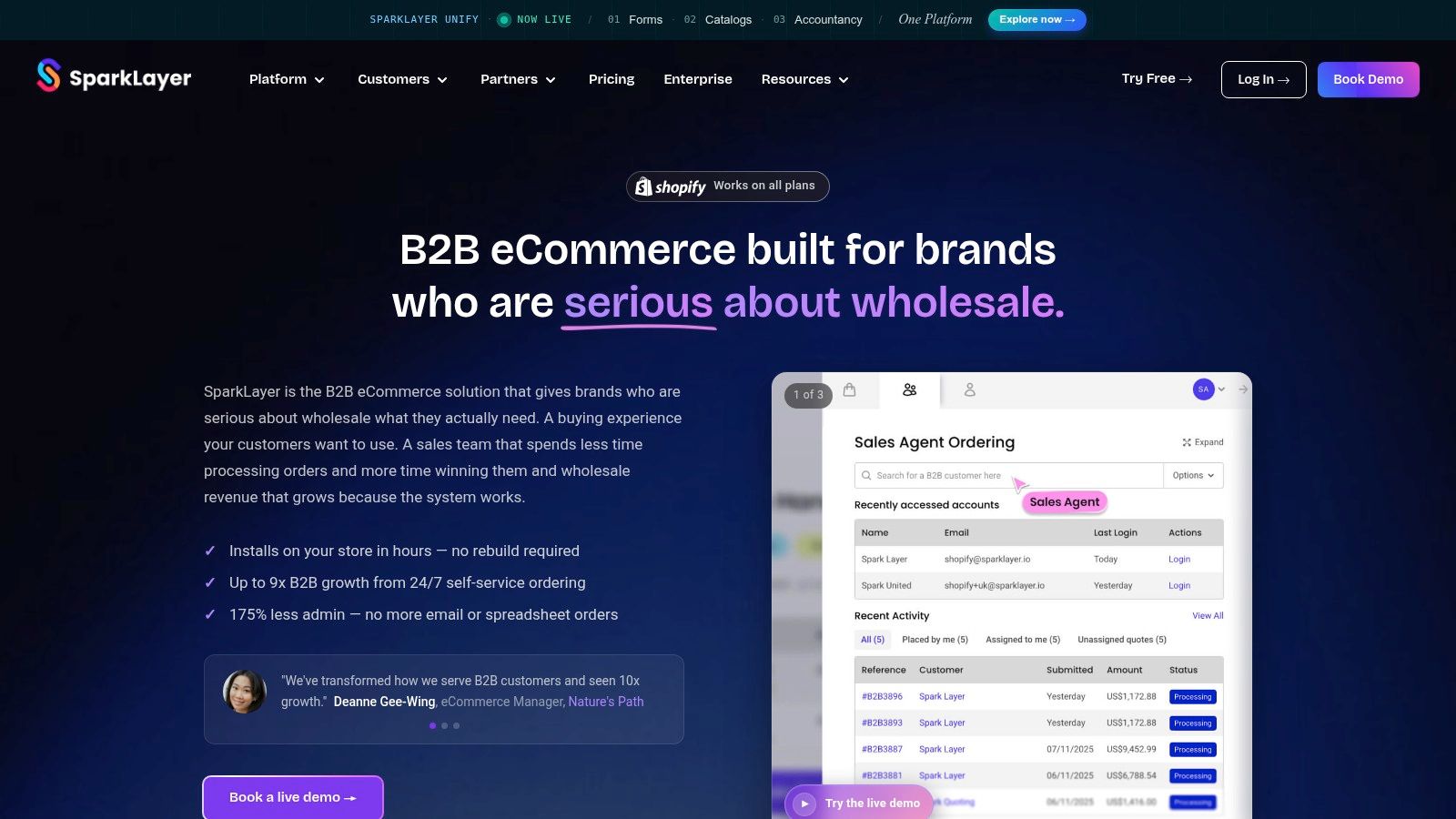
SparkLayer is often the cleanest answer when native Shopify B2B gets close, but not far enough. It tends to fit merchants that already know their buyers need more than segmented pricing. They also need quoting, sales rep support, account nuance, and stronger wholesale UX on the storefront itself.
Where SparkLayer fits
SparkLayer is strongest when B2B isn't experimental anymore. If the team is managing customer-specific price lists, net terms, quoting, and repeat procurement behavior, SparkLayer usually solves problems that native still handles more narrowly.
It also aligns with how crowded the category has become. Independent coverage points to Shopify wholesale as a category with 181 apps, which means merchants aren't choosing between one or two clear options. They're filtering through overlapping feature sets and trying to design a workable stack.
For operators weighing platform tier decisions, this is usually the same moment they ask whether they should upgrade to Shopify Plus.
Where it gets heavier
SparkLayer isn't the right fit for every blended store. It adds moving parts. That means more setup, more testing, and more process discipline around theme behavior and internal ownership.
SparkLayer makes sense when B2B has enough complexity to justify a real buying environment, not just a pricing rule layered onto a retail store.
If a brand only needs gated pricing and occasional wholesale orders, SparkLayer can feel heavier than necessary.
Wholesale Gorilla, strongest for SMB wholesale add-on
Wholesale Gorilla fits the operator who wants wholesale capabilities without rebuilding the store around B2B. It is usually a practical choice for brands adding a wholesale channel to an existing DTC operation, especially when the buyer journey is still fairly straightforward.
Best use case
This is the kind of app that works when the main need is reliable daily wholesale mechanics. Group pricing, tiered discounts, minimum order rules, and quick ordering matter more than deep account hierarchy or a polished self-service portal.
That makes it well suited to lean teams. The merchant doesn't need to replace the whole stack. The merchant needs the wholesale channel to stop generating manual work.
Choose Wholesale Gorilla if the store needs pricing tiers, MOQs, and quick ordering without a large implementation project.
Skip it if the team needs deeper quoting, broad ERP coordination, or layered approval structures.
Keep expectations realistic if sales reps, procurement roles, or account-specific catalog logic are central to the business.
Trade-offs to watch
The trade-off is ceiling, not floor. Wholesale Gorilla usually covers the operational basics well, but once the business gets more account-specific, adjacent apps often start to appear around forms, quoting, or back-office sync.
That isn't a failure. It's a signal that the wholesale channel has moved beyond add-on status.
B2B Wave, strongest for catalog complexity
B2B Wave is a better fit when the hardest problem isn't checkout. It's structure. Some B2B ecommerce Shopify setups break because the product model is messy across price books, buyer groups, and account visibility rules. In those situations, catalog logic matters more than front-end polish.
Why complex catalogs change the decision
The best Shopify B2B apps aren't always the most feature-rich. They're the ones that reduce exceptions. When catalogs vary by buyer type, territory, or contract arrangement, a pricing-only app often starts to show cracks. Products appear where they shouldn't. Reordering is inconsistent. Sales has to explain availability manually.
That's why B2B Wave deserves attention from teams with layered assortments or wholesale programs that behave more like account-managed catalogs than simple discount ladders.
Complex catalogs punish lightweight tools. The workaround cost shows up later in support tickets, pricing disputes, and internal exception handling.
What to confirm before rollout
Before choosing B2B Wave, the operator should be clear on whether catalog complexity is the core problem or just a symptom of broader workflow issues. If the business also needs stronger quoting, finance controls, or Shopify-native company account behavior, another stack may fit better.
This is also where direct vendor access matters. In crowded categories, merchants often need more than feature screenshots. They need proof that a team understands their edge cases and will respond when those cases hit production.
Tiered pricing & customer-specific catalogs
Most Shopify wholesale projects start here. The merchant wants one store, one admin, and different commercial logic by customer. That can mean tiered pricing, contract pricing, hidden collections, variant-level visibility, or all of it at once.
The market is crowded enough that discovery itself has become a problem. Recent coverage describes a freshness and trust gap in Shopify's wholesale app market, where merchants face growing discovery overload and need better ways to judge emerging tools and vendor responsiveness.
What works
Customer-specific catalogs work best when the pricing model is stable and the team can explain it clearly. If account groups are clean, pricing logic is consistent, and product availability follows a repeatable rule, several app approaches can work.
The strongest setups usually solve one narrow operational layer well. That's consistent with Shopify's broader B2B guidance, where merchants often compose workflows from specialized tools rather than expecting one product to do everything.
Native Shopify B2B works when the catalog model is controlled and the business wants fewer moving parts.
SparkLayer works when pricing and catalog rules also need richer account UX and buying tools.
Wholesale Gorilla or similar pricing-first tools work when the problem is mainly wholesale pricing and order mechanics.
What usually breaks
What fails isn't usually the price list itself. It is the interaction between pricing, permissions, and storefront visibility. A team can get the right numbers in the admin and still create buyer confusion on collection pages, search results, or mixed DTC/B2B merchandising.
That is why "best app" articles often overlook the actual decision. The decision is usually about workflow fit, migration risk, and ownership inside the business, not headline features.
Net terms & PO workflows
At a certain point, many blended stores stop behaving like retail with discounts and start behaving like actual B2B. Once buyers expect invoice payment, approval loops, PO references, account-level credit expectations, or finance-led ordering, the stack has to serve procurement, not just browsing.
What serious operators need
Net terms and PO workflows require more than a checkout option. They need internal accountability. Someone has to know who can buy, who approved the order, what terms apply, and how that maps into accounting.
That is also why Shopify B2B app selection gets fragmented across functions. Merchants commonly need different tools for quote requests, buyer roles, loyalty, shopping lists, and ERP integration, which reinforces the point that B2B stacks are usually assembled, not bought whole.
The finance workflow decides whether B2B ops stay manageable. Front-end convenience alone won't save a sloppy terms process.
Where native plus apps becomes necessary
Native Shopify B2B can handle part of this. But once the team needs negotiated quotes, stronger sales-agent workflows, or more explicit PO behavior, apps start to earn their keep.
This is often the point where operators should evaluate total cost of ownership, not just app fees. A "cheaper" stack that creates manual invoice cleanup, credit confusion, or account mistakes is usually more expensive in practice.
When B2B changes your tech stack
The clearest threshold isn't store size. It's operational dependence. When B2B is still opportunistic, the merchant can tolerate workarounds. When it becomes a meaningful revenue line, those workarounds start driving stack decisions.
The threshold that matters
A useful practical threshold is when wholesale or broader B2B starts approaching a major share of revenue. At that point, the business usually needs to stop treating B2B as an extension of DTC. It becomes its own operating model with different buyers, approval patterns, payment expectations, and service requirements.
The strongest B2B apps on Shopify tend to align with how buyers purchase on the platform. Features like customer-specific pricing, quick ordering, sales-agent workflows, and company accounts matter because they map to real buying behavior, not because they look good on a comparison page.
What the stack usually adds next
When B2B becomes a material part of the business, the tech stack often changes in predictable ways:
Finance layer gets tighter. Net terms, tax control, and order accountability stop being optional.
Catalog control gets stricter. The team needs cleaner segmentation by account, region, or contract.
Operational tooling expands. Quick reorder, sales support, and ERP or accounting alignment become higher priority.
Vendor quality matters more. The merchant needs responsive app partners, not just a feature checklist.
Serious operators deserve a greater advantage than the App Store normally provides. In a crowded ecosystem, trusted access to vendors becomes part of product evaluation.
Top 10 Shopify B2B Apps, Features & Pricing
A merchant doing occasional wholesale can often get by with a lighter setup. Once B2B starts carrying real revenue weight, app choice affects pricing control, order accuracy, finance workflows, and how much manual work your team absorbs every week.
Use the table below as a selection framework, not a feature dump. Native Shopify usually makes sense when B2B is still operationally simple and the business wants one admin with fewer moving parts. Third-party apps start to earn their keep when you need rep workflows, stronger quoting, catalog segmentation, net terms controls, or faster ordering for repeat buyers.
Solution | Core features | Best for / Target merchants | Unique selling point (value) | UX & setup notes | AppStoreResearch benefit & soft CTA |
|---|---|---|---|---|---|
B2B on Shopify (native) | Company profiles, custom catalogs, pricing rules, vaulted cards, Flow/Markets integration | Merchants wanting minimal friction and single-admin DTC+B2B | Tight native Shopify integration and lower operational overhead | Clean admin experience. Some gaps still show up outside Shopify Plus and in edge-case B2B flows | Merchants can join paid product research sessions and share direct feedback with product teams. |
SparkLayer B2B & Wholesale | Unlimited price lists, quoting, sales-rep portal, ERP integrations, multi-lang | Scaling B2B with quoting, rep workflows, and multi-currency requirements | Strong quoting and rep tools where native Shopify still needs help | Requires theme and widget setup. Cost rises with volume and feature depth | Useful if you want direct input on integrations or roadmap gaps through paid research conversations. |
Wholesale Gorilla | Unlimited pricing rules, tiered discounts, MOQs, quick order UX, net terms | Merchants needing dependable day-to-day wholesale operations | Good balance of wholesale depth, support quality, and usability | Fast onboarding for most stores. Less flexible for unusual enterprise workflows | Operators can use paid feedback sessions to compare implementation approaches before committing. |
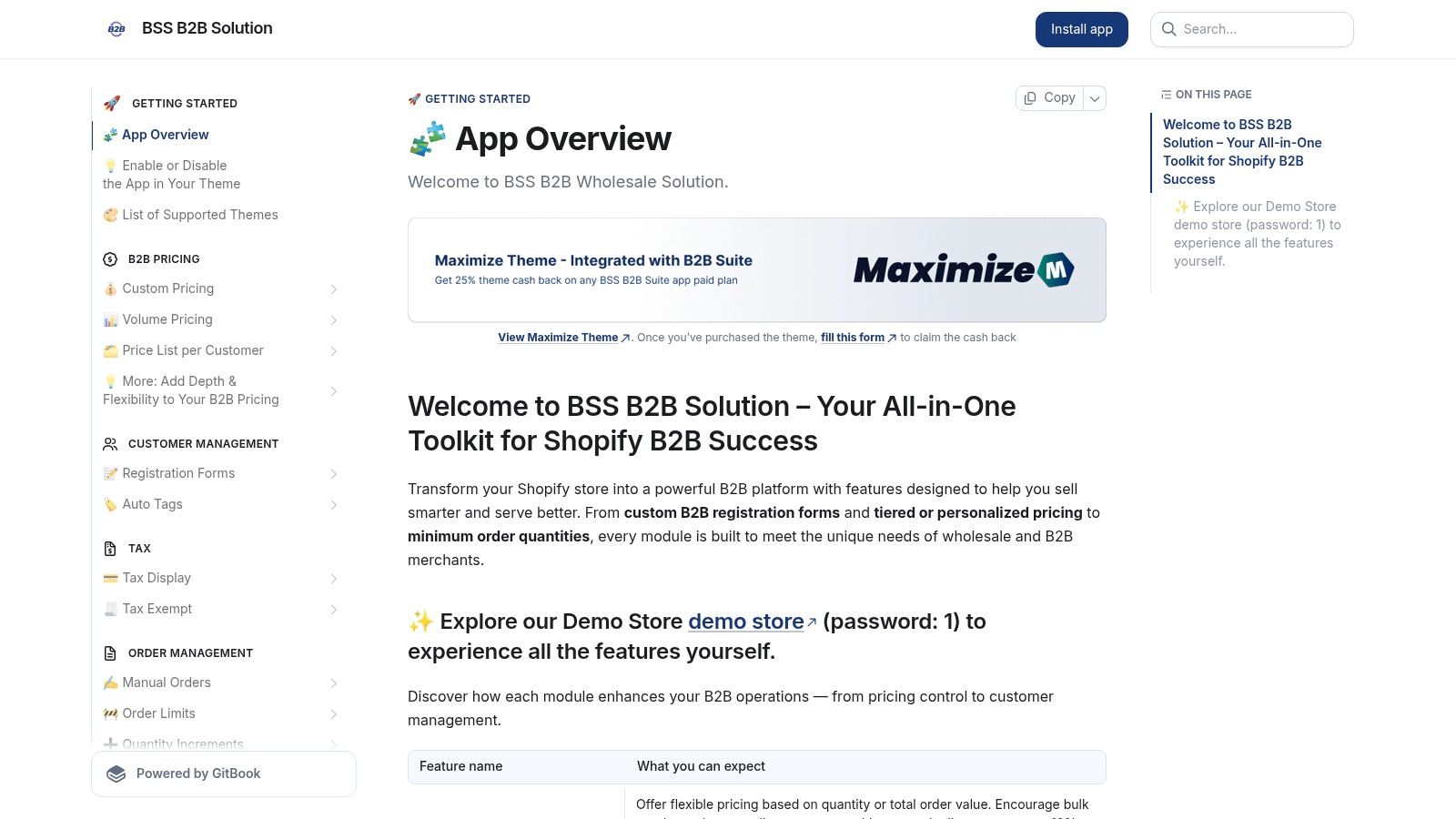
BSS B2B & Wholesale Solution | Per-customer price lists, MOQs/MOV, approvals, net terms, POS/API | Blended DTC+B2B stores needing broad module coverage | Wide module set for merchants that want many B2B controls in one app | More admin complexity than lighter tools. Some stores will need add-ons for specific workflows. Teams evaluating total app spend should also review how to reduce app costs | Paid research access can help merchants pressure-test scope before they overbuy features. |
B2B Wholesale Hub (Orbit) | Tag-based pricing, variant overrides, volume breaks, quick order | Piloting B2B on part of catalog, lightweight portal needs | Easy way to test wholesale on a live theme without a full rebuild | Usually quick to launch. Theme compatibility needs checking on more customized storefronts | Practical for merchants who want to validate buyer demand before investing in a larger stack. |
Wholesale Pricing Discount (Wholesale Helper) | Unlimited groups, tiered discounts, MOQs, net terms, CSV import/export | DTC stores adding wholesale pricing without separate portal | Broad pricing and rule coverage for blended stores | Checkout and discount logic need careful testing. Some stores also add a lock app | Paid feedback sessions can help merchants sort pricing logic before launch. |
Duos B2B Self-service (Qikify) | Modular company accounts, quotes, quick order, B2B finance, Flow triggers | Lean merchants wanting native-aligned, modular B2B features | Modular approach. Merchants can buy only the pieces they need | Promising fit for simpler builds. Review depth is lighter than longer-established apps | Best used by teams that want native-style structure without committing to a heavy implementation. |
Locksmith (Lightward) | Fine-grained locks by tags/passcodes, hide price, API/Liquid support | Stores gating B2B content or running private wholesale areas | Precise access control for mixed DTC and wholesale storefronts | Useful companion app, not a pricing engine. Poor setup can affect search visibility and storefront access | Helpful when the main problem is visibility control, not account pricing logic. |
WSH Order Form & ReOrder | Quick order grid, CSV import/export, min/max rules, SKU display | High-volume replenishment and bulk buyers needing fast carts | Speeds up large repeat orders better than standard storefront browsing | Works best as a companion app. Reporting is lighter on lower tiers | Good fit when buyer speed matters more than portal complexity. |
SA Request a Quote, Hide Price (Samita/Globo) | RFQ flow, hide price, convert quote→order, CRM integrations | Merchants managing negotiated pricing and quote workflows | Straightforward quote capture and price-gating for sales-led B2B | Check compatibility with product options and custom themes. It does not replace a full B2B pricing system | Best for merchants whose sales process starts with a quote instead of a logged-in catalog. |
Per-customer price lists, net terms, RFQ, sales-rep portal, company accounts, ERP/API sync | Hybrid DTC+B2B stores scaling wholesale on a standard Shopify plan | Unlimited price lists, orders, and customer groups at flat pricing, so cost doesn't climb as B2B scales | All-in-one app keeps the workflow in one place. Runs at the theme level, so headless/Hydrogen storefronts need integration work | Paid research sessions let operators pressure-test all-in-one B2B against stitched stacks before committing |
A simple rule helps. If B2B is a smaller channel and your requirements mostly center on account access, price lists, and basic company management, start with native Shopify or a lighter add-on. If B2B is pushing toward a substantial share of revenue and operations now involve negotiated pricing, approvals, reps, reorders, or finance rules, a specialized app stack usually pays for itself by cutting manual work and reducing order mistakes.
Get Paid for Your Expertise Shape the Future of B2B Apps
A common pattern shows up once B2B starts to matter. The team pieces together pricing rules, net terms, approvals, and account logic across Shopify, an app or two, and manual workarounds. Then order volume climbs, a few edge cases hit at once, and vendor quality matters as much as feature lists.
At that point, polished app listings are not enough. Operators need direct answers on implementation risk, support quality, roadmap priorities, and how a tool holds up in mixed DTC and wholesale environments. That is especially true once B2B moves past a side channel and starts influencing finance, operations, and customer service.
App store research gives merchants a way to speak directly with app developers and product teams through paid research interviews. For Shopify operators evaluating B2B software, that can be useful for a practical reason. It creates a better buying process than relying only on public reviews and sales calls.
The true value is not the payout, though paid sessions are part of the model. The value is access to the people building the software you may depend on for pricing, ordering, and account workflows. Serious merchants usually want to ask specific questions before committing. How does the product handle approval chains? What breaks under catalog complexity? How fast does support respond when wholesale ordering fails during business hours?
Those conversations matter more once B2B revenue crosses a meaningful threshold. Below that line, native Shopify B2B or a lighter app stack often covers the basics. Above it, the cost of choosing the wrong vendor rises fast because the failure points move from merchandising into finance and operations.
For operators who want more direct input into the tools they use, you can apply to participate in the network. There is also broader technical context on how product teams interpret buying and transaction signals in infrastructure like a transaction identification API. The practical takeaway is simple. Better operator feedback usually leads to better B2B software.

Author
Jonathan Kennedy
Jonathan Kennedy is the founder of app store research and shopexperts, platforms that connect operators, founders, and experts across the Shopify ecosystem to drive better decisions, product development, and growth.