Boost Your Shopify App Marketing Strategy in 2026
/


Author
Jonathan Kennedy
Founder at appstoreresearch
Jonathan Kennedy is the founder of app store research and shopexperts, platforms that connect operators, founders, and experts across the Shopify ecosystem to drive better decisions, product development, and growth.
A Shopify app goes live, the listing looks clean, the features are solid, and the team assumes installs will follow. Then almost nothing happens. A few merchants install, some uninstall fast, reviews come in slowly, and paid traffic feels expensive before the funnel is even understood.
That pattern usually isn't a product problem first. It's a positioning problem, a distribution problem, and a feedback problem. In the Shopify ecosystem, an app marketing strategy works when it starts with merchant language, merchant workflows, and merchant objections, then keeps feeding that signal back into the listing, onboarding, content, partnerships, and product roadmap.
Generic mobile growth advice misses that reality. Shopify merchants don't buy apps the way consumers download games. They compare apps in the Shopify App Store, ask agencies what they trust, look at setup friction, scan screenshots, read reviews, and decide whether the tool will improve conversion, retention, AOV, operations, or reporting without adding another headache.
Table of Contents
Why Most Shopify App Marketing Fails Before It Starts
The Foundation Research-Led Positioning
Start with an ideal merchant profile, not a broad persona
Turn interview notes into positioning that sharpens conversion
Your 24/7 Sales Rep Optimizing the App Store Listing
Treat search intent as the starting point
Make the listing do the selling
Building Gravity with Content and Partnerships
Content that answers merchant buying questions
Partnerships that compound trust
From Install to Advocate Onboarding and Retention Loops
Shorten the path to first value
Build retention loops from real merchant feedback
Measuring What Matters a Simple KPI Dashboard
Separate signal from vanity
A dashboard that supports decisions
Why Most Shopify App Marketing Fails Before It Starts
Most Shopify app marketing fails before launch day because the team builds the app, then treats marketing as packaging. That sequence is backwards. By the time the listing is live, the market has already judged the category, merchants already have alternatives, and the app is entering a store where buyers are overloaded with similar promises.
A weak app marketing strategy usually sounds like this: “built for Shopify merchants,” “boost sales,” “improve retention,” “save time.” None of that helps a merchant decide whether the app is right for a DTC operator running subscriptions, a Plus team managing international storefronts, or an agency standardizing a client stack.
The problem gets worse inside the Shopify ecosystem because buyers are practical. They don't want broad benefits. They want to know whether the app fits their stack, whether setup will be painful, whether support is responsive, and whether the value shows up quickly enough to justify another monthly software bill.
Practical rule: If the team can't describe the exact merchant, trigger moment, and promised outcome in one tight sentence, the market won't do that work for them.
There's also a timing mistake. Teams wait too long to talk to merchants. They collect feature requests after churn starts instead of using merchant conversations to shape positioning before the listing, landing pages, outreach, and partner motion go live.
That's why the strongest app marketing playbooks look less like campaigns and more like operating systems:
Merchant understanding first: identify the buyer, operator, or influencer involved in app selection.
Message before media: fix the positioning before buying traffic or publishing content.
Channel choice by evidence: use merchant calls to learn where trust already exists.
Feedback as a loop: carry objections from sales calls and onboarding into copy, product, and partnerships.
In crowded app categories, marketing isn't a broadcast. It's a continuous conversation with the merchants the team wants to win.
The Foundation Research-Led Positioning
Research-led positioning is still underexplained in most app marketing advice. The strongest guidance is to interview users and run competitive research to validate whether the app solves a real pain point and how buyers describe that pain, because that directly shapes messaging and channel decisions, as noted in Smashing Magazine's guide to mobile app marketing.
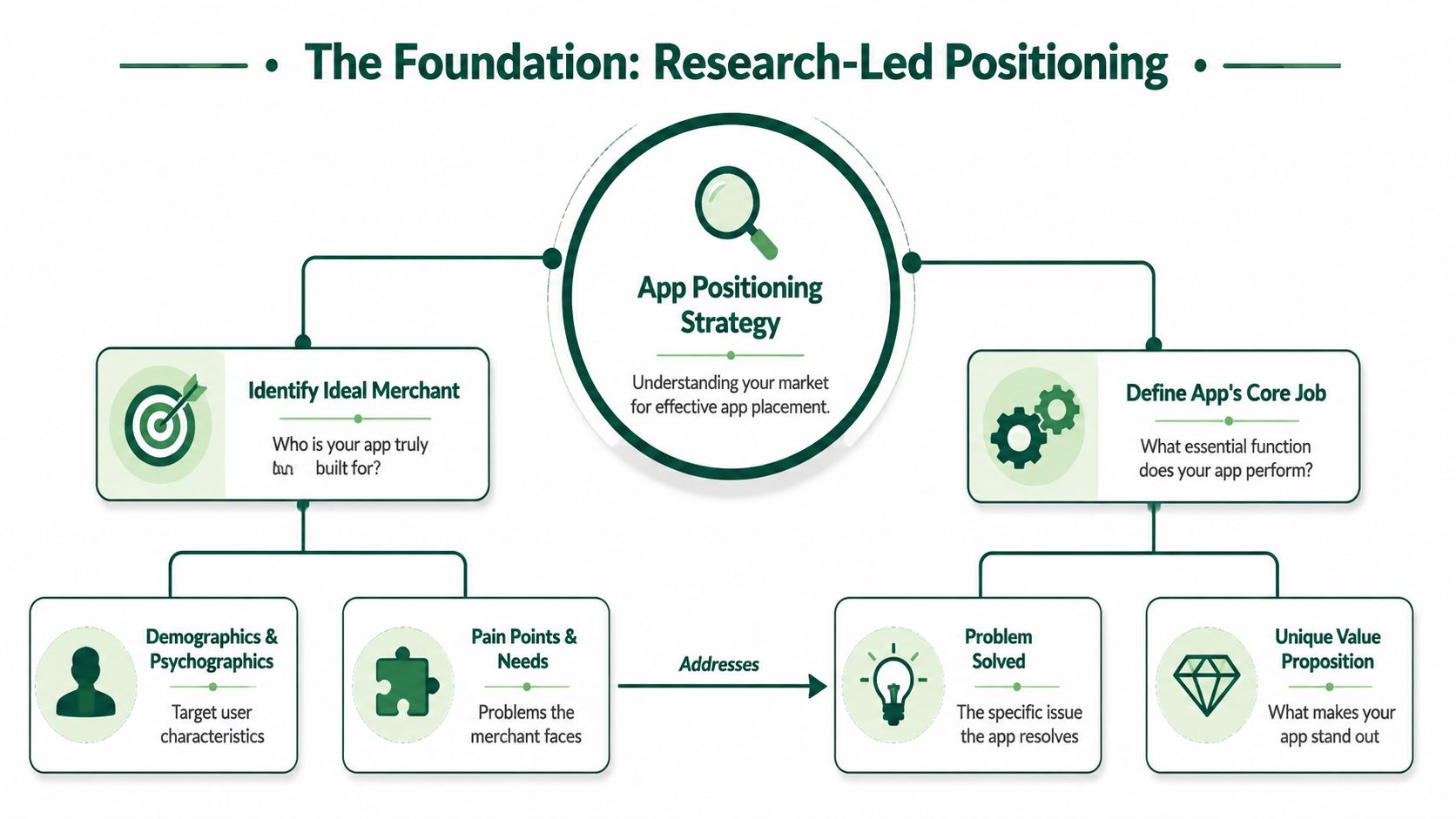
Start with an ideal merchant profile, not a broad persona
“Shopify merchants” is not a market segment. It's a software platform with different buying motions, budgets, internal workflows, and success criteria.
A sharper starting point is an ideal merchant profile built from factors that affect app adoption:
Factor | What to define |
|---|---|
Business type | DTC brand, marketplace seller, B2B seller, subscription brand, agency |
Revenue band | Early-stage, scaling, or established operator with process maturity |
Shopify complexity | Standard Shopify setup, Plus environment, multi-store setup, headless-adjacent stack |
Job role | Founder, ecommerce manager, retention lead, CRO lead, agency implementer |
Trigger event | Rising returns, weak upsell performance, theme migration, international expansion, retention issue |
Replacement context | First tool in category, switching from another app, replacing spreadsheet/manual workflow |
Merchants don't compare every app the same way. A founder-led brand may care most about speed to setup and support. A Plus operator may care more about workflow control, permissions, integrations, and rollout risk. Agencies may care about repeatability across clients.
A strong profile also tells the team what not to say. If the app is best for experienced operators, broad “easy for everyone” messaging can attract the wrong installs and create avoidable churn. If the app is built for lean brands, enterprise language can suppress conversion because it signals complexity.
Turn interview notes into positioning that sharpens conversion
Merchant calls are useful only when the team turns them into decisions. Raw transcripts alone won't improve the listing or the sales process.
A practical synthesis method looks like this:
Capture exact phrases merchants use when describing the problem, failed workaround, and desired outcome.
Map competitors by promise rather than by feature count. Merchants often choose based on clarity and trust before they compare depth.
Identify the buying trigger that creates urgency. Some apps are bought during migration, some after revenue leakage becomes visible, some when a team hires a specialist operator.
Write a positioning statement that names the audience, problem, mechanism, and differentiator in plain language.
Test that statement in the app listing subtitle, demo outreach, landing page hero, and partner pitch.
A useful positioning statement usually answers four questions fast:
Who is this for
What painful job does it handle
Why this approach is different
When a merchant should switch or install now
Merchant interviews are most valuable when they reduce message ambiguity. The goal isn't more feedback. The goal is fewer guesses.
Competitive research sharpens this further. If every app in the category promises “increase revenue,” the winning message often comes from naming the specific operational problem underneath that revenue goal. Merchants buy root-cause clarity.
For teams that need a practical framework, this guide on defining a Shopify app positioning strategy is a useful way to structure the work before rewriting the listing or launching campaigns.
Your 24/7 Sales Rep Optimizing the App Store Listing
For most Shopify apps, the listing is the most important sales asset. Discovery is still concentrated in app stores, with over 70% of app downloads starting with a store search, which is why ASO and conversion-focused listing work remain central to app marketing strategy, according to Dedicated Developers' app marketing analysis.
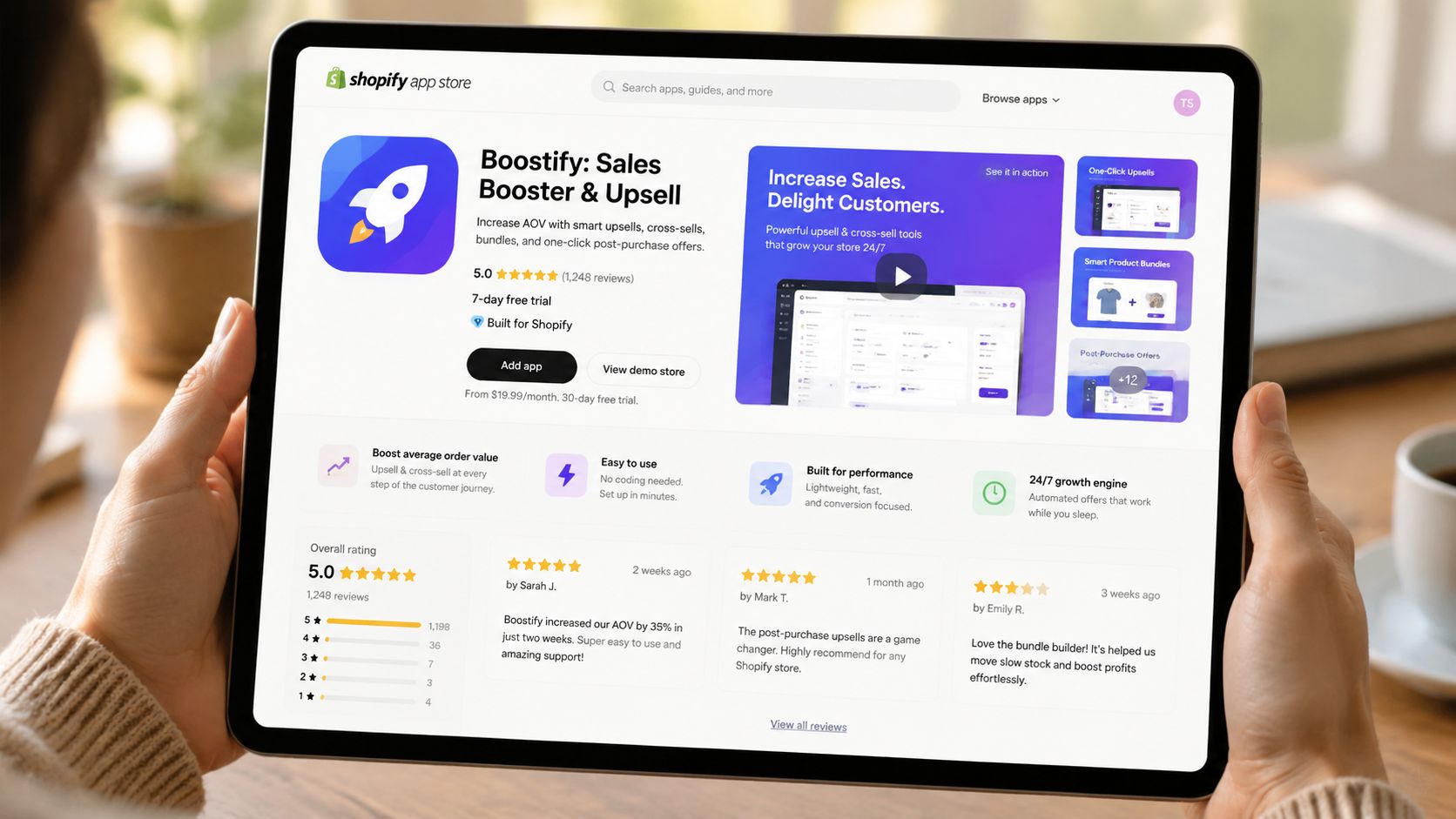
Treat search intent as the starting point
A Shopify App Store listing doesn't need clever copy first. It needs accurate intent matching. Teams should start with audience definition and competitor research, then move to keyword research and metadata optimization. AppsFlyer's guidance is useful here because it recommends validating keywords against relevance, difficulty or competition, and search volume before adding them to the store page.
That framework is especially useful in Shopify because category language can be messy. Merchants may search by outcome, like upsell or subscription retention, by tool category, like loyalty or reviews, or by workflow, like post-purchase survey or bundle builder.
A practical keyword workflow looks like this:
Start with merchant language: pull terms from demos, support tickets, sales calls, and review text.
Check competitor listings: note repeated patterns, but avoid cloning category clichés.
Prioritize buying terms: words tied to active implementation tend to convert better than broad educational phrases.
Match metadata to reality: never chase a keyword that the product can't satisfy cleanly after install.
Make the listing do the selling
Merchants don't read listings like blog posts. They scan for fit, proof, and friction. That means every part of the page needs a job.
The title and tagline should identify the category and core promise fast. Screenshots should show the app inside realistic Shopify workflows. The description should explain what the app solves, who it's best for, and what setup involves. If there's a free trial, onboarding support, or a clear implementation path, that should be visible.
A simple review framework helps keep the page honest:
Listing element | What good looks like | What usually hurts conversion |
|---|---|---|
Title and tagline | Clear category fit and specific value | Generic growth language |
Screenshots | Real interface, real workflow, clear captions | Decorative graphics with no context |
Description | Specific problems, setup expectations, fit criteria | Feature dumping |
Reviews | Recent, credible, operationally relevant | Sparse or outdated feedback |
Teams often underuse screenshots. A merchant should be able to understand the app's core use case without reading the full description. Captions matter. “Create post-purchase offers in minutes” is stronger than “Powerful campaign builder.”
The listing should answer the merchant's silent question: “Will this work for a store like mine without becoming another project?”
Reviews deserve operational attention too. The best time to ask is after a visible win, successful onboarding milestone, or support interaction that resolved friction. Asking too early produces shallow reviews. Asking after value creates useful proof.
For teams revisiting weak conversion pages, this breakdown of common mistakes in Shopify app listings is a practical audit checklist.
Building Gravity with Content and Partnerships
A lot of Shopify apps hit the same ceiling. Listing traffic plateaus, paid acquisition gets harder to justify, and the team keeps polishing messaging without learning why merchants buy, stall, or churn.
Gravity solves that. The goal is to create enough useful market presence that merchants hear about the app before they start a store search, arrive with better context, and already trust the category story.

Content that answers merchant buying questions
Content for Shopify apps works best when it comes straight from merchant conversations. Research calls give teams the raw material. You hear the exact words merchants use, the stack conflicts they worry about, the budget logic behind the purchase, and the alternatives they are comparing.
That feedback loop should drive the editorial plan.
Useful topics usually fall into four buckets:
Comparison content: when a merchant should choose one app category, setup, or workflow over another
Implementation content: how to launch, migrate, configure, or troubleshoot a use case inside Shopify
ROI content: what work the app replaces, how quickly it can pay back, and where the operational lift really sits
Stack content: which combinations work well across subscriptions, reviews, loyalty, CRO, analytics, and agency-led builds
The pieces that perform are often plainspoken and specific. Migration guides, setup checklists, templates, teardown posts, and honest "not a fit if..." articles usually do more for pipeline quality than broad thought leadership.
For retention-oriented apps, content also needs to connect acquisition to repeat purchase behavior. A practical example is this guide to Shopify customer retention strategies that increase repeat purchases, which maps the problem in merchant terms instead of app terms.
Partnerships that compound trust
In the Shopify ecosystem, the best partnerships come from shared implementation value. Agencies, consultants, tech partners, and adjacent apps already have merchant trust. The question is whether your app makes their delivery stronger or creates extra support load.
That trade-off matters. A partner will promote an app that helps them get a result faster, reduces edge-case risk, and gives them clear fit criteria. They will stop mentioning an app that creates cleanup work.
A practical partnership motion looks like this:
Start with one overlap use case. Retention plus subscriptions, reviews plus conversion optimization, or analytics plus merchandising are easier to sell than a vague strategic alliance.
Build one useful shared asset. A webinar, implementation guide, checklist, or teardown is enough to test whether both sides attract the same merchant profile.
Give partners sharp qualification language. They need to know who the app is for, what setup involves, and where the app is likely to struggle.
Feed product learning back into the relationship. If partners keep hearing the same objection or setup issue, that should shape onboarding, docs, and roadmap priorities.
Community participation follows the same rule. Useful operators earn attention by answering real setup questions, sharing lessons from failed experiments, and posting concrete examples. Dropping links into every thread does not build demand.
A partner channel works when the app helps the partner look competent and well-prepared in front of the merchant.
Research calls also become strategically useful here. A platform such as App Store Research can help teams run paid product interviews with merchants, agencies, and operators so they can hear which channels buyers trust, which partnership angles feel credible, and which objections show up before they invest in outreach.
From Install to Advocate Onboarding and Retention Loops
An install is only useful if the merchant reaches value fast enough to keep going. Many Shopify apps lose users because the setup path asks for too much too early, hides the payoff, or assumes the merchant already understands how the app should fit into their stack.
The fix isn't more onboarding screens. It's a shorter path to the first meaningful outcome.
Shorten the path to first value
Teams should define one activation milestone that proves the app is working. For one app, that may be publishing a widget. For another, syncing data correctly. For another, launching the first offer, rule, or workflow.
Onboarding should then remove anything that delays that moment.
A practical way to tighten activation:
Reduce early choices: don't present advanced settings before the merchant has seen the core value.
Use role-based onboarding: an agency implementer needs different guidance than a founder setting up the app alone.
Show a next best action: every step should point to the next action that gets the merchant closer to visible value.
Expose support at the right moment: help content and chat matter most at friction points, not buried in a footer.
A lot of apps try to educate and configure everything upfront. That feels thorough internally but creates abandonment externally. Merchants usually need confidence first, depth later.
Build retention loops from real merchant feedback
Post-install feedback is where marketing and product start working together. When a merchant succeeds, the team learns what to amplify in the listing and content. When a merchant stalls, the team learns what promise wasn't matched by the onboarding flow or product experience.
Good feedback loops are lightweight and consistent:
Moment | Useful question |
|---|---|
After install | What was the main problem the merchant expected the app to solve |
After setup milestone | What felt easy, and what almost blocked completion |
After early usage | What result made the app feel worth keeping |
Before churn or uninstall | What was missing, confusing, or not worth the effort |
This process also improves retention messaging. If merchants keep saying they installed for one reason but stay for another, the team has learned something important about product value. That can reshape onboarding emails, lifecycle messaging, support scripts, and app store copy.
For teams focused on reducing drop-off after install, this guide to Shopify customer retention is useful because it keeps the discussion tied to merchant behavior instead of vanity engagement.
Happy users become advocates when the team gives them a reason to share. That doesn't mean aggressive referral asks. It means delivering enough value, fast enough, that agencies recommend the app to clients and operators mention it in conversations without being prompted.
Measuring What Matters a Simple KPI Dashboard
The easiest way to waste time in app marketing is to track everything and learn nothing. Dashboard clutter obscures the core problem. A strong app marketing strategy uses a small set of metrics tied to business goals, then reviews them often enough to change decisions.
A better benchmark is lifecycle measurement. Adjust recommends choosing the metrics that matter most to the business goal, such as installs, retention, engagement, revenue, or lifetime value, while Salesforce adds that teams should track downloads, daily active users, and customer lifetime value as they keep iterating, as outlined in Adjust's mobile app marketing guide.
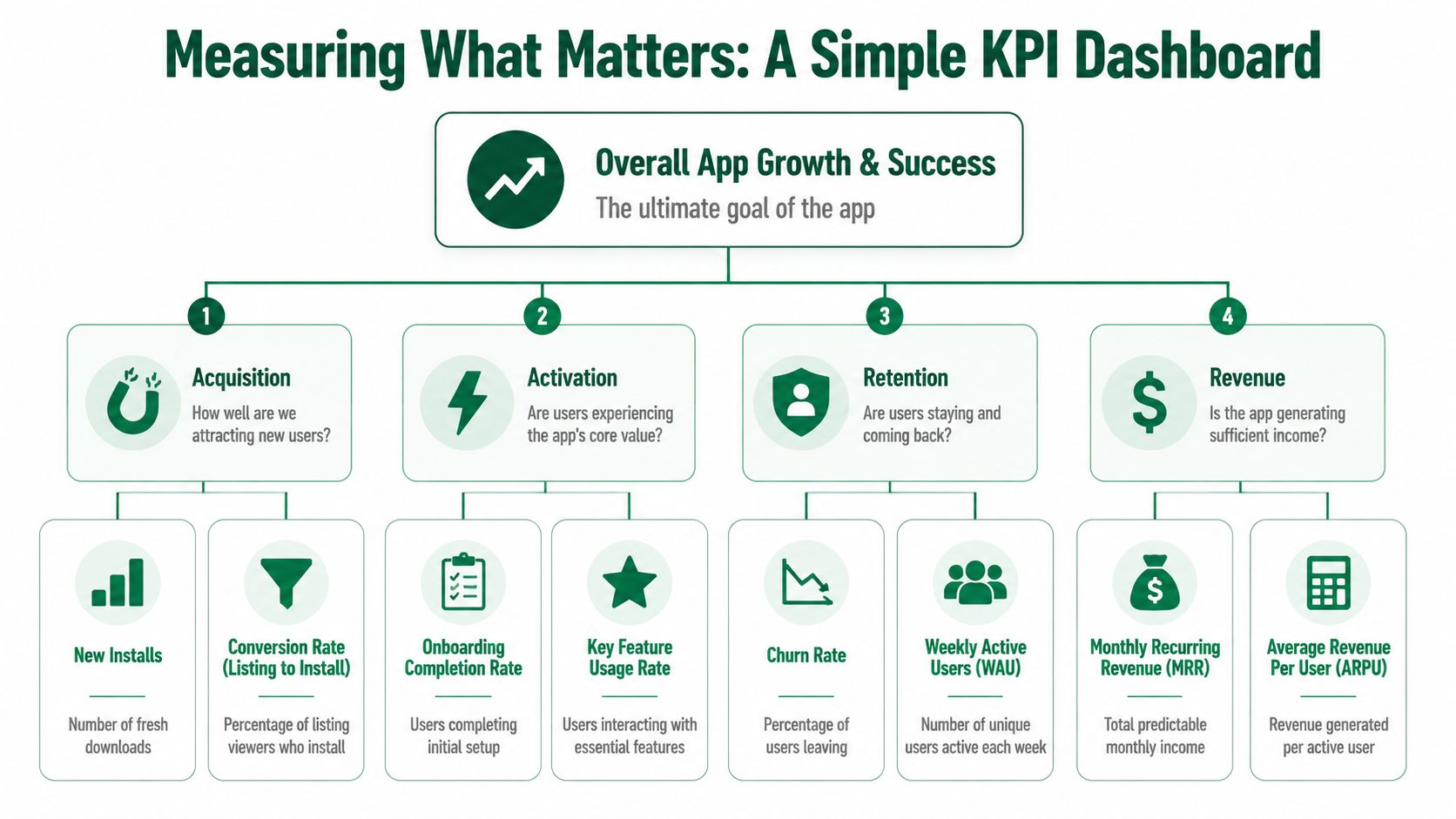
Separate signal from vanity
Total installs can be useful, but they rarely explain business health on their own. If installs rise while activation drops, the team may have improved top-of-funnel reach while attracting worse-fit merchants. If listing traffic grows but reviews get weaker, the message may be overselling the product.
A simple way to divide metrics:
Acquisition metrics: listing views, install rate, source mix.
Activation metrics: onboarding completion, first key action, time to first value.
Retention metrics: active usage, repeat engagement, churn signals.
Revenue metrics: trial-to-paid conversion, expansion, lifetime value.
This type of structure helps teams diagnose where the funnel is weak. It also stops the common mistake of trying to solve a retention problem with more acquisition.
A dashboard that supports decisions
The useful question isn't “what can be measured?” It's “what decision will this metric change?”
A lean KPI dashboard for a Shopify app team might look like this:
KPI area | Question it answers | Action it should trigger |
|---|---|---|
Listing to install | Is the market interested after seeing the page | Rewrite screenshots, subtitle, and social proof |
Install to activation | Are merchants reaching first value | Simplify onboarding and setup guidance |
Activation to paid | Is the app proving economic value | Tighten value communication and pricing logic |
Retention and LTV | Are the right merchants staying | Improve fit, support, and product depth |
Teams that need a plain-English refresher on how to think about measurement can use Refgrow's KPI measurement guide as a companion resource. It's useful because it keeps attention on how metrics are defined and interpreted, not just collected.
The main discipline is consistency. Weekly reviews tend to work better than occasional deep dives because they force the team to connect data with action while the signal is still fresh. That same operating rhythm also makes merchant research more valuable. Calls stop being isolated anecdotes and start becoming context for why a metric moved.
Merchants and agency operators understand this better than many vendors assume. Their feedback often surfaces why an app was shortlisted, why it was rejected, what nearly blocked implementation, and which feature or pricing change would make adoption easier. That makes research participation useful for both sides. App teams get sharper decisions, and operators get paid for real expertise they already use when evaluating tools.
Shopify merchants, agency operators, and app teams that want to share that expertise can join App Store Research, a platform that connects Shopify merchants with paid product research interviews with app developers and UX teams. It's a practical way to influence app roadmaps, discover new tools early, build stronger relationships with vendors, and get paid for feedback grounded in real store operations.

Reviewed by
Filip Djokic
Product Designer at appstoreresearch.com
Filip is a Product and UI/UX Designer with over 10 years of experience in digital product design. With a strong background in the Shopify ecosystem, he focuses on improving user experiences and turning merchant insights into better product decisions at appstoreresearch..