Subscription churn usually shows up the same way in the dashboard. Active subscribers drop. Recurring revenue softens. Support hears more complaints about billing, timing, or product fatigue. The mistake is treating all of that as one problem.
It isn't one problem.
For most Shopify operators, Shopify subscription churn only becomes manageable once it's split into the two buckets that matter. Some customers meant to leave. Some never intended to leave at all. Those require different workflows, different app features, and different teams to own the fix.
Shopify's own guidance puts average monthly churn for subscription ecommerce at 5% and notes that this compounds to roughly 46% annual churn if sustained, which is why serious teams track churn by cohorts and observation windows instead of relying on raw period-end counts alone (Shopify churn guidance). That matters even more in ecommerce because retention is structurally hard. Shopify also notes that average ecommerce retention is about 30%, while subscription ecommerce tends to land around 30% to 45% retention, with an average repeat customer rate of 28.2% in broader ecommerce contexts (Shopify enterprise retention guidance).
That backdrop is why small subscription-retention gains matter so much. A better skip flow, smarter dunning, or a cleaner cancellation path can change revenue quality fast.
Table of Contents
Voluntary vs Involuntary Churn and the Different Fixes
Start with churn composition, not total churn
Why this matters on Shopify
Involuntary Churn Fixes Dunning, Smart Retries, and Card Updaters
Dunning should work like a recovery system
What to look for in the app
Voluntary Churn Fixes Skip, Swap, and Strategic Gifts
Give the customer an off-ramp that matches the reason
What usually fails
App Differences in Churn Handling Recharge vs Skio vs Loop
Subscription app churn feature comparison
How to choose based on your churn problem
Realistic Subscription Churn Benchmarks by Category
Benchmarks matter less than benchmark fi
Category context changes what good looks like
What to compare instead of chasing one headline number
The Retention Metric Stack That Serious Operators Use
The dashboard that actually helps
Where operator research helps
Get Paid to Influence the Tools You Use
Voluntary vs Involuntary Churn and the Different Fixes
When a subscription operator says churn is high, the first useful question isn't “how high.” It's “what kind.”
Start with churn composition, not total churn
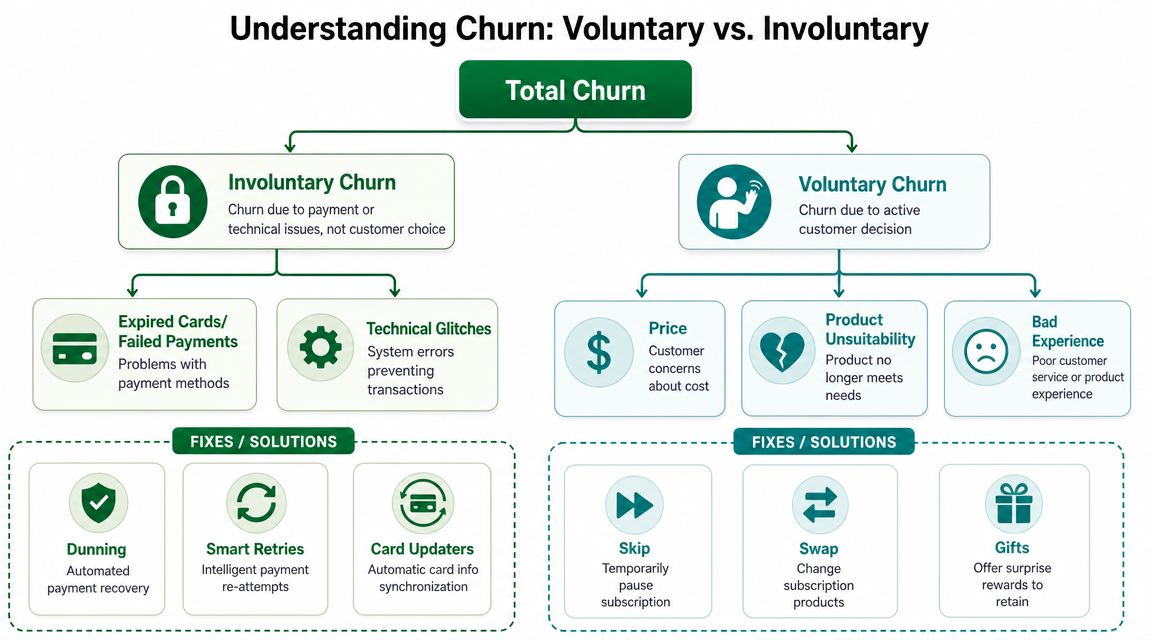
Voluntary churn is an active cancellation. The customer chooses to stop. Usually that traces back to price pressure, too much product on hand, poor fit, weak onboarding, or a rigid subscription experience.
Involuntary churn is operational churn. The customer didn't choose to cancel. A payment failed, a card expired, retries were weak, or the recovery flow added too much friction.
Loop's guidance is practical here. Split churn into voluntary cancellations and involuntary payment failures, then quantify each by revenue impact. Loop recommends prioritizing involuntary churn work when more than 30% of total churn comes from failed payments, and prioritizing cancellation interventions when 70% or more of churn is voluntary (Loop's breakdown of voluntary vs involuntary churn).
Practical rule: If the customer still wants the product, fix the payment stack. If the customer wants out, fix the experience and offer structure.
That distinction sounds obvious, but plenty of brands still throw discounts at payment-failure problems and retry logic at customers who are overstocked. Both waste time.
For a broader operating view, some of the thinking in Querio's churn prevention tactics is useful because it pushes teams to diagnose root causes before pushing retention offers.
Why this matters on Shopify
On Shopify, low retention in the broader ecommerce market means subscription churn isn't just a billing metric. It's one of the main levers protecting lifetime value.
A useful operating habit is to create two owners. One person owns payment recovery. Another owns cancellation prevention. Once those responsibilities are separated, tooling decisions get cleaner too. Recharge, Skio, Loop, and Stay AI don't all solve the same churn problem equally well.
Involuntary Churn Fixes Dunning, Smart Retries, and Card Updaters
Involuntary churn is usually the cleanest revenue leak to fix because the product relationship often still works. The problem is collections.
Dunning should work like a recovery system
A lot of teams still treat dunning as a few generic failed-payment emails. That's not enough.
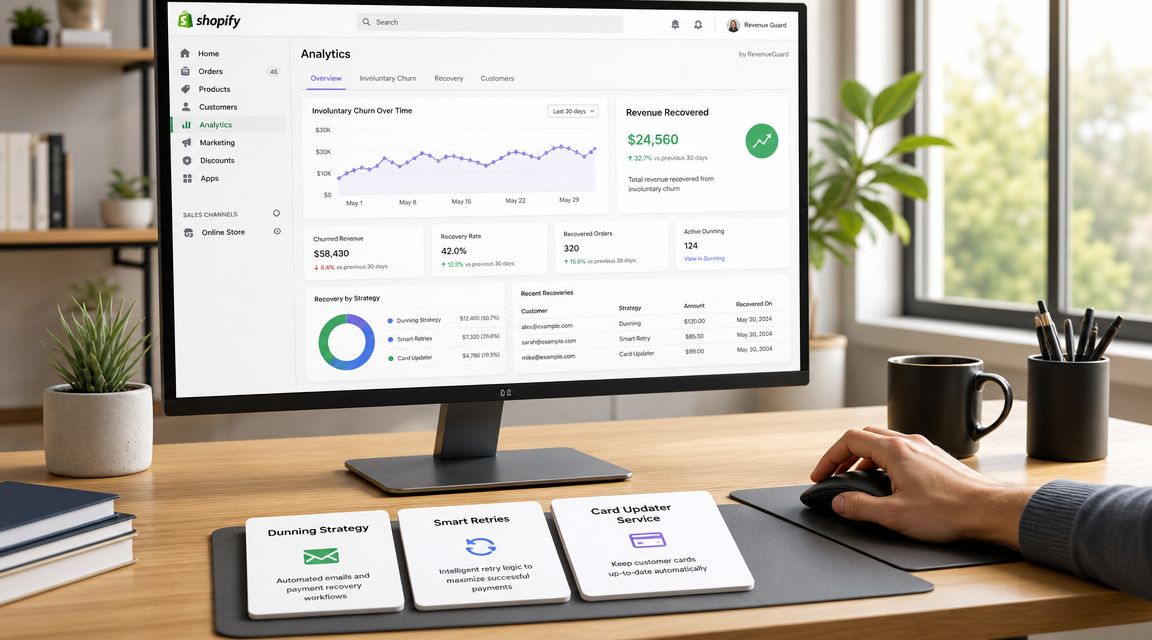
A real dunning system has three parts working together:
Communication logic: The customer gets clear notices that payment failed, what happens next, and the fastest path to update the method.
Retry logic: Retries should happen intelligently based on decline behavior, not on a fixed blind schedule.
Payment credential recovery: Card updater services and network token support reduce avoidable failures before the customer even notices.
For operators who want a concise overview of the mechanics, understanding the dunning process is a helpful primer.
Failed-payment churn usually isn't a brand problem. It's an operations problem sitting in the revenue line.
The most common mistake is friction. If the recovery email sends the customer into a login loop, a password reset, or a slow account page, recovery rates suffer. The best flows push the customer to a fast payment update action and get them out.
What to look for in the app
When evaluating a Shopify subscription app for involuntary churn handling, the questions should be specific.
Capability | What matters in practice |
|---|---|
Dunning management | Custom retry logic, clear failed-payment states, and merchant visibility into recovery |
Smart retries | Retry timing that adapts to decline conditions instead of a flat schedule |
Card updaters | Support for automatic credential refresh where the payment rails allow it |
Customer messaging | Email or SMS triggers that are timely and easy to understand |
Recovery UX | Minimal steps to update billing details and resume the subscription |
What doesn't work well is relying on support to manually recover failed subscriptions. That doesn't scale, and it delays revenue recovery until after the customer has already disengaged.
For stores with meaningful failed-payment volume, subscription retention often improves fastest by addressing this issue. Not because persuasion got better, but because the billing system stopped canceling willing customers.
Voluntary Churn Fixes Skip, Swap, and Strategic Gifts
A customer opens the portal because they have three bags left, their routine changed, or they are tired of the same variant. If the only visible action is "cancel," voluntary churn goes up for a reason that had a fix.

Voluntary churn is a product and experience problem, not a billing problem. The customer is choosing to leave, so the job is to give them a better path that protects MRR without training them to wait for a discount.
Give the customer an off-ramp that matches the reason
The highest-performing save flows usually map to three customer states.
Skip fits overstock and timing issues. The customer still wants the product. They just do not need the next order yet. For many operators, this is the cleanest save because it preserves the subscription relationship and avoids unnecessary support tickets.
Swap fits preference changes. This matters in categories like coffee, supplements, skincare, pet food, and beauty, where flavor, scent, format, or seasonal needs shift over time. If the app makes swaps hard to find or hard to execute, customers use cancellation as the easier product discovery tool.
Strategic gifts fit customers who still like the product but need a reason to stay. The offer has to be specific. A free gift on the next renewal, bonus loyalty points, or a one-time add-on tied to tenure usually holds margin better than broad discounting.
Customers often cancel because the subscription structure stopped fitting their life, not because the brand lost them completely.
On Shopify, app choice matters. Some tools are stronger on customer-facing flexibility, while others are better at billing operations. If voluntary churn is the bigger revenue leak, review the Shopify subscription apps with stronger skip, swap, and retention flow support through that lens instead of comparing dashboards.
What usually fails
The weak pattern is familiar.
Hard-cancel first: No skip, no swap, no pause, and no attempt to match the action to the reason.
One offer for everyone: Overstock, product fatigue, and price sensitivity get the same discount.
Clunky portal UX: Customers need support to change cadence, edit items, or manage the next order.
Retention only at exit: The brand waits for the cancel click instead of making flexibility visible throughout the account experience.
I have seen teams overuse discounts here because they are easy to launch. That can save some subscriptions in the short term, but it also compresses margin and trains customers to threaten churn. Skip and swap usually age better because they solve the actual problem.
Reason-based intervention works better. Overstock should trigger skip. Preference fatigue should trigger swap. Price pressure may justify a lower-frequency plan or a one-time save offer. Customers asking for control should get control fast.
App Differences in Churn Handling Recharge vs Skio vs Loop
Operators choosing a subscription stack shouldn't compare apps as generic “subscription platforms.” The better question is which one is strongest against the churn type causing the most revenue damage.
Subscription app churn feature comparison
Feature | Recharge | Skio | Loop | Stay AI |
|---|---|---|---|---|
Involuntary churn handling | Strong billing infrastructure, mature subscription operations, and broad merchant familiarity | Strong modern checkout and customer experience orientation with solid developer flexibility | Strong emphasis on churn diagnosis and retention workflows tied to payment-failure analysis | More retention-program oriented than billing-infrastructure oriented |
Dunning and payment recovery | Best fit for teams that want established billing controls and operational depth | Best fit for teams that want a modern stack and lower customer friction | Best fit for teams that want churn split clearly between voluntary and involuntary with action paths | Better viewed as a retention layer than a core billing recovery system |
Cancellation flow sophistication | Capable, but often depends on surrounding implementation and app stack choices | Improving, with strength in cleaner customer-facing UX | Strongest fit when cancellation reasons and save offers are central to the strategy | Strong focus on loyalty, engagement, and save experiences |
Skip and swap flexibility | Solid and proven | Strong user-facing experience | Strong retention framing around save actions | Strong where community, perks, and offer design matter |
Analytics for churn reasons | Useful, especially for established teams with internal analytics support | Better for teams that want cleaner product experiences and custom builds | Strong on diagnosing why people cancel and where revenue leaks sit | Better for layered retention strategy than core churn forensics |
Best fit | Teams prioritizing mature subscription infrastructure | Teams prioritizing modern UX and developer-friendly implementation | Teams prioritizing churn reduction workflows and cancellation intelligence | Teams prioritizing relationship-led retention programs |
Recharge is usually the safer choice for brands that want operational maturity and already have a more complex subscription setup. Skio is often more appealing when the team prioritizes customer-facing experience, checkout friction, and a modern implementation model.
Loop stands out when the problem is explicitly reduce subscription churn through better diagnosis and retention mechanics. Its framing around voluntary versus involuntary churn is useful because it maps directly to how operators should prioritize work. Stay AI is different again. It tends to fit brands that want a broader retention program wrapped around loyalty, offers, and relationship building.
How to choose based on your churn problem
If payment failures are the bigger issue, prioritize billing recovery depth.
If cancellation volume is the bigger issue, prioritize reason-based save flows, self-service flexibility, and strong subscription portal UX.
If the stack is under review, this is also where direct merchant interviews help more than feature-checking. A store operator evaluating tools can learn more from candid conversations with teams using the same stack than from app listing copy. For a broader platform comparison, this guide to the best Shopify subscription apps is a useful starting point.
One practical pattern from operator research is consistent. Teams regret migrations done for surface-level UX reasons if the billing layer gets weaker. They also regret staying on mature infrastructure when the cancellation experience keeps bleeding subscribers. The right answer depends on where the churn really comes from.
Realistic Subscription Churn Benchmarks by Category
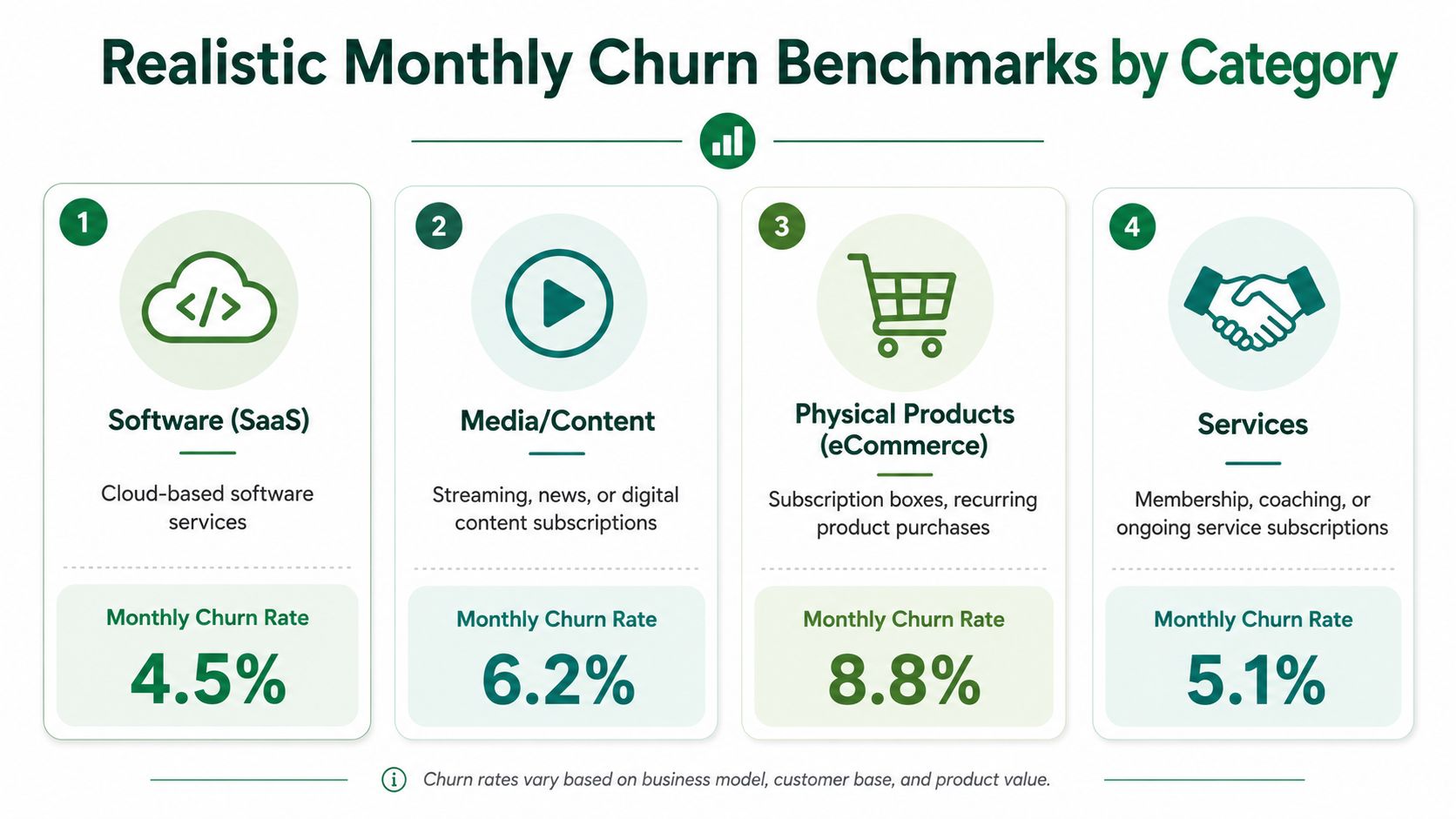
A 6% monthly churn rate can mean two very different businesses. For a replenishment brand with stable usage, that number usually signals a retention problem. For a high-novelty box with natural trial behavior, it may be close to expected. Benchmarks help only if they match the subscription model behind the number.
Benchmarks matter less than benchmark fit
The average ecommerce subscription benchmark cited earlier is a decent starting point. It is not a decision-making system.
Operators should sort benchmarks by category first, then by churn type. A vitamin brand, a coffee brand, and a pet food brand can all sell on subscription and still produce very different retention curves. Consumption certainty, reorder cadence, and product fatigue all change what "normal" looks like.
The voluntary versus involuntary split matters here too. If one brand posts 7% churn because cancellations are high, the fix sits in skip, swap, delay, gifting, and portal UX. If another brand posts 7% because cards fail and recovery is weak, the fix sits in dunning, retries, and account updater coverage. The blended benchmark is the same. The operating plan is not.
Category context changes what good looks like
Replenishment products usually earn more tolerance from customers if timing is flexible. If the product gets used on a clear cycle, churn often drops when subscribers can skip or push an order without contacting support.
Discovery products run into a different ceiling. People may like the brand and still cancel because they want less frequency, less surprise, or more control over what ships. In those categories, a "healthy" churn number often depends less on product quality and more on whether the subscription experience respects changing intent.
That is why serious teams compare themselves to category peers and to their own cohorts over time. A practical Shopify customer retention measurement approach is more useful than a single top-line churn figure pulled from another vertical.
What to compare instead of chasing one headline number
Use benchmarks to answer these questions:
Is churn separated by type? Voluntary and involuntary should be reviewed separately before anyone decides the app, offer, or workflow is the problem.
Is the benchmark matched to the product model? Daily-use replenishment, monthly discovery, and seasonal replenishment should not share the same target.
Is cadence part of the analysis? Many stores call it churn when the actual issue is an order schedule that does not match consumption.
Are cohorts holding up? If newer signup cohorts cancel faster than older ones, acquisition quality, onboarding, or first-order expectations may be slipping.
One more useful cross-check comes from outside ecommerce. This SaaS guide on preventing churn focuses on a different business model, but the framing is still useful. Good operators diagnose why customers leave before they pick the save tactic.
The mistake is treating churn benchmarks like a scoreboard. Use them like a diagnostic range. If the number is high for your category, identify whether cancellations or payment failures drive it, then judge apps and retention tactics against that specific problem.
The Retention Metric Stack That Serious Operators Use
A single churn number doesn't help much once a program reaches scale. Serious operators run a small metric stack that shows how subscriber behavior changes over time and where revenue quality is improving or weakening.
The dashboard that actually helps
The stack usually starts with cohort retention. Shopify specifically recommends cohort-based measurement because raw counts can hide what different signup groups are doing over a defined window (Shopify's customer-retention guidance). Cohorts show whether acquisition quality is improving, whether onboarding got better, and whether a product or portal change affected later-order retention.
Then comes churn by type. Voluntary and involuntary should never be blended for decision-making. A blended rate is useful for reporting. It isn't useful for fixing anything.
After that, operators usually care about:
Repeat purchase timeline: This helps identify when a subscriber is late versus merely following a longer reorder rhythm.
Cancellation reasons: Only useful if the save offers are mapped to those reasons.
Recovery workflow health: Failed payments need their own operational review.
Subscriber lifetime value directionally: The point isn't a vanity number. It's understanding whether newer cohorts are becoming more valuable or less valuable.
For teams looking outside ecommerce for framework ideas, some of the thinking in this SaaS guide on preventing churn is still relevant at a systems level. The categories differ, but the habit of separating diagnosis, intervention, and measurement carries over well.
Where operator research helps
The hard part isn't building a dashboard. It's deciding what to trust and what to change.
Qualitative operator input matters more than another dashboard widget. When teams interview merchants who recently migrated from Recharge, evaluated Skio, or adopted Loop for cancellation flows, the insights tend to be practical. Which portal changes reduced support burden. Which dunning flows were too opaque. Which save offers felt manipulative. Which features looked strong in demos but broke under real subscription complexity.
That kind of input is especially useful for app teams and product leaders. In the article on why 8-figure Shopify brands build direct relationships with app founders, the underlying point is simple. Operators want control over the tools they depend on, not just another vendor pitch.
One relevant option here is app store research, a platform that connects Shopify merchants with paid product research interviews with app developers and UX teams. For subscription operators, that matters when choosing tools, validating migration concerns, or pushing founders on real churn problems that don't show up in feature lists.
Get Paid to Influence the Tools You Use
The operators running subscription revenue inside Shopify stores are usually the people with the clearest view of what the tooling gets wrong. They know where failed-payment recovery breaks. They know which cancellation offers feel weak. They know when an app promises flexibility but creates support debt instead.
That experience has value beyond the store itself.
There's a growing category of direct research conversations where operators speak with app founders and product teams about billing, retention, UX, and roadmap decisions. Those calls are useful because they create access. They also give operators a cleaner way to influence the tools they use every day, without getting buried in marketplace noise or sales spam.
For brands evaluating subscription apps, those conversations can also create earlier visibility into what vendors are building next and where the roadmap is heading.
The network worth paying attention to is app store research, where Shopify operators get paid to talk directly to the app founders building the tools they use every day. Its primary value is access, influence over product direction, and stronger vendor relationships. If that sounds useful, join the network.

Author
Jonathan Kennedy
Jonathan Kennedy is the founder of app store research and shopexperts, platforms that connect operators, founders, and experts across the Shopify ecosystem to drive better decisions, product development, and growth.