Product Launch Strategy for Shopify Apps: A Playbook
/


Author
Jonathan Kennedy
Founder at appstoreresearch
Jonathan Kennedy is the founder of app store research and shopexperts, platforms that connect operators, founders, and experts across the Shopify ecosystem to drive better decisions, product development, and growth.
A Shopify app can feel ready to launch long before it's actually ready to sell.
The team has shipped the core workflow. The App Store listing draft looks polished. The demo works on the happy path. Then the hard question lands. Will merchants care enough to install it, understand it fast enough to activate, and trust it enough to pay?
That gap between internal confidence and market reality is where most launch stress lives. In the Shopify ecosystem, it's worse because merchants already deal with constant app pitches, crowded categories, overlapping features, and rising app spend. A new app doesn't just need to exist. It needs to earn attention from operators who are already filtering noise all day.
A practical product launch strategy starts earlier than generally assumed. It starts with repeated conversations with the merchants the app is built for. Not broad surveys. Not applause from friendly peers. Not guesswork from competitor listings. Direct calls, before build, during MVP shaping, before pricing, during rollout, and after launch.
Table of Contents
The Silence Before the Launch
Why gut feel breaks down in Shopify
What strong launch teams do instead
Validate the Problem Before You Write a Line of Code
What teams usually get wrong
A better way to recruit merchants
Questions that surface real pain
Set Your Go/No-Go Criteria for the MVP
Turn conversations into decision rules
Separate leading and lagging signals
Test Positioning and Pricing with Real Merchants
Messaging should survive a live conversation
Pricing belongs in discovery not at the end
Orchestrate Launch Ops and Build Your Adopter Pipeline
Launch relationships before launch assets
A simple launch rhythm
Track Post-Launch KPIs and Iterate with Feedback
Watch for value, not vanity
Keep the call loop running
Build Your App's Flywheel From Day One
The Silence Before the Launch
Every Shopify app team knows the quiet period before launch. There's a lot of activity internally and very little certainty externally. Engineering is still polishing edge cases. Marketing is writing copy. Founders are watching competitors and trying to decide whether the app is differentiated enough to matter.
That silence is expensive. A team can spend months building features merchants never asked for, then mistake a lack of traction for a distribution problem. In reality, the app often lands with fuzzy positioning, weak proof of value, or a pricing model that creates friction on first contact.

A disciplined launch strategy is built around measurable goals and stage-specific KPIs, because shipping isn't the same as proving adoption or value. Guidance on launch goals and product KPIs points teams toward targets such as sign-ups, conversion thresholds, revenue goals, activation rate, time to value, feature usage, retention, and CAC across pre-launch, launch, and post-launch phases.
Why gut feel breaks down in Shopify
Shopify categories look simple from the outside. A founder sees a gap, checks a few competing apps, and assumes a better product will win. Merchants rarely buy that way.
Operators buy when a problem is painful, current, and costly enough to change behavior. A complaint is not the same as a buying trigger. Teams that skip merchant conversations often discover too late that the pain was real but not urgent, or urgent but owned by a different role than the one they targeted.
Practical rule: If a merchant can't describe the cost of the problem in workflow terms, the team probably hasn't found a launchable wedge yet.
What strong launch teams do instead
Strong teams use calls early because calls reveal language, objections, decision criteria, internal ownership, and switching friction. Those details shape the roadmap faster than another sprint of speculative development.
Research on launch success also ties outcomes to capability across multiple functions, including marketing research, sales force, distribution, promotion, R&D, and engineering, which supports a cross-functional model rather than a marketing-only rollout, as noted in new product launch research.
In practice, that means product launch strategy for Shopify apps works best when product, UX, sales, and founder conversations all point at the same merchant reality.
Validate the Problem Before You Write a Line of Code
The fastest way to waste a quarter is to build an app around a problem merchants only describe politely.
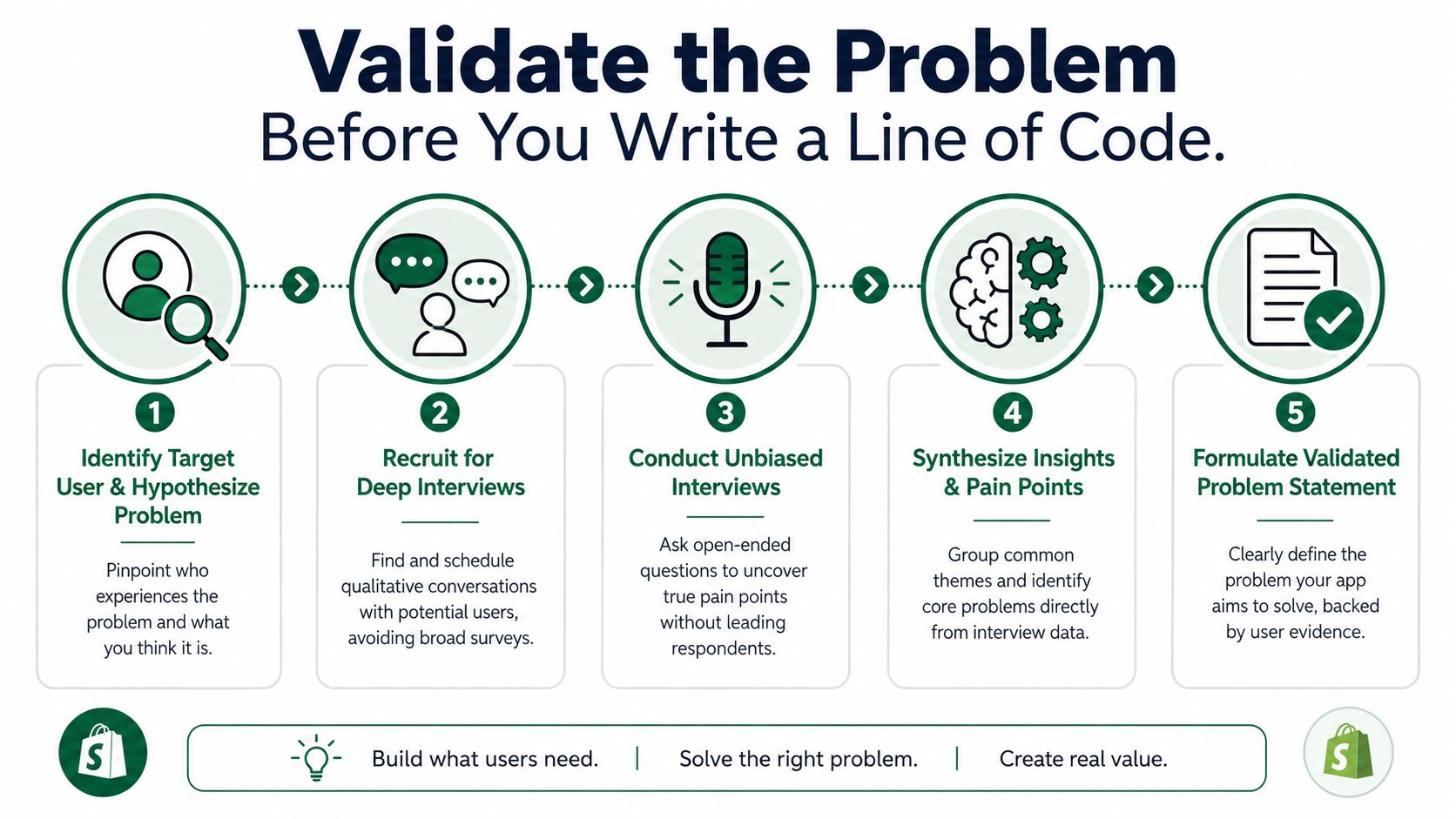
For Shopify apps, problem validation needs depth. Categories are noisy, merchants are busy, and operators have learned to ignore vendor outreach that sounds generic. Standard launch guidance increasingly points toward identifying underserved personas and testing segmented rollouts, especially in noisy markets where discovery is the problem, not awareness, as described in this product launch strategy analysis.
What teams usually get wrong
Product validation tends to be overly generalized, speaking to “Shopify merchants” as if that's one buyer group. It isn't. A retention app for a Plus brand, a merchandising tool for a mid-market apparel store, and an operations product for an agency partner each face different workflows, budgets, and urgency.
Surveys make this worse. They flatten context. A merchant may click that something is “important” without exposing whether the issue appears weekly, who owns it, what tools are already in place, or whether budget would ever be assigned to fix it.
A better approach is a small batch of one-to-one calls with tight screening. Teams that need a practical baseline for interview design can borrow from these effective UX research strategies, then tailor the conversation to Shopify roles and operational realities.
A better way to recruit merchants
The screener should filter for pain, not curiosity. Good recruits are close to the problem, live with it often, and already use workarounds.
A useful screener includes prompts like these:
Role ownership: Ask whether the person directly owns ecommerce operations, retention, merchandising, support, or app evaluation.
Workflow exposure: Ask what tools they currently use in the area your app touches.
Problem frequency: Ask how often the issue comes up in the normal operating week.
Current workaround: Ask how the team solves it today, even if the method is manual.
Buying context: Ask whether they've evaluated or replaced tools in this category before.
That's also where a network like product discovery and roadmap validation can be useful. It gives Shopify teams a structured way to reach vetted operators for paid calls instead of relying on cold outreach or loose recruiting.
Questions that surface real pain
The interview script should stay grounded in past behavior. Hypothetical questions usually produce optimism. Operational questions produce evidence.
Use prompts such as:
Walk through the last time this happened. Who noticed it first? What broke?
What did the team do next? Manual fix, spreadsheet, agency workaround, another app?
What was the actual cost? Delayed campaign, missed handoff, support burden, reporting gap?
How do they evaluate solutions now? App Store search, agency recommendation, peer group, internal build?
What makes them reject a tool fast? Setup time, unclear ROI, weak support, pricing friction, poor fit for Plus workflows?
Merchants don't buy because a founder explains the feature well. They buy because the founder describes the operator's problem more clearly than the operator has heard it described before.
By the end of this phase, the team should be able to write a problem statement in merchant language, not startup language. If that statement still sounds broad, the audience is still too broad.
Set Your Go/No-Go Criteria for the MVP
A surprising amount of bad product work happens after teams hear encouraging feedback and mistake it for demand.
Positive interviews aren't enough. Merchants are polite. They'll say an app sounds useful and still never install it. A better product launch strategy forces a harder question before MVP build goes too far. What specific signal would justify moving forward, and what signal would stop the team?
Turn conversations into decision rules
A rigorous launch process can be framed as a five-step loop: define scope, access the target audience, filter to best-fit users, identify a success signal, and reuse those signals for the next segment. Teams should also separate leading indicators such as waitlist growth, landing-page conversion, and CTR from lagging indicators such as sales and retention so they can pivot before revenue data arrives, according to Paddle's launch strategy framework.
For an MVP, that means every interview should push toward observable behavior. Useful go or no-go criteria are qualitative unless the team has enough volume to support tighter thresholds. What matters is clarity.
A practical review grid might look like this:
Signal type | Go signal | Warning sign |
|---|---|---|
Problem clarity | Merchant describes the pain quickly in their own words | Merchant needs heavy prompting |
Value recognition | Merchant understands the core promise from a rough demo or concept slide | Merchant gets stuck on what the app actually does |
Workflow fit | Merchant can name where this fits in current ops | Merchant says it seems useful but can't place it |
Buying intent | Merchant asks about access, timing, setup, or pricing | Merchant offers praise but no next-step behavior |
Separate leading and lagging signals
Many Shopify teams get tripped up by waiting for sales proof when earlier signals were already telling them the launch was weak.
Leading indicators for an MVP include:
Message comprehension: Can the merchant explain the value proposition back without help?
Follow-up intent: Do they ask to see the next version, share with a teammate, or join a pilot?
Use-case specificity: Can they point to the exact campaign, workflow, or reporting issue where the app would be used?
Lagging indicators matter later. For an MVP decision, they're too slow.
A merchant who asks, “Could this handle our current setup?” is worth more than a merchant who says, “Cool idea.”
Low-fidelity demos work well here. A clickable Figma flow, annotated mockup, or even a short deck is enough if it reveals reaction to the core workflow. The team doesn't need polished UI. It needs honest friction.
The point of the checkpoint isn't confidence. It's discipline. If reactions are vague, the team should narrow the user, simplify the use case, or rework the promise before adding more code.
Test Positioning and Pricing with Real Merchants
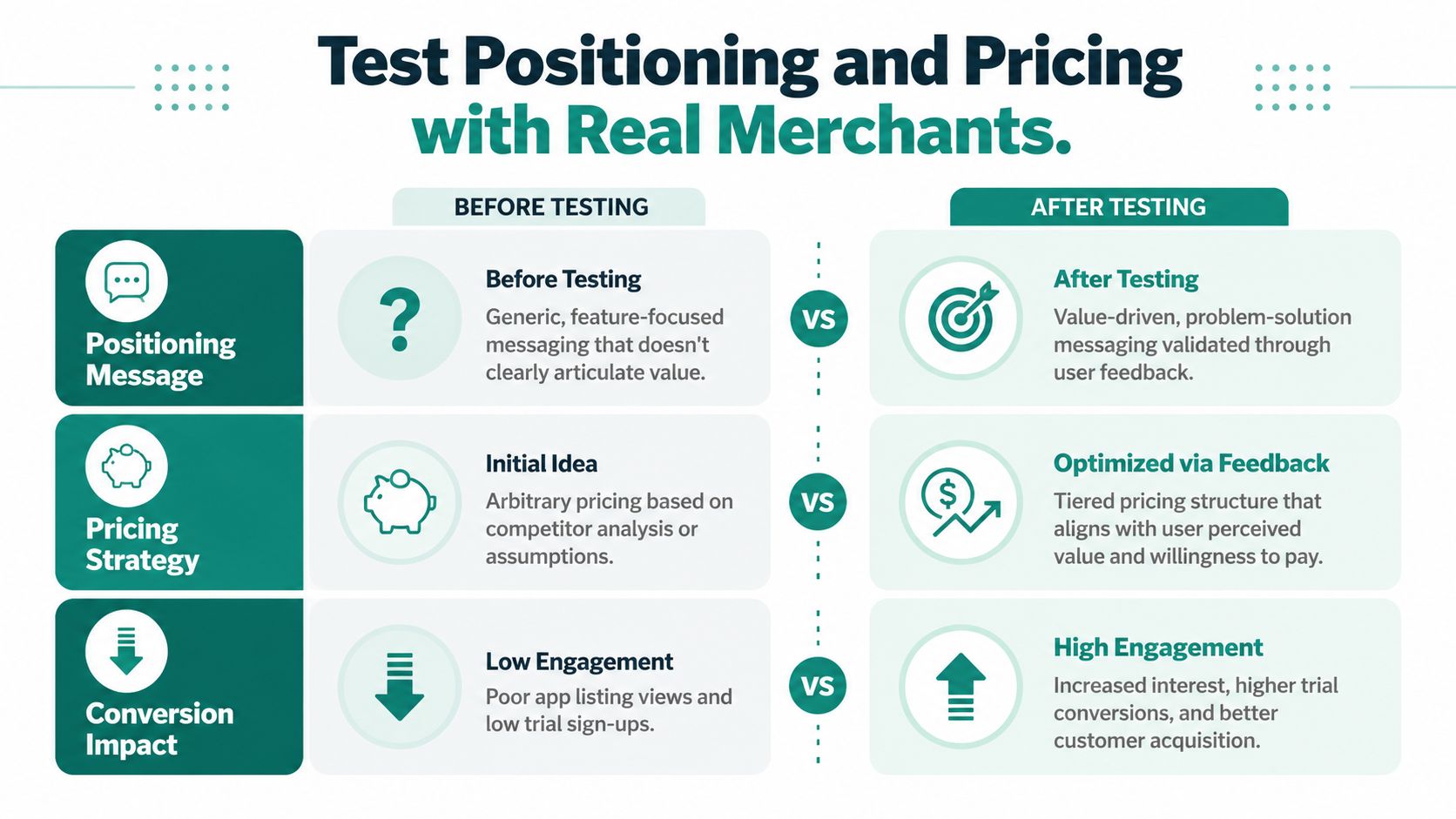
Most Shopify app teams treat positioning as copywriting and pricing as cleanup. Both choices usually show up too late, after the app is built and the team is emotionally attached to the offer.
That's backwards. Positioning decides whether the right merchant even pays attention. Pricing decides whether that attention becomes action. In crowded categories, weak messaging and awkward packaging can limit adoption before product quality gets a fair shot.
Messaging should survive a live conversation
If a founder reads the homepage headline to a merchant and the merchant answers with “so is this analytics, retention, or automation?” the positioning is still muddy.
Live calls expose this fast. Put two or three message angles in front of merchants and listen for where they lean in. One angle may sound sharper to the internal team but still fail because it describes the feature, not the buying reason.
Use a simple comparison during calls:
Version one: Feature-led framing
Version two: Outcome-led framing
Version three: Workflow-led framing tied to a specific operator role
Then ask:
What does this sound like it helps with?
Who on the team would care most?
What would make this feel different from another app in the category?
The strongest positioning is usually the one merchants can retell without translation.
Pricing belongs in discovery not at the end
Pricing and packaging are a core part of launch strategy, not a late-stage marketing decision. Launch planning should validate willingness to pay, price elasticity, bundle design, lifecycle pricing, and post-launch pricing feedback, as outlined in Simon-Kucher's product launch guidance.
For Shopify apps, the common mistake is copying a competitor's pricing page without understanding why merchants hesitate. Friction often comes from packaging, not absolute price. A plan-based tier may confuse merchants. A usage-based model may feel risky. A free trial might help one category and attract low-fit installs in another.
A short pricing conversation works better than founders expect:
Ask | What it reveals |
|---|---|
“How do you usually evaluate spend for apps like this?” | Budget logic and owner |
“What would make this feel easy to try?” | Friction points |
“What kind of pricing model feels fair for this workflow?” | Packaging preference |
“What would make the price feel too risky?” | Objections and trust gaps |
For teams working through pricing and packaging decisions, merchant interviews are often where the underlying pricing story appears. Operators explain not just what feels expensive, but what makes a tool feel worth defending internally.
Orchestrate Launch Ops and Build Your Adopter Pipeline
Launch day rarely creates momentum from scratch. It reveals whether momentum was built beforehand.
That matters because buyer timing is uneven. Only about 15% of customers buy a new product immediately after launch, while roughly 50% wait until it has been in market longer, according to Ciradar's launch statistics summary. For Shopify apps, that means credibility and repeated exposure matter as much as the announcement itself.
Launch relationships before launch assets
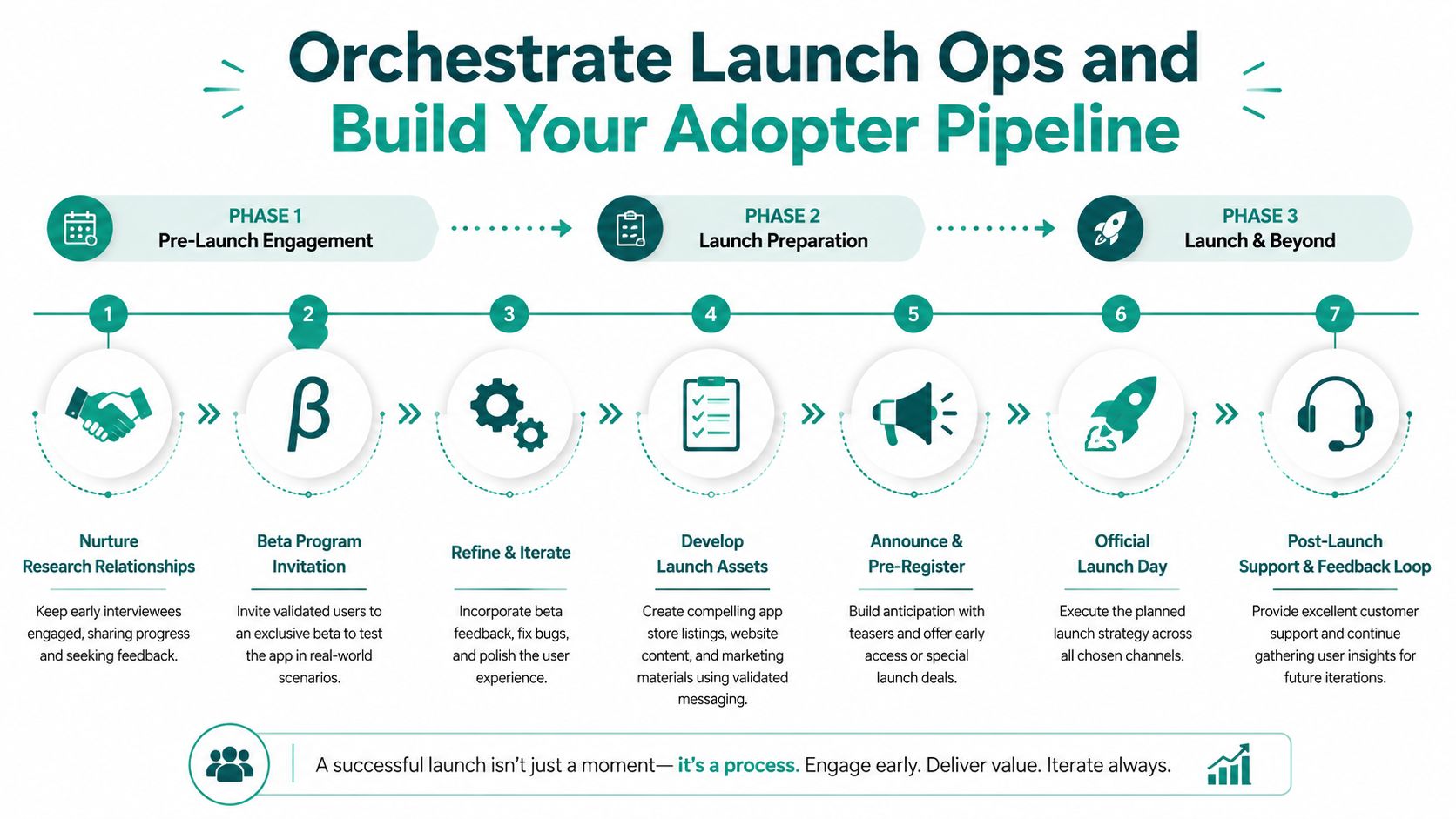
The best early adopters often come from research, not from public promotion. Merchants who joined discovery calls, gave blunt feedback, and saw the product evolve already have context. They're warmer than a cold visitor landing on an App Store page for the first time.
This is especially useful for Shopify Plus sales motions. A founder can use early calls to identify operators with active evaluation cycles, complex workflows, or agency influence. Those conversations don't need to feel like hard sales. They just need a clear next step.
A working pipeline often includes:
Research participants: Invite them into beta or private onboarding.
Warm observers: Keep them updated with short product progress notes.
High-intent evaluators: Book follow-up calls around launch timing and implementation fit.
Agency partners: Ask where the app fits or fails across multiple client scenarios.
For teams that want a more structured approach to turning calls into opportunities, this overview of a smart sales automation platform is useful background on how repeatable follow-up can support founder-led and product-led sales motions.
A simple launch rhythm
A strong operational cadence looks more like a sequence than a single event.
In the weeks before launch
Tighten the beta cohort: Keep the group small enough for fast fixes.
Prepare support responses: Merchant objections repeat. Document the answers.
Finalize proof assets: Screenshots, onboarding walkthroughs, and merchant language should match what was learned in calls.
On launch week
Prioritize warm outreach first: Talk to merchants who already know the app.
Watch for onboarding friction: Issues in setup or first-run experience need immediate attention.
Route signals quickly: Product, support, and sales should review the same feedback.
In the first month
Rebook the first cohort: Ask what happened after install, not just whether they liked the demo.
Track early opportunity patterns: Which verticals, plans, or roles convert faster.
Keep pipeline creation active: A flow of calls beats a one-time spike of attention.
For Shopify app teams that want recurring merchant calls to support both discovery and pipeline, sales discovery and pipeline creation is one way to structure that process with vetted operators.
Track Post-Launch KPIs and Iterate with Feedback
The critical test starts after install. A Shopify app earns its place when a merchant reaches value fast enough to keep it in their workflow a week later, then a month later.
Post-launch measurement should stay tied to the promise that got the install in the first place. For app teams, that usually means watching activation, time to first value, repeat usage, retention, and the points where merchants stall or leave. Amplitude's guide to product metrics is a useful reference for this stage because it focuses on behavior after signup, not just top-of-funnel attention.
Watch for value, not vanity
Installs can mislead you.
A strong App Store listing, a free plan, or curiosity about a new use case can drive early volume without proving the product is working. I would rather see fewer installs with clear activation than a spike of signups that never finish setup.
The questions worth reviewing every week are simple:
Are merchants completing the setup that matters? If not, the onboarding path or the promise on the listing is off.
How quickly do they reach first value? Long setup time creates churn risk right away.
What gets used after day one? That should shape the roadmap more than founder opinions.
Which merchant segment sticks? Retention usually concentrates in a narrower slice than expected.
What triggers support tickets or uninstalls? Those patterns often point to a sharper fix than a broad feature push.
The launch promise sets the expectation. Post-launch KPIs show whether merchants actually got what they came for.
Keep the call loop running
Post-launch research should not stop at a survey or a support inbox. Rebook the first cohort into paid calls and do it on a schedule.
A useful rhythm is one conversation after onboarding, one after the app has been used in a real workflow, and one when renewal, downgrade, or uninstall risk shows up. Those calls surface the details analytics miss: why a merchant skipped a step, what they assumed the app would do, which feature felt too risky to turn on, and what made the app feel worth keeping.
That loop cuts waste. Instead of guessing whether to rebuild onboarding, change pricing, add integrations, or narrow the target segment, you hear the trade-offs directly from operators using the app in live stores.
The teams that iterate well combine both views. Product data shows where behavior drops. Merchant calls explain why. That combination is how you improve activation, protect retention, and keep the launch process alive after release.
Build Your App's Flywheel From Day One
A founder ships the app, gets a spike of installs, then watches growth stall because the feedback loop ends at launch. In Shopify, the better pattern is to build the loop before the launch spike ever arrives.
The flywheel starts with merchant conversations and keeps running after the app is live. Calls shape the problem selection, the MVP scope, the positioning, the pricing, onboarding, and the roadmap. Each round of real merchant input removes a little guesswork and lowers the cost of building the wrong thing.
That matters because merchants are overloaded. They ignore broad claims, skip bad-fit installs, and keep the tools that solve a specific problem fast. Founders who stay close to those conversations usually make better trade-offs. They know which friction to fix first, which feature request to ignore, and which segment is willing to pay.
A small research network compounds. Ten merchants who reliably take calls and speak plainly about their workflows are often more useful than a much bigger audience that only clicks, browses, or answers surveys.
That participation loop matters for merchants too. Agencies, Shopify Plus teams, and operators often want earlier access to products, a direct line to founders, and a cleaner way to give feedback without sitting through a sales pitch. Paid research calls can create that exchange if they are run well.
If you want to make that loop part of your launch process, it helps to use a channel built for recruiting and compensating participants. The platform details below come from the app store research about and participant pages.
Incentivized Research Opportunities | Details |
|---|---|
Network Size | Thousands of Shopify operators, merchants, and agencies |
Incentives Paid to Date | Ongoing paid product research opportunities for qualified participants |
Shopify merchants, agency operators, and app teams that want to share product feedback and get paid for it can join app store research, a platform that connects Shopify merchants with paid product research interviews with app developers and UX teams.

Reviewed by
Filip Djokic
Product Designer at appstoreresearch.com
Filip is a Product and UI/UX Designer with over 10 years of experience in digital product design. With a strong background in the Shopify ecosystem, he focuses on improving user experiences and turning merchant insights into better product decisions at appstoreresearch..