Shopify App Ecosystem Trends You Can't Ignore in 2026
/
A Shopify operator opens the App Store to solve one problem. Maybe it's post-purchase upsells, subscriptions, returns, bundles, search, or B2B workflows. Ten minutes later, there are twelve tabs open, five apps that look almost identical, pricing pages that don't answer the core question, and reviews that all sound polished in the same way.
That experience isn't a sign that the buyer is bad at evaluation. It's a sign that the market has changed. The current wave of Shopify app ecosystem trends has less to do with flashy features and more to do with saturation, pricing pressure, workflow overlap, and a growing trust gap between merchants and vendors.
For merchants, that means more app fatigue and more expensive mistakes. For app teams, it means getting listed is no longer the hard part. Getting believed is.
Table of Contents
The Overwhelming Search for the Right Shopify App
Why this feels heavier than it used to
What experienced teams do instead
Understanding the New Reality A Hyper-Saturated Market
Why discovery now feels broken
What this changes for merchants
Trend 1 The Great Consolidation and Pricing Pressure
Why merchants are cutting tools
Why vendors push harder on pricing
Trend 2 The Shift from Standalone Features to Integrated Workflows
Single features are easier to replace
What stronger apps do differently
Trend 3 Overcoming the Discovery and Trust Deficit
Trust is now the bottleneck
What buyers should verify before installing
A Smarter Way to Navigate the App Ecosystem
Direct conversation beats passive browsing
How teams can make this practical
Your Action Plan for 2026 and Beyond
For merchants and operators
For app teams and agencies
The Overwhelming Search for the Right Shopify App
A merchant needs something simple. Add subscriptions without wrecking the theme. Improve onsite search. Reduce support tickets around returns. On paper, that should be a fast decision.
In practice, it usually turns into a stack review, a pricing review, a support review, and a risk review. One app looks affordable until usage fees appear. Another has strong reviews but a weak setup flow. A third promises everything, but the product page says almost nothing about how it behaves with the rest of the stack.
That's why smart operators don't just ask, “Does this app have the feature?” They ask whether it will create more operational drag than it removes. A practical evaluation process usually matters more than the feature checklist itself, which is why guides on how to evaluate Shopify apps have become more useful than generic “best apps” lists.
Why this feels heavier than it used to
The App Store used to feel more like a directory. It now feels more like a crowded buying environment where every listing competes aggressively for attention. That changes buyer behavior.
Operators become slower to trust. They lean harder on peer recommendations. They delay installs because removing a bad-fit app later often costs more than spending extra time upfront.
The real cost of a wrong app isn't just the monthly fee. It's broken workflows, retraining, cleanup, and the next migration.
What experienced teams do instead
The strongest buyers usually narrow decisions with a few hard filters:
Workflow fit first: They start with the business process that needs fixing, not the feature category.
Stack compatibility: They check how the app fits with existing tools for subscriptions, reviews, bundles, shipping, analytics, and support.
Support quality: They look for signs that a team will provide a real response when something breaks.
Exit cost: They ask how painful uninstalling will be if the app underdelivers.
That mindset matters because the pressure merchants feel in the App Store is tied to a deeper market shift, not just bad browsing habits.
Understanding the New Reality A Hyper-Saturated Market
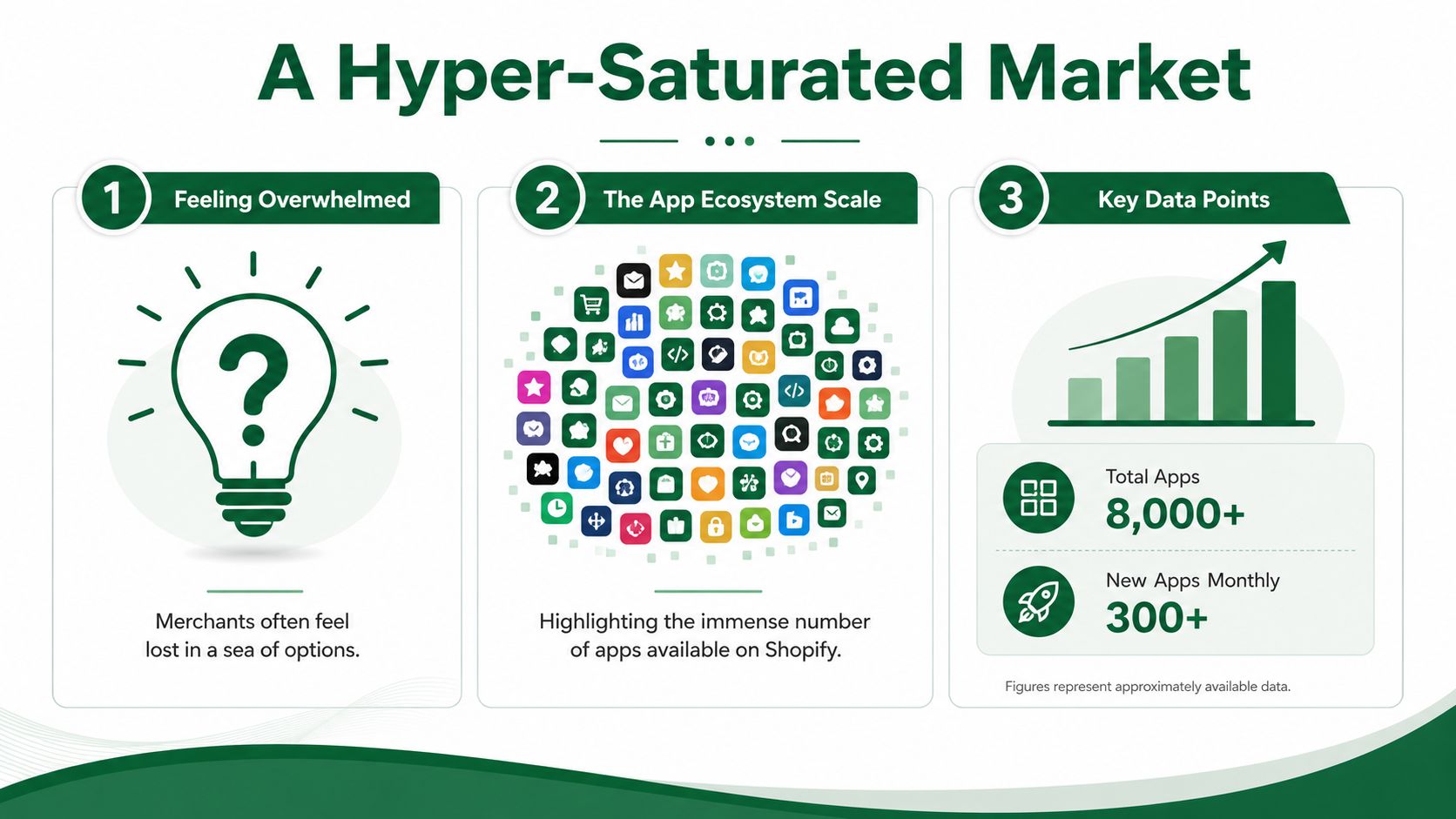
The scale of the Shopify ecosystem explains why app selection has become harder. One independent 2026 estimate puts the App Store at 17,600+ apps with roughly 550 new solutions per month, and says merchants install 6 apps on average, with some using up to 30 apps (Craftberry's Shopify App Store statistics).
Why discovery now feels broken
At this size, the App Store stops behaving like a clean marketplace and starts behaving like a dense advertising surface. More choice sounds good until too many products solve roughly the same problem with slightly different language, packaging, and UX.
A separate community analysis also described a market with 12,211 apps, 1,289,708+ reviews, and 3,301 new apps launched in 2024 alone (Shopify community market trends discussion). That matters because category leaders don't win only on features anymore. They also win on integration depth, clearer positioning, and enough proof that merchants feel safe adopting them.
What this changes for merchants
Merchants now have to evaluate two things at once:
Buying question | What it really means |
|---|---|
Does the app solve the problem? | Feature fit and workflow fit |
Will the vendor still be worth using in six months? | Support, roadmap, pricing discipline, and trust |
That second question has become much more important.
More overlap: Many apps now look similar at the listing level.
More cognitive load: Every install affects theme behavior, operations, reporting, and monthly software spend.
More vendor risk: Some apps are maintained well. Others stall, overpromise, or get outpaced.
Practical rule: In a crowded app market, the safest purchase usually isn't the loudest listing. It's the product with the clearest fit inside an already messy workflow.
This is one of the clearest Shopify app ecosystem trends in 2026. Discovery hasn't become impossible. It has become more expensive in time, attention, and trust.
Trend 1 The Great Consolidation and Pricing Pressure
The biggest economic shift in the ecosystem isn't a new feature category. It's consolidation. Merchants want fewer tools doing more work, and vendors feel pressure to capture more revenue from a smaller set of buyers.

Independent analysis of 7,378 apps found average monthly revenue of $20,037 but a median of only $725, showing how skewed the market is. The same analysis found that among 2,265 developers reviewed, a majority earned under $1,000 per month (HulkApps analysis of Shopify app economics).
Why merchants are cutting tools
That revenue distribution explains a lot of merchant behavior. Buyers know many apps won't become durable businesses. So they become stricter about adding anything new to the stack.
A practical stack review now looks less like “what can this app add?” and more like “what can this replace?” That's the logic behind ongoing Shopify stack consolidation work inside serious brands.
Common operator questions now include:
Can one app replace two smaller ones?
Will this reduce manual work or just add another dashboard?
Is pricing predictable once volume grows?
Does the vendor improve margins, or just software complexity?
Why vendors push harder on pricing
When most apps don't scale meaningfully, product teams react in familiar ways. Some build broader suites. Some add usage-based pricing. Some tighten free plans. Some lean into upsells because they need more revenue from fewer accounts.
None of that is irrational. But merchants feel the consequences fast.
When an app category gets crowded, weak differentiation often turns into pricing friction.
The healthiest vendors usually do three things well:
They tie pricing to a clear outcome. Buyers can see why the app costs what it costs.
They reduce overlap. The app owns a workflow, not a tiny feature wedge.
They avoid surprise expansion costs. Trust drops quickly when usage pricing feels hidden.
For merchants, the takeaway is simple. Audit app spend regularly. Look for overlap. Keep the tools that remove operational pain and cut the ones that mostly create administration. In the current market, disciplined subtraction is often a bigger win than another install.
Trend 2 The Shift from Standalone Features to Integrated Workflows
The market is moving away from isolated point solutions. Apps that only do one narrow thing can still work, but they're easier to replace when a larger platform, a broader app, or native Shopify functionality closes the gap.
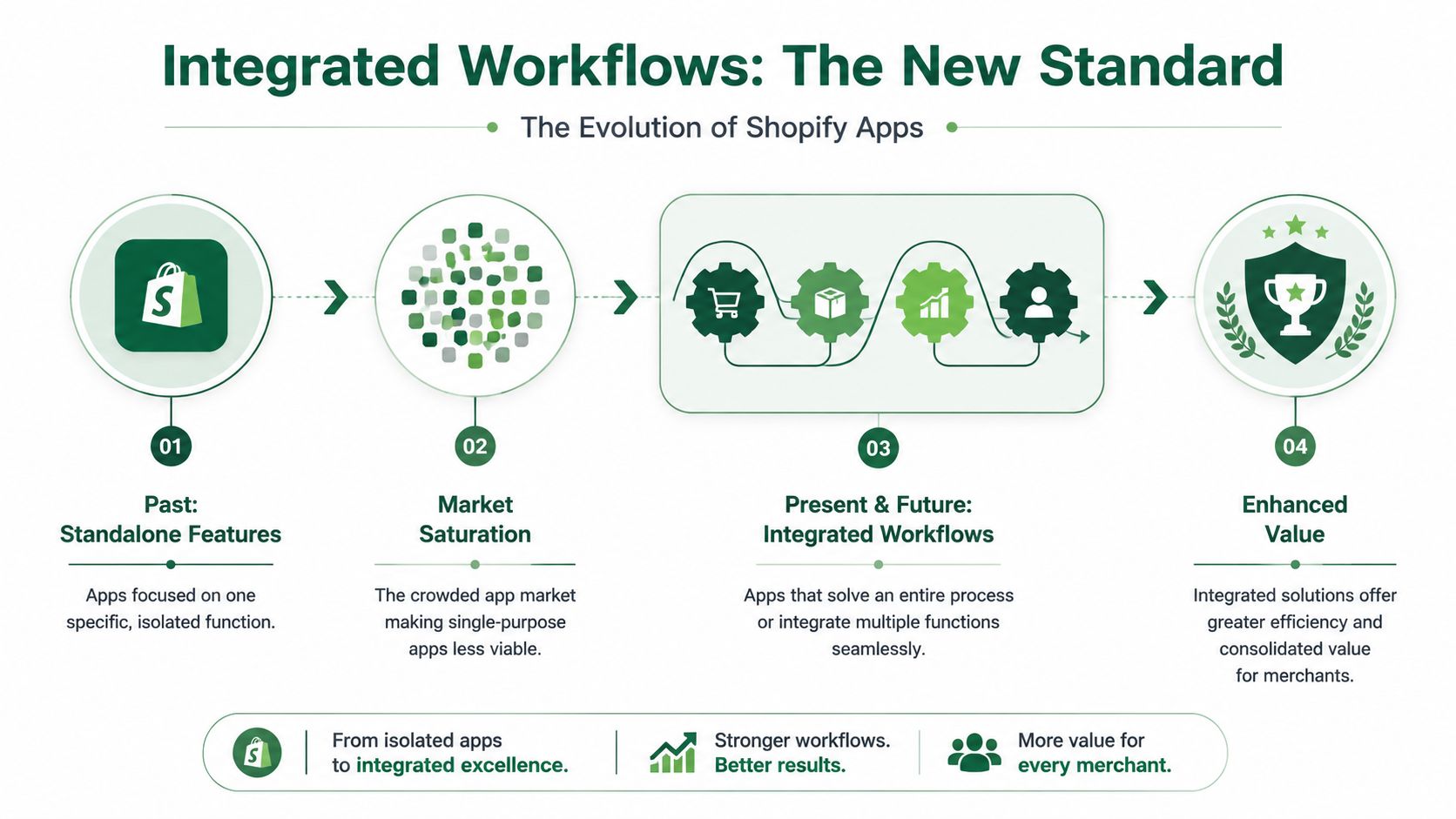
Uptek's app-store trend snapshot shows an ecosystem that moved from expansion-first toward a more selective, quality-driven phase. It also notes Shopify merchants processed an average of 199 million orders per month in 2023, which helps explain why apps now need to solve more operationally meaningful problems (Uptek Shopify App Store statistics).
Single features are easier to replace
A popup app that only shows a popup. A search app that improves search but creates merchandising headaches. A subscriptions tool that handles billing but causes support issues elsewhere. Buyers are much less tolerant of narrow wins that create wider friction.
That's especially true for Shopify Plus operators, where primary pain usually lives between systems. Orders, fulfillment, merchandising, subscriptions, returns, customer support, B2B pricing, and reporting all touch each other.
What stronger apps do differently
The better products now tend to solve end-to-end tasks, not isolated moments.
App type | Weak version | Stronger version |
|---|---|---|
Search | Better results page | Search plus merchandising controls and reporting |
Returns | Return portal only | Returns plus support reduction and policy logic |
Upsell | One offer placement | Upsell logic across cart, checkout, and post-purchase |
B2B tool | One pricing tweak | Catalog, permissions, workflow, and account logic |
Buyers keep apps when the app fits the way the business actually runs, not when the feature demo looks clean.
For merchants, that means evaluating apps against workflow questions:
Where does this tool start and stop?
Who on the team will use it after setup?
What existing process becomes simpler because of it?
Does it cooperate with the rest of the stack or compete with it?
For app builders, one of the strongest Shopify app ecosystem trends is this shift in buyer expectation. Merchants don't need more isolated features. They need fewer points of failure.
Trend 3 Overcoming the Discovery and Trust Deficit
The discovery problem isn't just volume. It's credibility.
Merchants are surrounded by polished listings, outreach messages, retargeting, affiliate content, and product pages that all claim to be easy, fast, and proven. That makes it harder for useful apps to stand out, especially if they're newer and don't have years of review history behind them.
Trust is now the bottleneck
Operators don't struggle because there are too few options. They struggle because too many signals are biased. Reviews can be hard to interpret. Sales calls can feel scripted. Listing pages usually show ideal use cases, not implementation pain.
That's also why direct human input matters more than synthetic evaluation alone. Teams exploring the difference between modeled feedback and real buyer behavior may find this breakdown of synthetic vs human users useful, especially when the goal is understanding how merchants choose, hesitate, and reject apps.
A weak trust environment creates two bad outcomes at once:
Merchants delay decisions because every install feels risky.
Good vendors get flattened into the same visual and messaging noise as everyone else.
What buyers should verify before installing
A better trust screen is usually simple and specific.
Listing clarity: Does the app explain who it's for, what it replaces, and what setup really involves?
Support reality: Is there evidence the team helps during onboarding and post-install issues?
Merchant fit: Does the app seem built for the store's stage, complexity, and stack?
Roadmap signal: Does the vendor sound like they're learning from merchants, or just broadcasting features?
Merchants can also learn a lot by reviewing common listing failures. This analysis of common mistakes in Shopify app listings and how to avoid them is useful because weak positioning often reveals weak customer understanding.
A trustworthy app usually sounds more specific, not more impressive.
That matters because trust now drives discovery almost as much as rank, reviews, or category placement.
A Smarter Way to Navigate the App Ecosystem
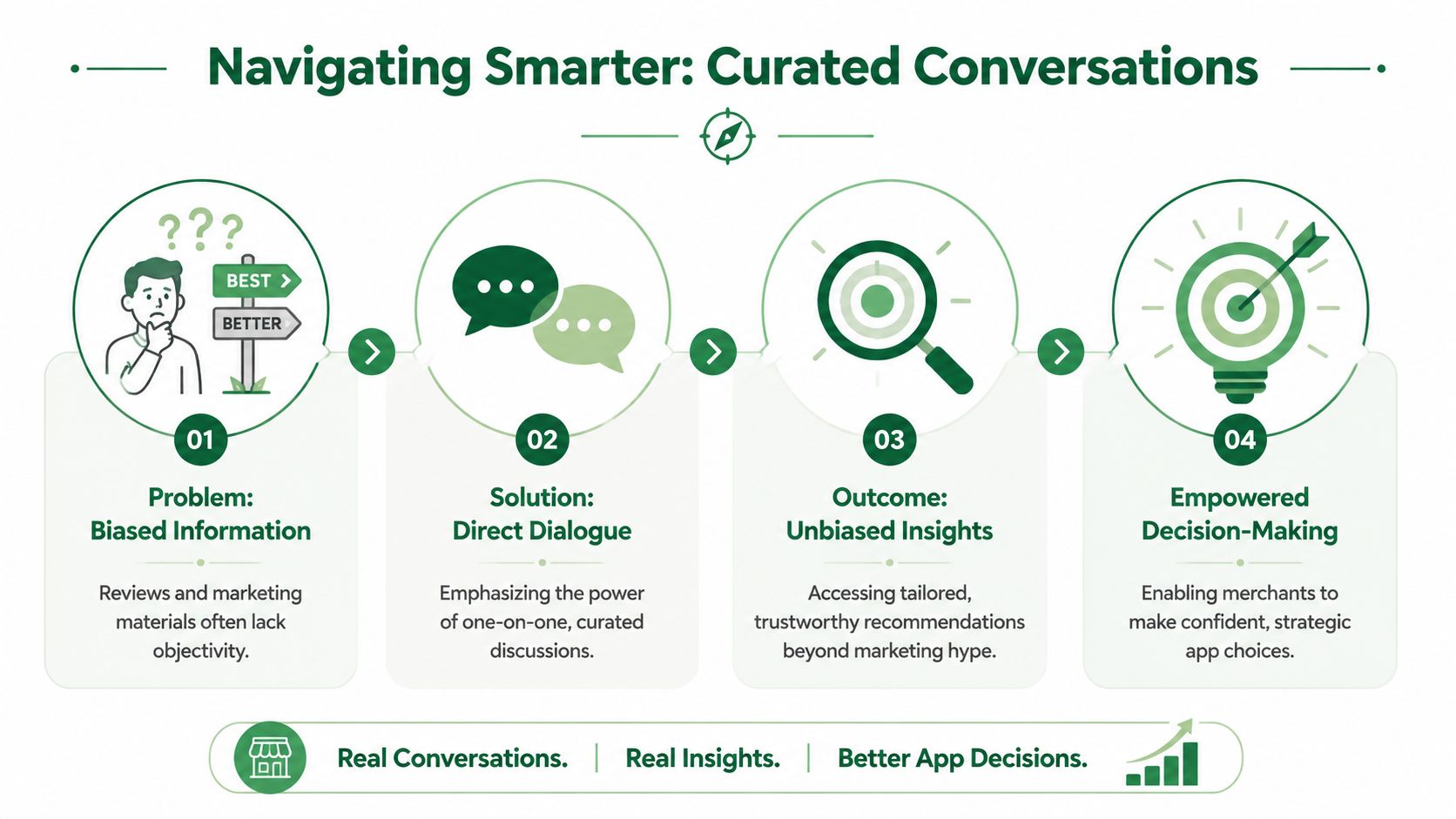
The most reliable way through a crowded market is direct conversation. Not more listicles. Not another generic comparison page. Actual discussion with the people building the product and the operators using tools in live stores.
Direct conversation beats passive browsing
For merchants, curated app conversations do a few things that the App Store alone can't do well:
They reduce noise. The merchant can skip broad browsing and focus on a smaller set of relevant tools.
They improve context. The app team can explain trade-offs, implementation details, and edge cases.
They provide influence. Merchants can influence product direction through feature requests and direct feedback.
They open access. Sometimes the conversation leads to early product access, commercial flexibility, or stronger founder-level support.
For app teams, direct merchant calls are just as valuable. They reveal where positioning is vague, where onboarding is failing, and where pricing creates hesitation. They also surface buying language that rarely appears in dashboards.
How teams can make this practical
A workable approach looks more like ongoing relationship-building than one-off research.
Talk before roadmap decisions
Product teams should speak with merchants before committing to feature expansion, pricing changes, or repositioning.
Use calls to test buying friction
Sales and UX teams should listen for where merchants hesitate, not just where they say yes.
Keep the feedback loop narrow
Small, relevant conversations beat broad low-context surveys when the goal is product clarity.
A practical option here is App Store Research, a platform that connects Shopify merchants with paid product research interviews with app developers and UX teams. For operators, that creates a quieter way to discover emerging tools, shape products through direct feedback, and get paid for time. For app teams, it creates a structured path to merchant interviews without relying only on cold outreach or App Store reviews.
The best merchant research conversations often improve product decisions and pipeline quality at the same time.
This is one of the more important Shopify app ecosystem trends to watch. As trust gets harder to earn in public channels, private, curated conversations become more valuable.
Your Action Plan for 2026 and Beyond
The practical response to current Shopify app ecosystem trends isn't to stop using apps. It's to get stricter about selection, clearer about workflows, and more intentional about who gets access to the stack.
For merchants and operators
A simple operating discipline goes a long way.
Audit the stack on a schedule: Review overlap, usage, and value before renewals pile up.
Buy workflows, not widgets: Prioritize apps that simplify real business processes.
Pressure-test pricing: Ask what happens to cost as order volume, team size, or usage grows.
Talk to vendors directly: Short conversations often reveal more than long listing pages.
Stay close to product teams: Good vendors often respond well when merchants give specific feedback.
For app teams and agencies
The lesson is different but just as clear.
If a team wants | It should focus on |
|---|---|
Better retention | Clearer ROI and tighter workflow fit |
Better positioning | Merchant language from real interviews |
Better product decisions | Recurring feedback, not one-off opinion gathering |
Better trust | Specificity, transparency, and support quality |
The merchants shaping the next generation of Shopify tools are often the ones willing to share operational detail, point out friction, and explain what's worth paying for. The app teams that listen closely will build stronger products. The merchants who participate in those conversations will usually discover better tools earlier and avoid more expensive mistakes later.
Shopify operators, agencies, and app builders who want that kind of access can join app store research to share product feedback in paid conversations. The network includes 3,000 operators and has paid out $1M in incentives, giving merchants a practical way to influence the apps they use, discover new tools without the usual spam, and get compensated for their time.

Author
Jonathan Kennedy
Jonathan Kennedy is the founder of app store research and shopexperts, platforms that connect operators, founders, and experts across the Shopify ecosystem to drive better decisions, product development, and growth.