Best Shopify Mobile App Builders: An Operator's Guide 2026
/
Should a brand launch a Shopify mobile app because mobile traffic is high, or because the economics finally support one?
That distinction matters more than the feature grid. For stores doing $500K+ a month, a mobile app can improve repeat purchase rate, lift push-driven campaign revenue, and give the retention team a channel they control. For stores without enough returning-customer density, the app often turns into overhead. More QA, more creative to ship, more lifecycle work, and another surface that has to earn its keep.
That is the lens for this guide.
You will not get another generic roundup of app builders with the same recycled pros and cons. The useful question is whether an app fits the current stage of the business, then which builder matches the way the team operates. Some brands need speed and low internal lift. Others need tighter design control, stronger native behavior, or a cheaper way to test whether app demand exists at all. The evaluation process should look a lot like a disciplined framework for evaluating Shopify apps before rollout, not a rush to install the most talked-about vendor.
The field is established. Appbrew includes Tapcart, Shopney, MobiLoud, Plobal Apps, MageNative, OneMobile, and Evlop in its best Shopify mobile app builders roundup. That matters because the decision is no longer whether tools exist. The trade-off is which builder fits your revenue base, team capacity, and retention model.
Teams also need to separate two decisions that often get blended together. One is whether an app deserves budget right now. The other is whether a builder approach or a more custom cross-platform mobile development model makes more sense for the business. Those are not the same call, and treating them as one is where plenty of app projects start drifting before launch.
Should you build a mobile app yet
Should a Shopify brand build an app as soon as mobile traffic gets big? Usually no.
An app earns its keep when it improves repeat purchase behavior, lifts conversion for high-intent customers, or gives the team a retention channel that email and SMS are not covering well. If it does not change purchase frequency, average order value, or margin after channel costs, it is another operating expense with app store overhead attached.
For stores doing $500K+/mo, the primary question is not whether mobile matters. Mobile already matters. The question is whether enough of that demand comes from existing customers who will install, opt into push, and buy often enough to justify the extra channel. That is the standard to use in a practical Shopify app evaluation process, not a feature checklist.
What mobile is actually for
Mobile apps are retention infrastructure. They work best for brands with repeatable purchase cycles, active merchandising, loyalty mechanics, and enough campaign cadence to make push notifications valuable. Beauty, replenishment, specialty food, drops, and membership-driven brands tend to have a clearer case than stores selling infrequent, one-off purchases.
A good mobile app should create one of three outcomes. More repeat sessions from existing buyers. Faster checkout for known customers. Better response to launches, restocks, and segmented offers.
If the mobile site already converts well and the brand has no meaningful reason for a customer to install an app, the app will struggle. Download counts can look respectable at launch and still produce weak long-term revenue if the installed base does not return.
Practical rule: if the strategy is “we should have an app too,” the economics are usually weak.
When the channel usually makes sense
The app channel tends to make more sense once the store has enough scale to treat retention as a system, not a campaign-by-campaign scramble. That usually means the team already knows its repeat customer cohorts, has a clear promotional calendar, and can support another owned channel without slowing down the core site.
That threshold often shows up more clearly above the mid-market range, especially for operators already investing in CRM, loyalty, subscriptions, or frequent product drops. At that point, the upside is less about novelty and more about control. Push can be cheaper than paid reacquisition. App users often move faster from intent to checkout. Merchandising teams also get a more direct line to high-value customers.
The failure case is easy to miss. Brands launch an app before they have repeat behavior, before they have a reason to drive installs, or while their mobile web experience still has basic conversion problems. In those cases, the app does not fix the business. It adds complexity on top of it.
Tapcart, strongest for hands-off, fast-to-launch
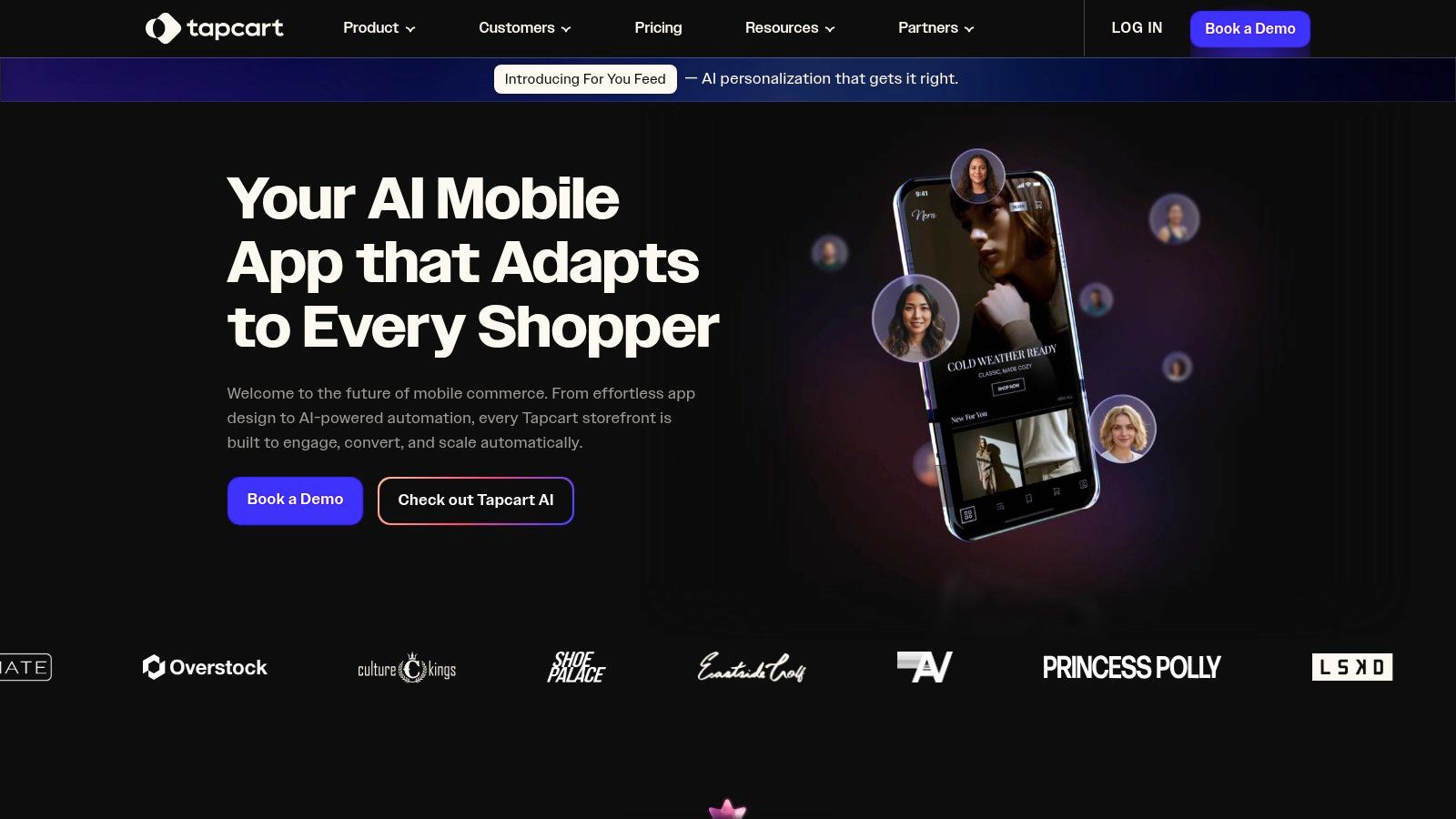
Tapcart is usually the cleanest choice for brands that want an app live fast, with minimal internal overhead and no appetite for a parallel product roadmap. For operators already doing meaningful volume, that matters. Speed to launch only has value if the team can keep the channel merchandised, promoted, and tied to retention revenue after the app store release.
The appeal is straightforward. Tapcart stays close to how Shopify teams already work. Merchandising, collections, product sync, and campaign execution feel familiar, which lowers training cost and reduces the odds that the app becomes an orphaned side project.
Where Tapcart fits
Tapcart fits brands that want execution speed over deep app-layer originality. If the goal is to get push notifications, mobile-first merchandising, and a branded checkout path into market without pulling developers into weekly app tickets, it does that well.
That is why it tends to work best for operators with a clear retention playbook already in place. Stores running frequent drops, restocks, launches, or member-style promotions can often justify the channel faster because the team already knows what to send, who to target, and how to measure repeat purchase lift. In that context, a fast-launch builder is not just convenient. It can shorten time to payback.
The constraint shows up later. Brands that want unusual navigation, custom account flows, deeper logic across subscriptions or loyalty, or a materially different app experience from the mobile site can run into ceiling effects. At that point, the question is less about launch speed and more about how much strategic control the team is giving up for convenience.
Cost discipline matters here too. Tapcart can be a strong fit and still become an expensive one if the brand adds premium functionality before the app has earned its keep. Teams evaluating total app overhead should review ways to reduce Shopify app costs without bloating the stack, especially if multiple retention tools are already in play.
A disciplined buyer should also assess the surrounding app ecosystem, support model, and long-term operating fit, not just the storefront demo. The practical standard is simple. Can the team run the app profitably, keep merchandising aligned with the core store, and avoid creating another channel that needs constant cleanup? That is the kind of due diligence covered in this guide to Shopify app evaluation.
For a $500K+/month store, that is the key Tapcart decision. It is not whether the platform can launch an app. It is whether fast, low-lift execution is the highest-value answer for the stage the business is in.
Mobiloud, strongest for native mobile from your existing site
MobiLoud fits operators who already invested heavily in mobile web and do not want to rebuild that experience inside a separate app builder. Its model is different from template-first platforms. It packages your existing site into a native app, handles app store submission, and adds push plus ongoing maintenance through a managed-service setup.
For a $500K+/month store, that can be a real advantage if the mobile site already carries the weight of the business. Many larger brands have years of work tied up in PDP logic, subscriptions, search, account flows, landing pages, content modules, and custom integrations. Recreating all of that in a second merchandising system is not just tedious. It creates another surface that can drift, break, or lag behind the core storefront.
That is the core MobiLoud trade-off. You get speed to app launch and much less rebuild work. You also accept that the app experience will be constrained by the quality of the site you already have.
Why the model appeals to larger operators
The strongest use case is simple. The site is already good on mobile, the team wants native distribution and push, and no one wants to manage a second front end just to get an app live.
In that setup, MobiLoud can reduce operational drag. Merchandising changes happen on the main storefront. The app reflects those changes without forcing the team to duplicate work in a separate builder. For lean ecommerce teams, that matters more than flashy app design controls.
I have seen this matter most for brands with custom stacks. The more logic a store has across subscriptions, memberships, product personalization, or account tooling, the less attractive a rebuild becomes. Costs rise fast when the app project turns into "recreate the website, then maintain both."
That cost discipline matters because app ROI is often lost in maintenance, not launch. Teams trying to keep total software overhead under control should review practical ways to reduce Shopify app costs before adding another retention channel.
The failure case is just as clear. If the current mobile site is slow, awkward, or conversion-soft, an app wrapper will not fix the underlying experience. It may improve retention for existing customers who already know the brand, but it rarely rescues a weak mobile journey.
So MobiLoud is strongest for a specific stage of operator. The store already has a disciplined mobile site. The team wants app-store presence and push. The business values operational simplicity over deep app-specific design control.
A direct platform reference is available at MobiLoud.
Vajro, strongest at the price point
Vajro earns its place for one reason. It gives mid-market Shopify teams a faster path to app-based retention without pushing them straight into enterprise-level cost and complexity.
That matters for brands doing serious volume but still watching payback periods closely. At roughly the stage where mobile starts to matter as a retention channel, but every new platform still has to justify itself, Vajro often fits better than higher-priced builders with broader customization.
Where Vajro makes financial sense
The strongest use case is a store that already has repeat purchase behavior, an active promo calendar, and enough customer demand to make push notifications, app-exclusive drops, and live selling worth operating. In that situation, the app is not just a branding project. It is a channel that needs to drive more repeat orders, higher customer retention, and better response to launches.
Vajro tends to appeal to operators who want those retention mechanics packaged into a plan that is easier to forecast. That is a practical advantage. App ROI often breaks because software spend expands in small increments through add-ons, support needs, and extra operating work. Teams preparing for Shopify Plus scaling readiness usually benefit from choosing systems that keep that complexity contained early.
There is also a staffing reality here. Some brands do not need full design freedom. They need an app that marketing can run every week without waiting on developers or rebuilding every campaign from scratch.
The trade-off experienced operators should watch
The upside is value per dollar. The limit is ceiling.
Vajro works well for merchants who want a capable app program with clear retention use cases and reasonable launch support. It becomes less comfortable when the team wants highly custom app journeys, unusual UX logic, or tighter control over how the mobile experience differs from the storefront. At that point, the lower price point can stop being an advantage if the app starts forcing the brand into template decisions it has outgrown.
That is the failure case operators rarely discuss. A lower-cost builder can still be expensive if the team outgrows it in 12 months and has to replatform after building audience habits around the first app.
The direct platform reference is Superfans.
Plobal, strongest for design control
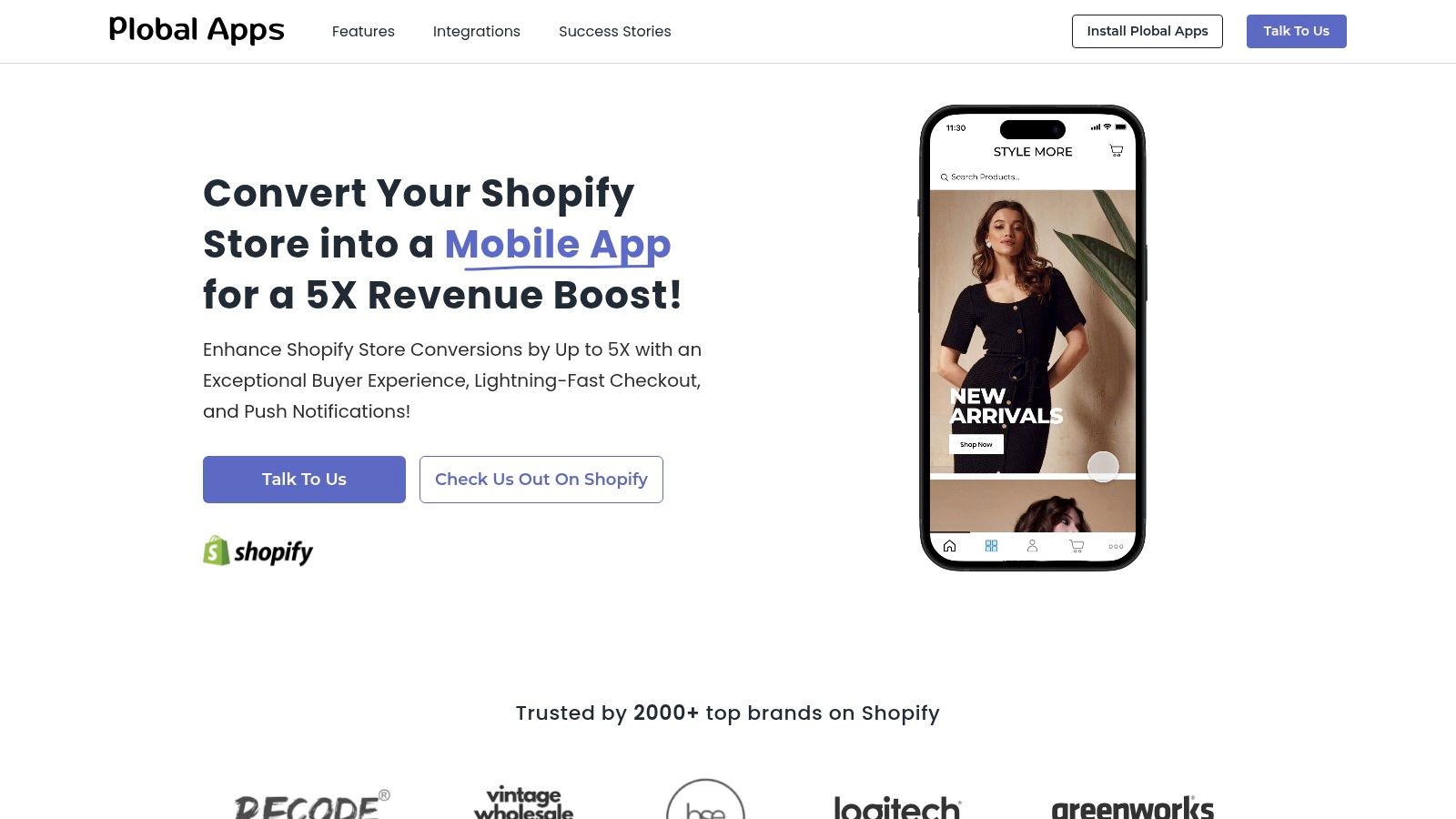
Need tighter control over how the app looks, merchandises, and changes week to week? Plobal is usually the better fit for that brief.
This option tends to make sense for brands that are past the “just get an app live” stage. The team already knows mobile can drive repeat revenue. Now the question is whether the app can become a stronger merchandising surface than the mobile site, especially for stores pushing frequent launches, category edits, bundles, and segmented campaigns.
That is where Plobal stands out. It gives operators more room to shape the in-app experience around the brand, instead of accepting a lighter template system and working around its limits. For a store doing meaningful volume, that control can matter. A small improvement in how collections, drops, or loyalty-driven offers are presented inside the app can change repeat purchase behavior enough to justify the extra operating effort.
The catch is straightforward. Design control only pays off if someone owns it.
If the retention team has a clear calendar, if creative can support app-specific merchandising, and if lifecycle marketing is already disciplined, Plobal can be a strong fit. It also lines up well for brands planning for Shopify Plus scaling readiness, where channel consistency and tighter merchandising systems start to matter more. If none of that infrastructure exists, extra flexibility becomes another surface to maintain.
That is the trade-off operators should price in before signing. Plobal gives more control than the lighter builders, but it also asks for more decisions, more QA, and more internal follow-through. Teams that want a mobile app channel with minimal weekly management may find that this level of flexibility creates drag instead of advantage.
A common failure case looks like this. The brand chooses the more configurable platform because the demo looks sharper, then treats the app like a side project after launch. Six months later, the app still exists, but merchandising is stale, push strategy is weak, and the mobile channel is underperforming because nobody is running it with intent. In that situation, design freedom was not the asset. Focus was.
The direct platform reference is Plobal Apps.
Pricing & realistic ROI math
The easiest way to waste money on a Shopify mobile app is to compare vendor pricing without pricing the operational burden. Monthly software cost is only part of the bill. The bigger cost often sits inside the team.
The cost questions that matter more than the sticker price
The first question is whether the builder charges in a way that stays legible as the app channel grows. Flat pricing is simpler to model. Tiered pricing can be fine if the breakpoints are predictable. Anything that turns success into a tax deserves close scrutiny.
The second question is what has to be rebuilt. If the app requires separate homepages, campaign blocks, navigation logic, and merchandising routines, that's not just software spend. That's a process change.
The third question is how much the app can move repeat revenue. If the brand lacks app-exclusive value, meaningful push strategy, or enough returning customers to sustain adoption, even a modest monthly fee can become dead weight.
A useful mental model is simple:
(Monthly App Cost / (AOV * App CVR)) / Repeat Customer Rate
That isn't a universal finance model. It is a sanity filter. It forces the operator to ask how many existing customers must become active app buyers just to justify the channel. If the answer feels implausible, the app is probably early.
For a team evaluating tapcart vs mobiloud, this is usually the core difference. Tapcart asks the brand to operate a purpose-built app surface. MobiLoud asks the brand to extend the mobile site it already runs. One can create more app-specific flexibility. The other can reduce duplicated effort. The right answer depends on where the hidden labor is lower.
When mobile fails (the cases nobody talks about)
Most failed app projects don't fail because the vendor was incompetent. They fail because the business never had a strong app use case in the first place.
The common failure patterns
The first pattern is weak repeat behavior. If customers buy infrequently, there's little reason to install an app unless the brand offers something materially different there.
The second pattern is no app-only value. Operators launch an app that behaves like the mobile site, then wonder why adoption stalls. If the app doesn't create a better habit, faster path, stronger reward, or more relevant communication loop, customers won't keep it.
The third pattern is internal neglect. An app can't become a forgotten side channel. Someone has to own push cadence, campaign planning, homepage freshness, and channel-specific merchandising.
A fourth pattern is stack mismatch. Some merchants buy a flexible builder, then don't have the product or design resources to use it well. Others buy a managed wrapper when what they really need is deeper native customization. Both lead to disappointment, just from opposite directions.
Mobile fails when it becomes a solution in search of a problem.
This is also why serious product teams increasingly seek direct operator feedback while building. In a crowded category, even small feature requests can shape roadmap priorities, pricing decisions, and partner strategy. That's one reason app founders use merchant interview networks instead of relying on shallow review data or sales calls.
Top 10 Shopify Mobile App Builders, Feature Comparison
Feature grids are useful, but operators making a real app decision usually need one thing the vendor pages avoid: fit. A builder can look strong on paper and still be the wrong buy for your team, margin profile, or retention model. Use this table to narrow the field by operating reality, not by headline features.
App | Best fit / Target brands | Key features / USP | Pricing / Cost note | AppStoreResearch benefit (soft CTA, 3k operators, $1M paid) |
|---|---|---|---|---|
Tapcart | US DTC brands that want a polished app fast and have a team ready to merchandise it weekly | Drag-and-drop editor, real-time Shopify sync, native checkout, AI tools | Tiered pricing. Costs rise once you add premium integrations and deeper analytics | Call with devs for incentives, influence features, early access |
Shopney | Brands that care about predictable software spend and want strong retention tooling without enterprise complexity | White-label iOS/Android, unlimited push, broad integrations for loyalty and subscriptions | Transparent flat pricing, commission-free plans | Discover integrations, get paid feedback, find deals |
Superfans (Vajro) | Brands focused on loyalty, community, and live selling that want heavier support from the vendor | Unlimited blocks and pushes, live streams, design manager, Slack support | Revenue-based pricing. Can get expensive as the business scales | Influence roadmap, get founder consults, earn incentives |
Plobal Apps | Teams that will actually use more merchandising and segmentation control, especially across growth stages | Drag-and-drop apps, segmented push automation, analytics, CSM support | Multiple pricing structures, including a starter tier. Some usage fees apply | Migration advice from vendors, paid sessions, product input |
Apptile | Creative-led teams that want more design freedom now, with room for custom development later. Also a fit for brands preparing for more operational complexity on Shopify Plus. Shopify Plus readiness considerations matter here. | 100+ design tiles, live selling, SDK and CLI for pro-code customization | Low entry price. Metered fees can show up around live-video usage | Test creative tools, shape UX, receive paid incentives |
Shop2App | Brands outgrowing template-first tools, especially stores with subscriptions, B2B needs, or heavy metafield use | Unlimited blocks, deep integrations with Recharge and Klaviyo, dedicated implementation teams | Higher starting price. Premium tiers enable more advanced flows | Bespoke implementation chats, paid feedback, negotiate help |
MageNative | Cost-sensitive brands that need native app basics without a large upfront software commitment | No-code builder, analytics, AR previews, social login, multi-currency | Budget-friendly with annual discounts. Integration depth is lighter than higher-end tools | Find affordable options, score deals, participate for pay |
Appmaker | Teams that need conditional logic, custom APIs, and more developer flexibility than template-led builders provide | Real-time sync, conditional blocks, code blocks, custom API support | Higher base pricing. Some plans take a share of in-app sales | Get dev guidance, influence integrations, earn paid calls |
MobiLoud | Brands with a strong mobile site that want an app presence without rebuilding the experience inside a separate editor | Web-to-app conversion, app store deployment, maintenance, push notifications | One-time setup plus monthly fee. Low engineering lift, but UX will stay closer to the site than a purpose-built native app | Rapid build feedback, talk to founders, paid participation |
Venn Apps | Shopify Plus brands, larger catalogs, and teams that want an agency-style partner for a more customized app rollout | Custom app design, advanced metafields, omnichannel support, international support | Higher monthly investment and longer onboarding than self-serve builders | White-glove consults, influence enterprise features, paid calls |
Decision framework
Choosing your builder or waiting
Should a store at your scale launch an app now, or keep the budget focused elsewhere?
The answer usually comes down to channel ownership and repeat purchase behavior. Stores doing meaningful volume can still waste money on an app if nobody owns pushes, app merchandising, campaign QA, and post-launch iteration. The brands that get paid back quickly already have retention discipline. The app gives them another high-intent surface to monetize. The brands that struggle usually expect the builder itself to create demand.
Builder choice follows that same logic.
Tapcart fits teams that want the fastest path to a Shopify-native app with low operating friction after launch. MobiLoud fits brands that already invested heavily in mobile web and do not want to rebuild the customer experience inside a separate app editor. Vajro makes sense when budget matters, but the store still wants push and core retention tooling. Plobal is the better fit when design control, merchandising logic, and app-specific UX could change conversion enough to justify more build complexity.
The practical question is simple. Who will run this channel every week?
An app becomes expensive fast when it turns into another surface the team only updates during big promos. That is the failure case operators do not talk about enough. App installs alone do not create incremental revenue. Consistent pushes, exclusive offers, fast QA, and clean merchandising do.
For a quick screen, use this:
Choose Tapcart if speed to launch and ease of management matter more than deeper customization.
Choose MobiLoud if your mobile site is already strong and rebuilding it as a more custom native app would burn time without a clear upside.
Choose Vajro if you want a better price-to-capability balance and can live with some ceiling on customization.
Choose Plobal if tighter control over app UX and merchandising will likely improve retention or conversion enough to cover the extra effort.
Wait if app traffic will start low, repeat purchase is weak, or no one on the team clearly owns app performance.
That last point matters more than feature comparisons.
At this end of the market, basic capabilities are expected. Catalog sync, push notifications, merchandising blocks, analytics, and Shopify compatibility are not what decide ROI. The harder questions are operational. How much work does campaign setup take? What breaks after theme changes? How dependent will your team be on the vendor for routine updates? How quickly can merchandising test and ship? Those are the details that separate a profitable retention channel from a side project that absorbs budget.
Before signing, pressure-test the vendor against your actual store economics. Ask for examples that match your AOV, catalog complexity, and repeat purchase pattern. Ask what adoption looks like after the first few months, what your team has to do each week, and where brands usually get stuck. Those answers will tell you more than another polished product demo.
For teams looking at mobile distribution more broadly, that evaluation also overlaps with questions like best app store optimization tools. Install growth matters. Retention, merchandising discipline, and ownership decide whether the app earns a permanent place in the stack.

Author
Jonathan Kennedy
Jonathan Kennedy is the founder of app store research and shopexperts, platforms that connect operators, founders, and experts across the Shopify ecosystem to drive better decisions, product development, and growth.