Top Respondent.io Alternatives for Shopify Operators (2026)
/
Top Respondent.io Alternatives for Shopify Operators (2026)
Respondent is good. But a Shopify operator's expertise is usually worth more than a generic B2B panel can recognize.
On Respondent's website, the value proposition is clear. It connects professionals to paid research studies across software, business workflows, and industry topics. For a lot of operators, that's a perfectly useful starting point.
The problem shows up after a few weeks on the platform. Invites drift toward broad business profiles. Screening gets repetitive. A deep ecommerce operator who runs Shopify apps, retention, merchandising, and conversion work can end up competing for the same studies as a general “marketing manager” who has never touched a Shopify stack. That mismatch matters when the best conversations happen with teams building the products used every day.
This guide focuses on respondent.io alternatives for experienced Shopify operators and B2B researchers who want more relevant projects, better alignment, and more influence in the calls they take. For operators thinking beyond one-off incentives, the upside is bigger than payout alone. It's access, influence, and direct contact with the founders and teams shaping the ecosystem. For a parallel view on where stronger ecommerce decisions come from, ButterflAI's eCommerce growth strategy is worth a read.
Table of Contents
What Respondent does well
Strong starting point for general B2B research
A Shopify operator might spend one week evaluating subscription apps and the next week weighing payroll software, analytics tools, or agency platforms. Respondent is useful in that second category. It performs best when the study needs a credible business respondent with the right title, company profile, or software exposure, but does not depend on deep commerce-platform nuance.
That makes it a practical panel to keep active if your experience spans ecommerce, SaaS, operations, or agency work. You will see studies that sit outside the Shopify app ecosystem, and some of them are worth taking because they pay well and expose you to adjacent tools that still affect store performance.
Use it for horizontal business topics.
Practical rule: Keep Respondent in your mix for broad B2B interviews, product tests, and market feedback. Use narrower panels when the project depends on hands-on Shopify operating depth.
Respondent also benefits from familiarity on the buyer side. Researchers know how to field interviews there, and experienced participants already understand the screening flow. If you want a refresher on what strong research sessions look like from the participant side, the SubmitMySaas guide to conducting user interviews is a solid reference.
Where it still earns a place
There is still a scale argument. Similarweb's May 2026 competitor view shows Respondent operating in a crowded category with larger traffic leaders around it, which matters less as a verdict on Respondent and more as proof that demand is spread across multiple recruiting models, not concentrated in one default platform (Similarweb competitor analysis for Respondent.io).
For experienced operators, the takeaway is straightforward. Respondent remains useful if you want access to general professional research and are willing to screen selectively.
The limitation is not payment mechanics or legitimacy. The limitation is fit. If incentive structure matters as much as topic relevance, it helps to compare how specialist panels handle participant incentives and payouts before treating Respondent as your primary channel.
Where it falls short for ecommerce specialists
A Shopify operator finishes a long screener, gets accepted, and joins a call that turns out to be about generic B2B software buying behavior. That happens often enough on broad panels to matter.
Generalist supply creates weak ecommerce matching
Respondent can screen for role, company size, and budget authority. The problem is that ecommerce expertise is usually more specific than those fields capture. There is a real difference between an ecommerce lead with hiring authority and an operator who has worked through Shopify Plus migrations, app reviews, checkout constraints, subscription churn, merchandising tests, and agency handoffs.
For Shopify specialists, that difference is the whole point of participating. The best projects are not broad “tell us about your business tools” interviews. They are conversations with app teams, agencies, and SaaS founders who need input from people running the stack every day.
That is where a general panel starts to lose precision.
Why relevance matters more than volume
A large panel can produce a lot of study listings while still giving ecommerce operators a mediocre hit rate. More applications go to studies that are only loosely related to store operations. More accepted sessions end up focused on general business workflows instead of the decisions that shape revenue, retention, conversion, and app spend.
G2's competitor page for Respondent shows the platform in a crowded field of alternatives, which is useful context for one reason. It reminds you there is no default panel that fits every research need equally well (G2's Respondent alternatives page).
For experienced Shopify operators, the cost is opportunity cost. A low-fit study does not just burn 30 or 60 minutes. It also crowds out the chance to speak with a founder, product team, or researcher working on tools you may install, recommend, or reject.
That is why niche panels can outperform larger ones for this audience. They value operational specificity over generic professional credentials.
If you care about whether the time pays off, compare both study relevance and how specialist panels handle participant incentives and payouts. The strongest option is usually the panel where your Shopify experience is the qualification, not a minor filter attached to a broad business profile.
The best panel for a Shopify operator is the one that produces the highest share of studies tied to real platform decisions, not the one with the biggest feed.
User Interviews strongest as a general alternative
Best fit
You finish a day in Shopify, check your study invites, and want one thing from a general panel. Fewer logistics problems and a better shot at speaking with a real product team. User Interviews does that better than most broad alternatives.
User Interviews stands out because it is not just a directory of paid calls. It also handles the operational layer around recruitment, including screening, scheduling, reminders, and participant management. For experienced operators, that usually means less time lost to messy coordination and low-signal outreach.
It is a strong choice when your expertise overlaps with broader business topics such as retention workflows, subscription operations, CX tooling, analytics setup, or purchase decision-making across an app stack. In those cases, being a Shopify operator helps, but the study does not require a Shopify-native panel to be useful.
A useful benchmark for teams recruiting their own users is this guide on targeting and recruiting participants.
Trade-offs
Breadth is still the constraint.
User Interviews works best as a generalist platform with better research operations than many competitors. That makes it attractive for researchers who need qualified professionals quickly. It does not automatically make it the best earning surface for a seasoned Shopify operator whose real value comes from platform-specific judgment, store complexity, and app adoption experience.
That distinction matters in practice. A study about “business software buyers” may accept ecommerce operators, but it will not always pay a premium for knowing how Shopify Markets affects merchandising, how post-purchase apps change retention economics, or why a checkout extension gets rejected by operators who have already tested three similar tools.
For app teams and SaaS researchers, User Interviews is often the right answer when the brief is broad and the team wants a cleaner process. For merchants and operators who want more relevant calls, higher fit usually comes from panels that treat Shopify experience as the main qualification rather than one line in a professional profile.
Prolific strongest for academic and quantitative research
Best fit
A team needs 200 completed responses by tomorrow morning, and the brief is tightly defined. Prolific fits that job better than Respondent in many cases because the platform is built for fast survey fielding, structured tasks, and high-volume recruiting rather than paid expert conversations.
That matters for concept testing, pricing surveys, message validation, and other studies where consistency beats nuance. Prolific is often the cleaner choice when the goal is directional evidence from a broad sample, not a long discussion with an operator who has lived through three replatforming projects and six app migrations.
Screening still decides whether the data is usable. For teams refining qualification logic before launch, this guide on how to write screener questions for your project is a practical reference.
Trade-offs
For Shopify operators, Prolific usually has a lower ceiling.
The platform is strong when researchers want completed tasks, survey responses, and standardized inputs. It is weaker when your value comes from how you evaluate app overlap, diagnose retention problems from tooling choices, or explain why a checkout, subscriptions, or search solution failed inside a real store environment. That kind of judgment is harder to price and recruit for in a broad quantitative panel.
There is also a strategic trade-off for the participant. If your goal is to pick up paid studies, Prolific can be useful. If your goal is to get in front of product teams building for ecommerce and influence roadmap decisions with operator-level context, general quant panels rarely put you in the strongest position.
Use Prolific for volume and speed. Use specialist panels when your Shopify experience is the product.
appstoreresearch.com strongest for Shopify operators specifically
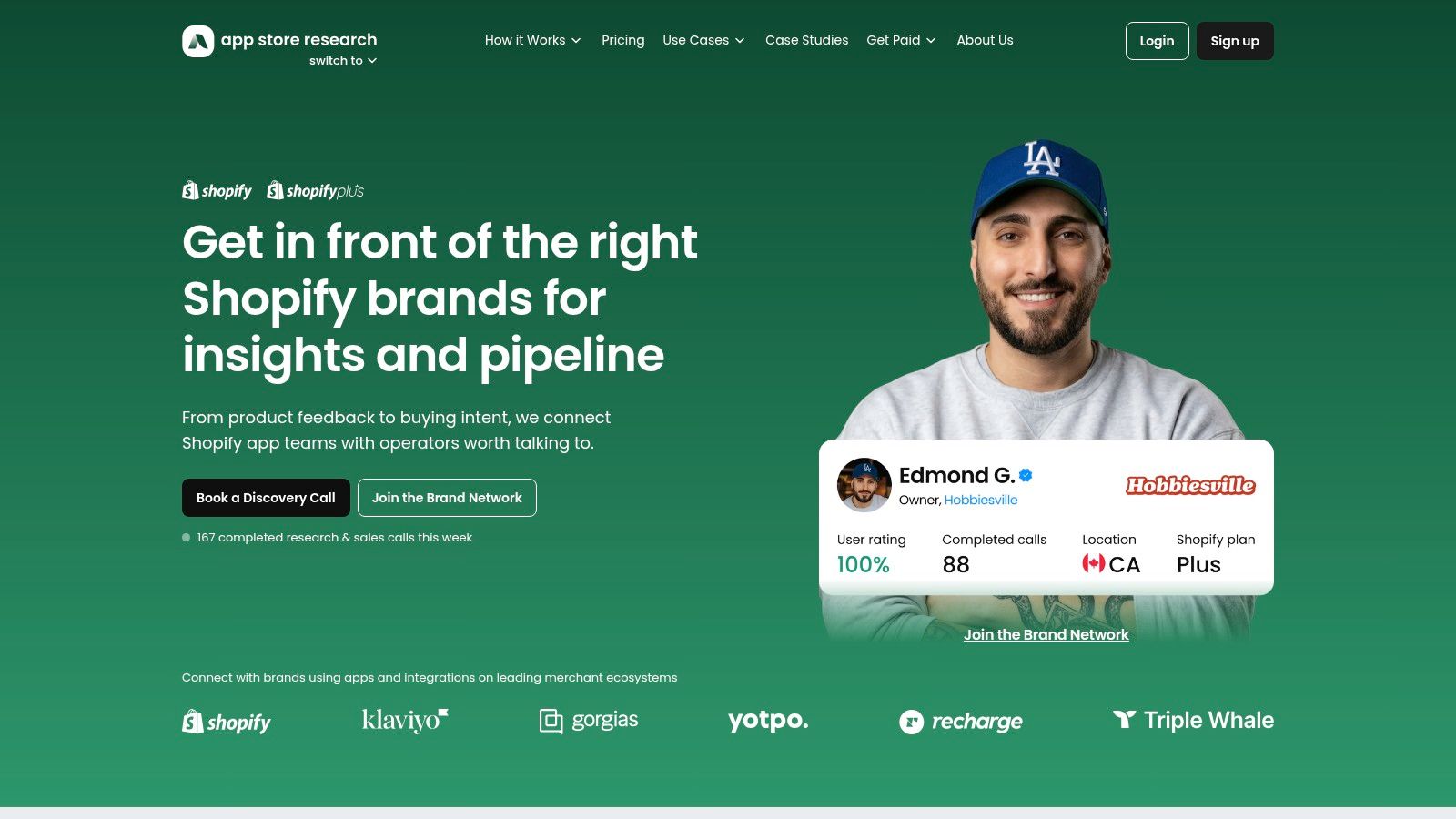
A Shopify operator joins a paid research call expecting another generic product interview. Ten minutes in, the researcher is asking about app overlap, checkout constraints, retention tooling, and why a migration created reporting problems across the stack. That is the difference with appstoreresearch.com. The study starts from store reality, not broad business demographics.
Why specialist panels change the economics
For Shopify operators, app store research is often the stronger choice because it prices and recruits around ecommerce judgment. General panels can verify your title. They are less reliable at identifying whether you have selected subscription apps, handled agency handoffs, audited storefront performance, or pushed back on bad implementation advice from vendors.
That changes both match quality and earning potential. If a product team needs feedback from people who live inside Shopify, a niche panel can screen for the decisions you make every week, not just the company you work for. Teams building studies in that category usually need tighter qualification logic too. This guide on writing screener questions for Shopify research projects shows the level of specificity serious recruiting requires.
The upside for the operator is practical. You are not only getting paid for time. You are getting access to the teams building tools you may buy, replace, recommend, or block.
Who should prioritize it
This fit is strongest for Shopify Plus operators, heads of ecommerce, lifecycle and retention leads, agency leaders, and founders who actively evaluate apps and workflows.
It is less useful if your experience is mostly general marketing, early-stage SaaS, or broad operations outside the Shopify ecosystem. A specialist panel gets stronger as your profile gets narrower. That trade-off matters. You will usually see fewer total invites than on a broad panel, but the projects are more likely to match your actual operating context.
For merchants and operators who want to understand the participant flow before committing, how app store research works gives a clear view of the process.
Operator lens: The best-paid conversations often come from decisions only a real Shopify operator can explain. Why one app made the stack harder to manage. Why another improved retention but hurt reporting. Why a feature looked good in a demo and failed in a live store.
How to use multiple panels strategically
A Shopify operator might qualify for three very different projects in the same week. A broad SaaS interview about budgeting tools. A fast survey on checkout behavior. A one-on-one call with an app team that wants feedback from someone who has managed subscriptions, retention flows, and app trade-offs inside a live store.
Those should not come from the same panel.
The practical setup is a panel mix with clear roles. Keep Respondent in the stack for broad B2B opportunities that fit your title and seniority. Use User Interviews for general professional studies that tend to run with tighter research operations. Use Prolific for survey-heavy or academic work where speed and volume matter. Use app store research for projects where Shopify context is the qualification, not just a nice-to-have.
That distinction matters because each panel pays for a different kind of signal. Broad panels reward category coverage. Ecommerce-specific panels reward operating context. If you run a Shopify store, advise brands on app selection, or own retention and merchandising decisions, the highest-value studies usually come from researchers who need that exact experience rather than generic “business decision-maker” credentials.
Current market direction points the same way. General platforms continue to compete on tooling, scale, and researcher workflow. Niche panels win by screening for narrower expertise and producing better-fit conversations. For Shopify operators, that usually means fewer invites, but a better hit rate on studies worth taking.
What fails is treating every panel as interchangeable. A moderated interview about app evaluation is a different recruiting job from filling a broad survey. A founder looking for message validation needs a different participant than a product team testing workflow friction with experienced operators. If the panel does not match the study, the screener gets sloppy, incentives drift, and the conversation turns shallow fast.
Experienced operators notice that immediately. Generic screener. Generic call. Generic payout.
Use the broad panels to keep volume steady. Use the specialist panel to get into the rooms where your Shopify experience carries real weight.
What ecommerce-specific panels look for in your profile
Profile signals that increase relevance
Specialist panels look for proof that an operator is close to real decisions. That usually means ownership over store performance, app evaluation, agency implementation, lifecycle programs, merchandising, conversion work, or platform migrations.
The profile should make that concrete in plain English. Name the stack categories handled. Mention whether the role sits brand-side, agency-side, or both. Clarify whether the operator influences purchasing, implementation, or vendor selection. Researchers and app teams care about operating context because it predicts whether feedback will be useful.
A short external primer on interview quality is this guide to conducting user interviews.
What to leave out
Generic résumé language hurts more than it helps. “Results-driven leader” doesn't help a screener. “Manages Klaviyo, subscription tooling, checkout experiments, search and merchandising apps, and post-purchase workflows” does.
The same goes for broad role inflation. If someone only advises occasionally on Shopify, that should be stated clearly. Ecommerce-specific panels are trying to avoid loose-fit applications because tight-fit participants create better conversations for everyone involved.
Respondent.io Alternatives: 10-Tool Feature Comparison
A Shopify app PM trying to recruit "ecommerce operators" can burn a week filling a study with broad B2B respondents who know retention theory but have never touched checkout extensibility, app billing, or merchandising rules. That is the essential sorting question in this category. Reach matters, but fit matters more.
The table below compares the main Respondent.io alternatives through that lens. For Shopify teams, the practical split is simple: generalist panels help with volume and broader recruiting coverage, while specialist panels produce tighter conversations and usually better economics for operators with real platform context.
Platform | Core features | Best for / Target audience | Quality & response | Price / incentives | Unique advantage / notes |
|---|---|---|---|---|---|
app store research | Vetted Shopify operator panel; managed screening, scheduling, incentives, transcripts, and tagged insights | Shopify app teams; brand and agency operators; product, UX, and sales teams | High relevance for Shopify studies because participants are screened for operating context, not generic business seniority | Participants can earn up to $500/session; pricing by quote | Best fit when the study needs merchants, consultants, or operators who actually use the Shopify stack and can shape product direction. Join Brand Network or book a call: https://appstoreresearch.com |
User Interviews | Large panel; screeners, scheduling, incentive tooling, moderated and unmoderated support | Broad B2B and professional recruiting; teams needing speed across many profiles | Usually fills common professional audiences quickly; quality depends on screener discipline for niche ecommerce studies | PAYG; incentives are separate from the base plan; processing fee applies if User Interviews sends payouts | Good default choice for research ops teams running frequent studies across multiple segments |
UserTesting (incl. UserZoom/IntelliZoom) | Video-first testing, moderated and unmoderated workflows, recruiting, summaries | UX testing programs at scale across B2C and B2B | Strong for task-based feedback and broad usability recruiting; less precise than a niche panel for Shopify operator targeting | Sales-led pricing; incentive handling varies by project. For incentive planning, see https://appstoreresearch.com/help-center/paying-incentives | Best used for workflow observation and usability validation, not for highly specific merchant recruiting |
PlaybookUX | Moderated and unmoderated sessions, card sorting, tree tests, surveys, transcripts, and summaries | Teams that want qualitative and quantitative methods in one place | Flexible method mix; panel quality depends on how tightly the audience is defined | Pay-per-use panel credits; recruiting costs rise with panel usage | Useful for mixed-method teams that want one tool for tests, interviews, and survey work |
Maze Panel | Recruitment tied directly to Maze testing workflows; all-in credit model | Prototype testing, product iteration, and fast-turn validation | Efficient for quick studies where recruitment and testing need to stay in one system | Credit-based pricing typically includes incentives | Good operational fit for product teams already running Maze and wanting fewer handoffs |
Prolific | Survey-first participant pool with transparent pay guidance and sample controls | Academic research, commercial surveys, and structured online tasks | Strong for quantitative quality and clean survey execution; weaker for narrow B2B interview recruiting | PAYG; researcher sets participant rewards and pays platform fees | Best option here for academic-style studies or quant work, not deep Shopify operator interviews |
dscout Recruit + Live/Diary | Recruiting, live moderated sessions, and mobile diary studies with multimedia capture | Longitudinal and in-context qualitative research | Strong for rich longitudinal data and participant-submitted context over time | Premium pricing; custom quotes are common | Best fit for diary studies, habit tracking, and research that needs evidence from real-world use |
CloudResearch Prime Panels | Access to multiple panels, feasibility tools, and quote-based survey sourcing | Large-scale surveys and sample buying, especially US-focused work | Useful for scaling survey fieldwork fast across broad audiences | All-in survey quotes typically include incentives | Better for survey procurement than for nuanced ecommerce operator interviews |
TestingTime (Norstat) | Recruiting for tests, interviews, and focus groups with quoting and logistics support | Mixed-method studies, especially with European coverage | Solid option when geography, scheduling, and logistics matter as much as the panel itself | Subscription or per-order pricing | Good choice for European research operations and studies that may include remote or in-person sessions |
CleverX | Verified B2B experts, decision-maker targeting, messaging, and workflow tools | Senior B2B titles, buyer research, and feature validation | Better suited than general consumer panels for hard-to-reach professional roles | PAYG or subscription options depending on usage | Useful for expert recruiting when the target is seniority or function. Less tailored to Shopify-specific operating depth than a niche commerce panel |
For experienced Shopify operators, the highest-value opportunities usually come from the platforms that recognize platform-specific context early in the screener. A generic "head of ecommerce" match can still miss the mark. A panel that asks about app stack ownership, migration work, subscription tooling, checkout changes, or agency implementation gets closer to the work that qualifies someone to give useful feedback.
Gain Influence, Not Just Another Side Hustle
For a serious Shopify operator, research participation shouldn't sit in the same mental category as random survey work. The better framing is an advantage. A strong panel creates direct access to product managers, founders, researchers, and go-to-market teams building the software that shapes daily operating decisions.
That's why the best respondent.io alternatives aren't always the biggest. They're the platforms that respect context. User Interviews is strong when broad B2B recruiting and research operations matter. Prolific is strong when the need is quantitative speed and structured sample quality. Respondent still earns a place for general studies. But none of those fully replace a specialist network when the operator's expertise is specifically Shopify.
For ecommerce professionals, relevance changes the economics of participation. The compensation matters, but it isn't the whole story. Significant value comes from being in conversations where product direction can move. An operator can push on pricing friction, onboarding gaps, migration pain, reporting problems, or feature requests with the people able to act on them. In a crowded app market, that kind of access is worth more than another generic B2B screener.
That's also why niche research panels fit the current Shopify environment so well. Merchants are dealing with app cost pressure, too many vendors, too much outbound noise, and too little signal. A focused research network cuts through that. It gives operators a cleaner way to evaluate what's being built, build direct vendor relationships, and shape roadmaps before products harden around assumptions.
The payout is a byproduct of specialist value. The conversation is the asset.
For operators who are tired of broad panels treating deep Shopify work like generic business experience, app store research stands out because the projects are tightly aligned with what these operators do. The network is built for people who want influence over the tools in their stack, early visibility into what app teams are building, and compensation that reflects specialist expertise.
If a Shopify operator wants more relevant calls, better alignment with daily work, and direct access to the teams building the ecosystem, join the network at app store research. It's where experienced merchants and agency operators get paid to speak directly with app founders, product teams, and UX researchers. The value is influence and access first. The incentive follows.

Author
Jonathan Kennedy
Jonathan Kennedy is the founder of app store research and shopexperts, platforms that connect operators, founders, and experts across the Shopify ecosystem to drive better decisions, product development, and growth.