How To Make Extra Money as a Shopify Store Owner
/


Author
Jonathan Kennedy
Founder at appstoreresearch
Jonathan Kennedy is the founder of app store research and shopexperts, platforms that connect operators, founders, and experts across the Shopify ecosystem to drive better decisions, product development, and growth.
Most advice on how to make extra money as a Shopify store owner misses the actual constraint. It assumes the owner needs another business. In practice, most established operators don't need more ideas. They need income streams that don't steal attention from merchandising, retention, operations, and channel performance.
That's why the usual list falls apart fast. Starting a second store, building a niche content brand, or spinning up another low-margin offer can work in theory. For a time-poor operator, it usually creates a new set of problems that competes with the main store.
Table of Contents
Why most 'side income' lists are wrong for Shopify owners
The bad advice is not random
The better model is leverage
9 income streams ranked by $/hour and time-to-first-payout
What actually belongs on the list
Shopify owner side hustles ranked by ROI
The hidden one: getting paid for your operator expertise
Why app teams pay for operator feedback
Where this gets interesting for experienced operators
How brand owners in our network earn up to $250/hr
What app teams want to learn
Why some brand owners get invited more often
How to get started this week
A simple three-step setup
Why most 'side income' lists are wrong for Shopify owners
Most side-income lists are written for beginners, not operators running real stores.
That distinction matters. A merchant doing meaningful revenue already has a scarce asset. It isn't ideas. It's attention. Any recommendation that asks that merchant to launch, market, support, and optimize a second business is usually a poor trade.
The bad advice is not random
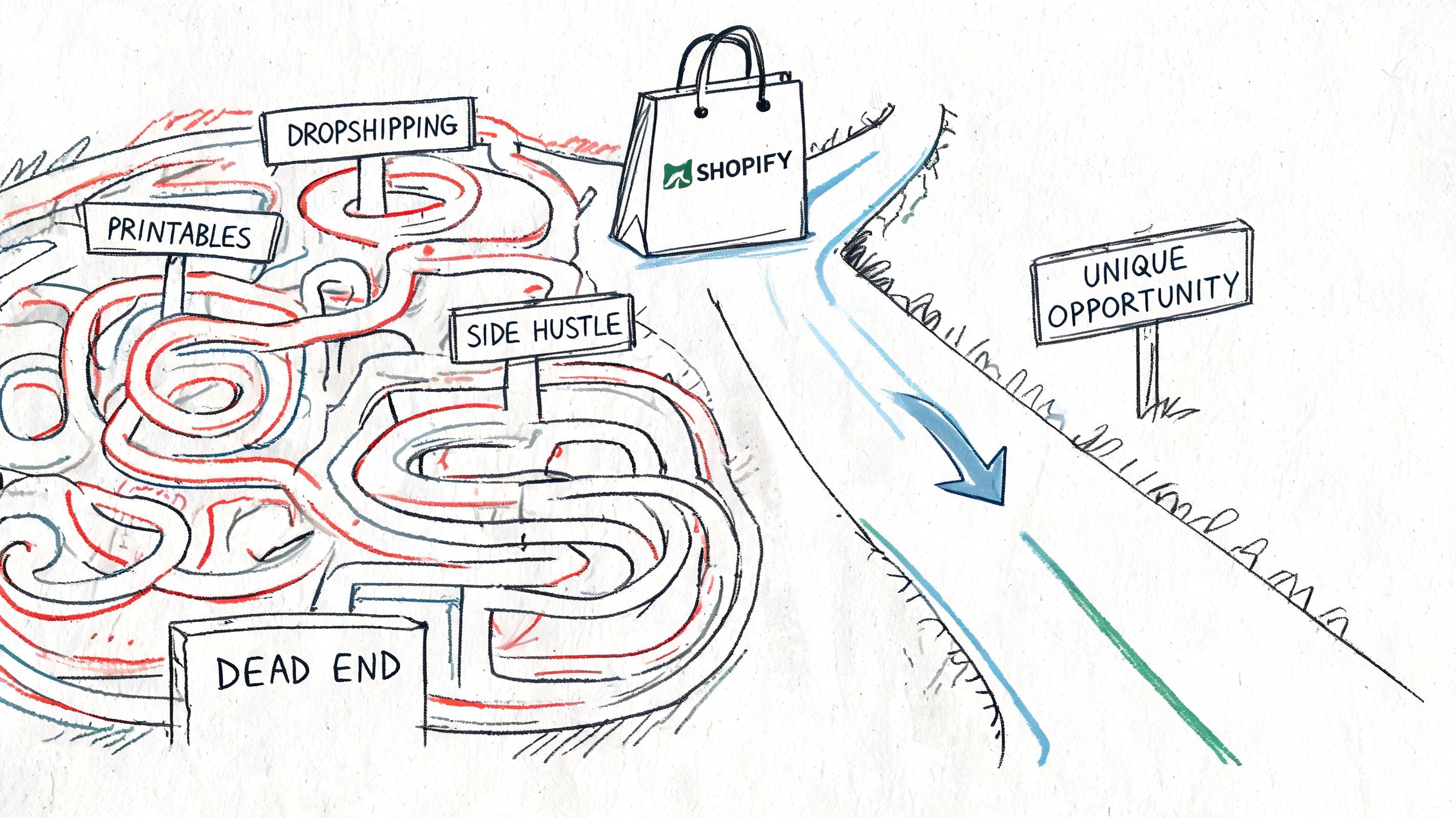
A lot of articles push print-on-demand, dropshipping, affiliate marketing, digital products, or content publishing because they're easy to explain. Some of those models are legitimate. They just aren't naturally aligned with a busy founder's calendar.
For example, Shopify notes that models like print-on-demand and dropshipping remove upfront inventory requirements and let merchants test multiple SKUs with near-zero working capital, but they also push the burden onto customer acquisition and the management of a second, often low-margin, operation, which is a real time cost for busy founders in Shopify's guidance on making money on Shopify.
Practical rule: If the side income idea needs its own acquisition engine, support queue, and app stack, it's probably not a side income stream. It's another job.
This is also why a lot of "easy passive income" advice underperforms for experienced operators. The work doesn't disappear. It just shifts into content production, list building, offer design, and ongoing maintenance.
The better model is leverage
The strongest second income for Shopify founders usually comes from assets they already have:
Operator judgment: Knowing which apps create friction, which workflows break, and where teams lose money.
Context from live systems: A real store has data, edge cases, and implementation constraints that software teams care about.
Pattern recognition: Merchants who have tested checkout, retention, subscriptions, returns, bundles, search, or email flows can spot weak product decisions quickly.
That kind of expertise is hard won. It's also marketable.
A founder who already spends time evaluating tools and fixing workflow problems can often make more by monetizing that judgment than by building another small ecommerce side project. Merchants who are already refining their stack can also sharpen that advantage by reviewing their Shopify app stack optimization decisions with a stricter lens.
9 income streams ranked by $/hour and time-to-first-payout
The usual list isn't completely wrong. It just treats every option as if the trade-offs are equal.
They aren't. A Shopify operator should care about two filters first: how long it takes to get to the first meaningful payout, and whether the work compounds existing expertise or distracts from the core store.
What actually belongs on the list
Some options create real upside but require a long setup. Others pay faster but don't scale well. A few sit in the sweet spot because they reuse experience the merchant already has.
The table below ranks common options qualitatively, not as a promise of exact earnings. Only one item in this category comes with verified payout data from the sources provided.
Shopify owner side hustles ranked by ROI
Income Stream | Est. $/Hour (Year 1) | Time to First $1,000 | Primary Challenge |
|---|---|---|---|
Paid app research interviews | Highest verified payout range | Fast | Requires a strong operator profile and relevant app experience |
Fractional ecommerce consulting | High | Medium | Needs positioning, referrals, and clear scope control |
Store audits for peers | Medium to high | Medium | Hard to standardize without turning it into an agency service |
UGC or creator partnerships for tools | Medium | Medium | Depends on audience trust and distribution |
Affiliate content for Shopify apps | Low to medium early | Slow | Traffic takes time and content has to rank or convert |
Paid newsletter or niche community | Low early, higher later | Slow | Requires consistent publishing and audience trust |
Course or workshop for merchants | Medium later | Slow | Front-loaded production and support work |
Print-on-demand side brand | Variable, often low early | Medium to slow | Customer acquisition becomes the real business |
Dropshipping side store | Variable, often low early | Medium to slow | Operational complexity and margin pressure |
A few patterns show up quickly.
Consulting can pay well, but it usually arrives with hidden admin. Proposals, scoping, revisions, Slack access, and after-hours questions turn a clean hourly rate into something messier.
Affiliate income sounds attractive because it appears passive. In reality, a store owner has to publish, rank, distribute, and maintain trust. Without distribution, there is no affiliate business.
The right side income should borrow strength from the store. It shouldn't require building a second acquisition machine from scratch.
Courses and templates look efficient once sold, but they have a slow start. Recording, packaging, support, refund handling, and promotion all land on the founder.
POD and dropshipping remain common recommendations because they reduce inventory risk. They still force the merchant to solve demand generation, creative testing, offer positioning, and support. That's why they're often a weak answer for a founder who already runs one store.
The outlier is the option that doesn't require a second brand, new product line, or content engine. It pays for applied knowledge directly.
The hidden one: getting paid for your operator expertise
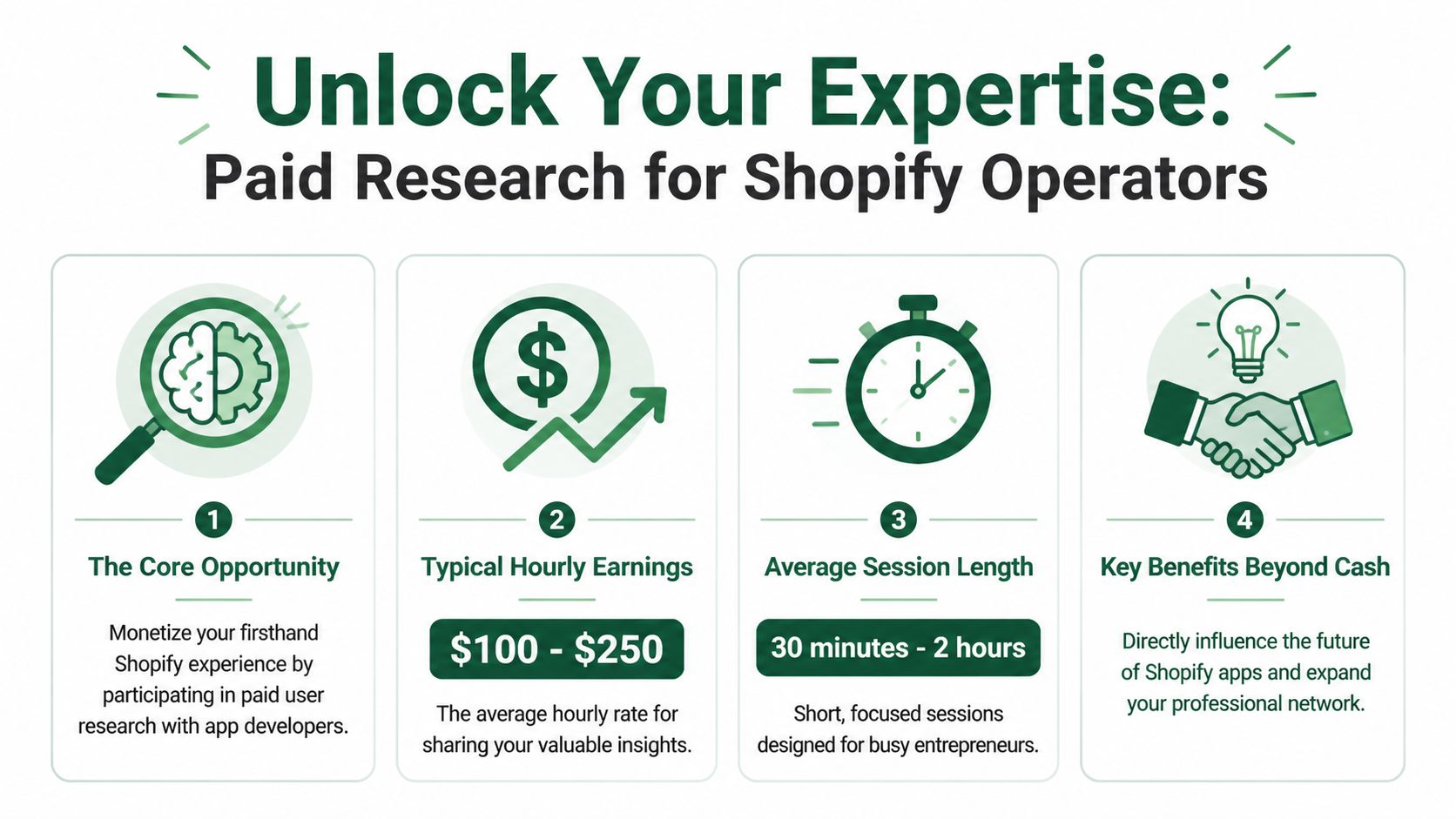
The best extra income stream for a Shopify owner is often hiding in plain sight. Selling operator insight to the app developers you already use can pay better, start faster, and create less overhead than building a second business.
App teams do not need another generic ecommerce opinion. They need a merchant who has chosen tools under pressure, handled a messy implementation, spotted where reporting breaks, and can explain why a workflow fails in the middle of a normal week.
Why app teams pay for operator feedback
One clear example is email. If a developer is building for retention, flows, segmentation, attribution, or campaign reporting, a merchant with hands-on lifecycle experience can save that team weeks of product guesswork. That is why an operator with practical channel knowledge can get paid for a short interview, and why studying how an email marketing consultant approaches segmentation, revenue attribution, and campaign structure helps sharpen the kind of feedback product teams will pay for.
The value is simple. A 45-minute call that prevents a bad feature decision, pricing mistake, or onboarding problem is cheap for the software company and high-margin for the merchant.
You do not need to package yourself as a consultant. In many cases, one focused call with a product manager or UX researcher is the whole job.
Where this gets interesting for experienced operators
A factual example is app store research, a platform that connects Shopify merchants with paid research interviews for app developers and UX teams.
The appeal is operational, not aspirational. No offer to build. No sales deck to write. No scope creep to manage. The merchant gets paid for context they already earned while running the store.
That setup also fits how experienced founders prefer to work. A strong profile with clear stack details, category experience, and examples of problems you have handled makes matching easier. Merchants who want those interviews to strengthen their reputation beyond the payout can review this guide on adding ASR consultant to a LinkedIn profile to strengthen operator credibility.
For Shopify owners, that is the hidden advantage. The highest-paying side income often comes from selling judgment, not starting another side hustle.
How brand owners in our network earn up to $250/hr
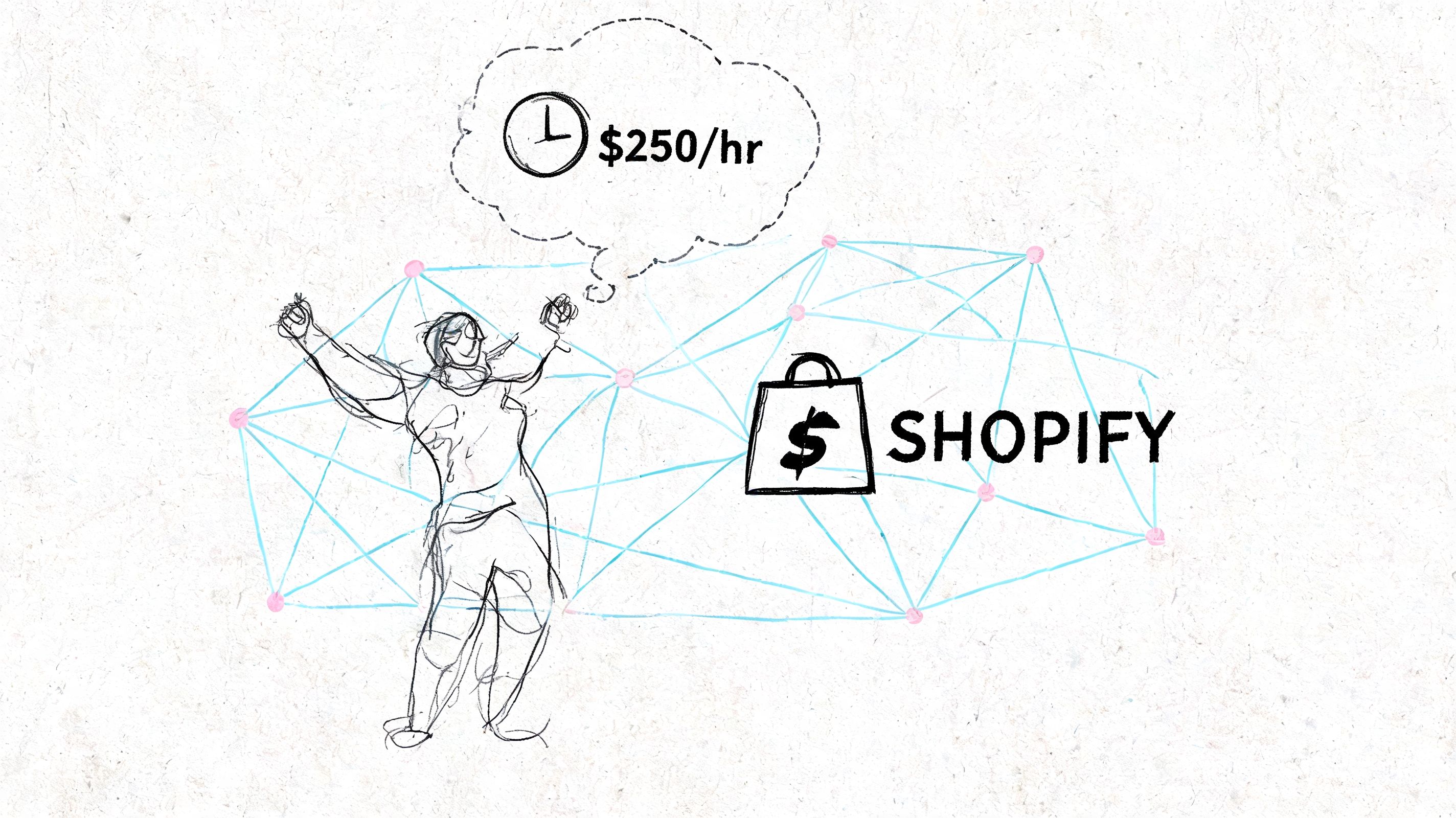
In our network, the highest hourly rates usually go to merchants with one thing: clear ownership over a painful part of the store. Product teams pay well when a founder or operator can explain how work gets done, where the process breaks, and what a better tool would need to fix.
That is why this income stream can beat the usual Shopify side hustle ideas on a dollars-per-hour basis. A store owner who has spent two years dealing with subscription churn, merchandising rules, checkout quirks, or inventory exceptions already has the hard part. The expertise is earned. The paid session is just the payout.
What app teams want to learn
A strong example is subscriptions. If a merchant has managed failed payments, skip logic, churn offers, prepaid plans, and win-back flows, that operator can save a subscription app team weeks of bad product guesses. One hour of specific feedback is cheap for the software company and high-value for the merchant.
The same pattern shows up across categories:
Merchandising tools: Teams want to understand collection logic, product discovery issues, and how operators balance margin, inventory, and conversion.
Retention apps: They look for firsthand detail on churn triggers, reorder timing, loyalty friction, and what customers ignore.
Operations software: They need to hear where exceptions pile up, where staff still use spreadsheets, and which automations fail under real store conditions.
The merchants who get booked fastest can describe a workflow in plain terms. They name the app stack, the bottleneck, the workaround, and the metric that matters.
Participant stories from Michael Bires and Darren Fenton are useful for seeing how this works in practice. The pattern is simple. They are not selling courses or trying to become creators. They are getting paid for operator judgment.
Why some brand owners get invited more often
Specificity wins.
The strongest participants can say what they own, what size store they run, which tools they use, and where money or time gets lost in the current setup. A founder who says, "We run a subscription brand and lose customers between second and third order because dunning recovery is weak," is far more useful than someone who says they know retention.
There is a second payoff beyond the session fee. These conversations often lead to earlier access to new tools, better support from app founders, and a clearer read on whether a product is worth installing at all. That matters if you already spend serious money on apps and do not want to add more software debt.
If you want a practical sense of what makes a profile matchable, this guide on how to become a participant in paid app research is a good place to start.
For experienced Shopify owners, this is the hidden opportunity. The best extra income often comes from selling hard-won operating context to the developers already building for your store.
How to get started this week
This only works if setup is simple. It is.
A simple three-step setup
Create a participant profile
Start with the participant sign-up page. Use plain language. List the store type, role, major tools, and categories where there is real hands-on experience.Add enough operating detail to be matchable
Good profiles mention tech stack, workflows owned, and where the operator has direct responsibility. Email, subscriptions, CRO, search, returns, analytics, bundles, post-purchase, or wholesale are all useful if they're genuine. This walkthrough on how to become a participant helps clarify what teams look for.Take the calls that fit
The best sessions are tightly matched. A merchant with direct ownership over lifecycle, merchandising, or app selection is much more useful than someone trying to sound generally knowledgeable.
This is the key filter for anyone searching monetize Shopify experience or second income for Shopify founders. The best option usually isn't adding another storefront. It's converting operating judgment into paid conversations with teams that need it.
For merchants who want a cleaner way to turn store experience into paid work, app store research offers a practical path. It connects Shopify operators with paid conversations with app developers and product teams, so experience with apps, workflows, and real store constraints can turn into direct compensation without building a second business.

Reviewed by
Filip Djokic
Product Designer at appstoreresearch.com
Filip is a Product and UI/UX Designer with over 10 years of experience in digital product design. With a strong background in the Shopify ecosystem, he focuses on improving user experiences and turning merchant insights into better product decisions at appstoreresearch..