Best Ecommerce Platform for Small Business: 2026 Guide
/
A founder usually starts with a simple question. Which platform gets the store live fastest without creating a mess six months later?
That question is rarely about templates or checkout buttons. It’s about what the business will have to carry after launch. Every platform decision changes the cost of app management, the amount of technical cleanup, the speed of merchandising changes, and how hard it becomes to add new channels later.
The best ecommerce platform for small business isn’t always the one with the longest feature list. It’s the one that fits the company’s operating model. A lean team needs something different from a brand with a dedicated developer. A content-led business needs something different from a catalog-heavy store with complex fulfillment rules. The wrong choice doesn’t fail immediately. It shows up later in theme workarounds, app conflicts, slow pages, and expensive rebuild conversations.
This guide looks at the platform choice the way operators experience it. Not as a software checklist, but as a foundation that affects cost, speed, flexibility, and decision quality across the whole business.
Table of Contents
Choosing Your Foundation The Small Business Platform Dilemma
A Framework for Choosing Your Ecommerce Platform
Start with total cost not sticker price
Measure the technical lift in weekly hours
Treat performance and scale as operating requirements
Audit the ecosystem before committing
The Main Contenders at a Glance
Ecommerce Platform Comparison for Small Businesses
Shopify The All-In-One Growth Engine
Why Shopify keeps winning for small businesses
Where the ecosystem changes the economics
When Shopify is the right call
WooCommerce and BigCommerce The Top Shopify Alternatives
Platforms built for control
Platforms with more built in
What small teams usually underestimate
Wix and Squarespace When to Choose a Website Builder First
The right fit for simple commerce
Where growth pressure shows up
Making Your Decision and The Path Forward
Choose for the next stage not just launch week
The app layer becomes the next real decision
Choosing Your Foundation The Small Business Platform Dilemma
A small business owner often hits this decision at the exact wrong time. Revenue matters now, the launch date feels close, and every platform demo looks good enough. The risk is treating the decision like a design choice when it’s really an operating model decision.
A store can launch on almost anything. The harder question is what happens after the first spike in orders, the first wholesale request, the first international push, or the first time the team needs better reporting and cleaner inventory workflows. That’s when a platform stops being a storefront and starts acting like infrastructure.

One founder might choose a low-friction setup because it’s easy to launch, then discover that product bundling, subscriptions, or channel sync require awkward workarounds. Another might choose a highly flexible setup because it seems future-proof, then spend too much time managing hosting, updates, plugin conflicts, and performance fixes instead of growing the business.
The platform decision feels large because it is. It affects who the business needs to hire, how quickly changes can ship, and how expensive growth becomes.
The strongest decisions usually come from a simple shift in thinking. Stop asking which platform has the most features. Start asking which platform creates the fewest operational headaches for the business model that already exists, and the one likely coming next.
That lens makes the trade-offs clearer. Some platforms reduce technical burden but limit edge-case flexibility. Others offer more control but hand more responsibility back to the merchant. Neither is automatically wrong. The mistake is choosing without understanding the second-order consequences.
A Framework for Choosing Your Ecommerce Platform
The fastest way to make a bad platform choice is to compare homepages and feature grids. Those views hide the actual cost. A better framework looks at what the business will need to maintain, adapt, and scale over time.
Start with total cost not sticker price
Monthly subscription cost matters, but it’s rarely the full story. Total cost of ownership includes design changes, developer support, app subscriptions, bug fixing, training, and the opportunity cost of a team waiting on technical work.
A platform with a low entry price can become expensive if every useful workflow needs custom development. A platform with a higher monthly fee can be cheaper if it removes hosting, security, maintenance, and a large share of ongoing troubleshooting.
A useful way to evaluate this is to list the first-year realities:
Launch work: theme setup, migration, catalog structure, policy pages, taxes, shipping logic
Ongoing changes: merchandising updates, landing pages, promotions, bundles, content edits
Hidden support load: plugin conflicts, checkout issues, speed fixes, integration problems
Decision debt: how often the team delays good ideas because implementation feels painful
For teams also thinking about monetization logic and packaging, pricing and packaging decisions for commerce products are easier when the underlying platform doesn’t make basic change requests expensive.
Measure the technical lift in weekly hours
Some founders say they want flexibility when what they really need is reliability. Technical lift is the amount of ongoing attention the platform demands from the team.
That includes routine maintenance, updates, testing after changes, and diagnosing why something broke. A business with an in-house technical operator may tolerate more complexity. A lean merchant team usually won’t.
Practical rule: If the platform requires a specialist for routine merchandising, it’s probably too heavy for an early-stage small business.
A good test is to ask who can do these tasks without escalation:
Create a new landing page tied to a campaign.
Adjust product merchandising for a seasonal push.
Install and evaluate an app or integration without fear of breaking core flows.
Troubleshoot a storefront issue quickly enough that revenue isn’t at risk.
If the answer is always “a developer,” the business is buying more complexity than it may need.
Treat performance and scale as operating requirements
Performance shouldn’t be treated as a luxury item for later. Slow storefronts increase friction, especially on mobile, and they make campaign traffic less efficient. Scale matters too. It’s not only about massive enterprise events. Even a small brand can hit pressure during launches, influencer traffic, promotions, or holiday weekends.
The right platform should give the business confidence that merchandising activity and traffic spikes won’t create a fire drill. That matters even more when a team depends on paid traffic, email campaigns, or social launches.
Audit the ecosystem before committing
No small business buys a platform alone. It buys the surrounding ecosystem of apps, agencies, freelancers, implementation patterns, and support resources. That ecosystem changes how fast the store can adapt.
A strong ecosystem helps when the business needs better search, subscriptions, reviews, B2B workflows, loyalty, analytics, merchandising, or international support. A weak ecosystem forces workarounds or expensive custom builds.
Before committing, merchants should audit three things:
App depth: are there mature options for the workflows the business already knows it needs
Operator familiarity: can agencies and hires step into the system quickly
Research visibility: can the team see how other merchants are solving the same problem
The platform itself matters. The ecosystem often matters more.
The Main Contenders at a Glance
Most small businesses don’t need dozens of platform options. They need a short list and a clear sense of trade-offs. The practical split usually comes down to commerce-first systems versus website-first systems.
Commerce-first setups tend to fit brands that expect operational complexity. That includes larger catalogs, omnichannel activity, stronger app dependency, or a team that wants cleaner long-term scale. Website-first setups tend to fit businesses where design presentation, content, or service sales lead the model and ecommerce plays a supporting role.
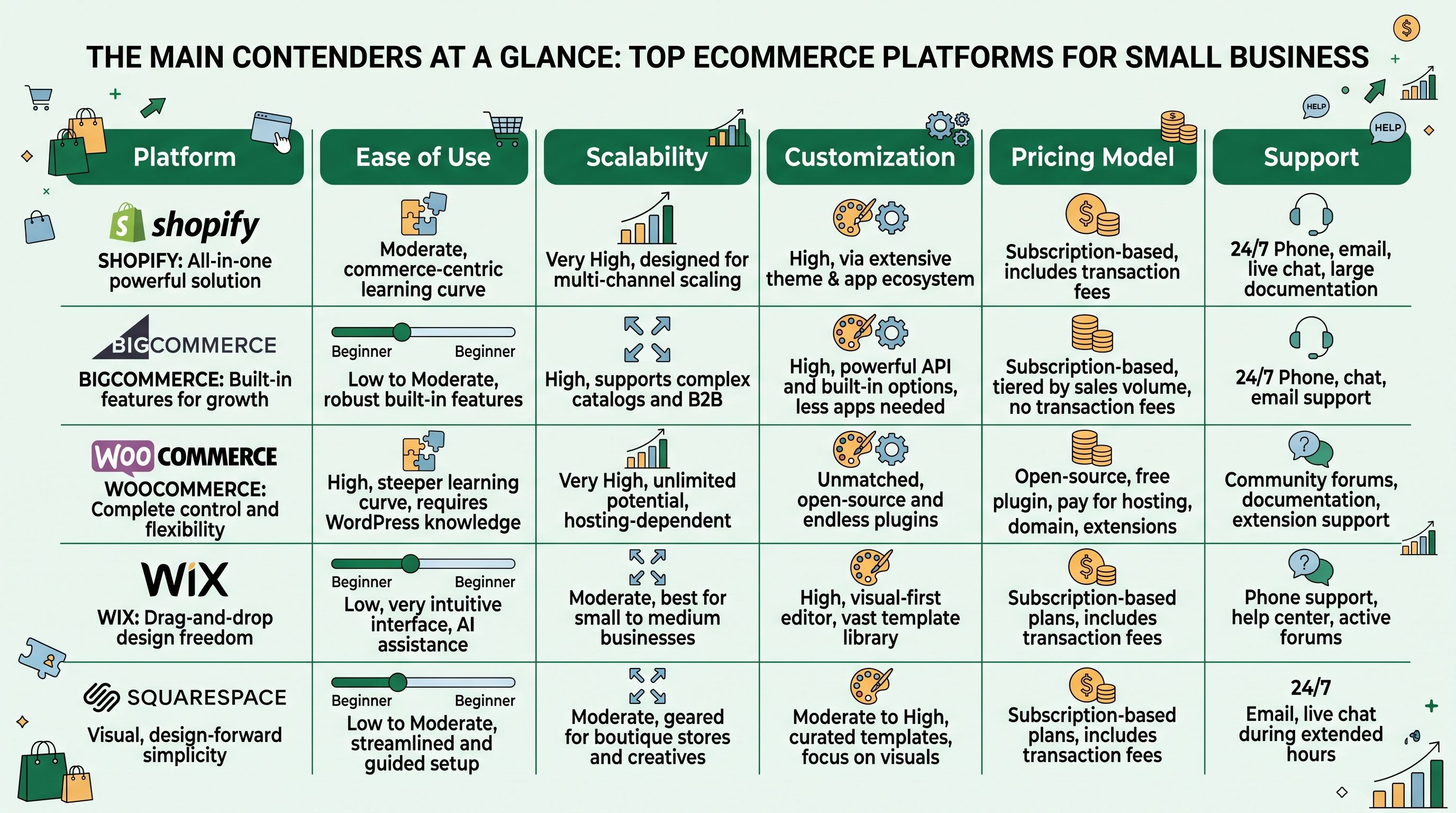
That distinction matters because the best ecommerce platform for small business depends less on abstract rankings and more on operational fit. A founder with no technical staff should value very different things from a team already comfortable managing infrastructure and custom code.
Ecommerce Platform Comparison for Small Businesses
Platform | Best For | Pricing Model | Technical Lift |
|---|---|---|---|
Shopify | Growth-focused small businesses that want an all-in-one commerce foundation | Subscription with platform-managed infrastructure | Low to moderate |
BigCommerce | Merchants who want strong native commerce features and can handle a more structured setup | Subscription | Moderate |
WooCommerce | Businesses that want deep control and are comfortable managing a more hands-on stack | Core software plus hosting, extensions, and development | Moderate to high |
Wix | Simpler storefronts where website presentation and ease of editing matter most | Subscription | Low |
Squarespace | Creator-led and service-led brands with limited product complexity | Subscription | Low |
A short reading of the table can be misleading, though. “Low technical lift” doesn’t mean “best for growth” in every case. “High control” doesn’t mean “best long-term choice” if the team can’t support that control in practice.
Merchants rarely regret choosing a platform that matches their operating capacity. They often regret choosing one that assumes resources they don’t actually have.
That’s why the next sections matter more than the label in a comparison row.
Shopify The All-In-One Growth Engine
For most small businesses with serious ecommerce intent, Shopify is the default recommendation because it reduces the amount of infrastructure the merchant has to think about while still supporting meaningful growth. That balance matters more than any one feature.

Why Shopify keeps winning for small businesses
Shopify’s small business platform overview states that Shopify stands out as the leading ecommerce platform for small businesses, consistently ranked #1 across multiple expert analyses in 2025-2026 due to its balance of ease of use, scalability, and features. The same source says it powers over 1.7 million live stores globally, that the Basic plan starts at $29/month with transaction fees of 2.9% + 30¢, and that its market share in small business ecommerce exceeds 28%.
Those numbers matter, but the practical reason many merchants choose Shopify is simpler. The platform handles hosting, security, payments, and core commerce infrastructure in a way that lets operators spend more time on merchandising, customer acquisition, retention, and creative work.
The operational benefit is often visible in ordinary tasks:
Store launches move faster because the core commerce stack is already assembled.
Non-technical teams can make more changes without escalating every request.
App selection is broader when the business needs to extend the stack.
Omnichannel selling is cleaner when online, retail, and social channels need to work together.
For teams planning future complexity, scaling readiness for more advanced Shopify operations becomes easier when the business starts on a platform designed for staged growth rather than a future rebuild.
Where the ecosystem changes the economics
A platform isn’t only software. It’s also the surrounding labor market and implementation environment. Shopify’s ecosystem is one of its strongest advantages because merchants can usually find app options, operator talent, implementation partners, and established workflows for common commerce needs.
That changes the economics of adaptation. If a brand needs subscriptions, better product discovery, post-purchase support, reviews, loyalty, or B2B functionality, the question often becomes which solution fits best, not whether the category is supported at all.
The strongest platform choice is often the one that keeps future decisions reversible.
That reversibility matters. A small business can start with a lean setup and add complexity later. It doesn’t need to overbuild on day one. It can choose a small set of apps, validate workflows, and refine the stack as operations mature.
When Shopify is the right call
Shopify is usually the right answer when the business is commerce-led, wants to grow without owning unnecessary infrastructure, and expects app usage to be a meaningful part of the operating model.
It’s especially strong for these cases:
Lean operator teams: they need reliability and straightforward admin workflows.
Brands planning channel expansion: they want online, point-of-sale, and social selling to work together.
Merchants who value speed: they need campaigns, merchandising updates, and app testing to happen without heavy development overhead.
Businesses that expect complexity later: they want a path forward without a full replatform.
The trade-off is that Shopify won’t be the preferred answer for every edge-case customization philosophy. Some merchants want maximum control at the infrastructure level. Others want a more website-led experience. But for the broad middle of small businesses trying to build a durable commerce operation, Shopify remains the strongest overall fit.
WooCommerce and BigCommerce The Top Shopify Alternatives
The main alternatives to Shopify usually appeal to founders for one of two reasons. They want more direct control over the stack, or they want more commerce functionality included before they start adding apps.
Platforms built for control
Some founders are drawn to a self-managed setup because it offers more freedom in how the site is hosted, customized, and extended. That freedom is real. So is the maintenance burden that comes with it.
On a small team, control only pays off if someone can consistently own updates, compatibility checks, speed issues, and checkout troubleshooting. If nobody owns those jobs, they land on the founder, an agency, or a developer who bills by the hour. That changes the economics fast.
The second-order cost shows up after launch. A plugin conflict can break checkout. A theme update can affect page speed. A hosting issue can turn a promotion day into a support problem. None of that appears on a feature checklist, but it absolutely belongs in total cost of ownership.
Platforms with more built in
Other alternatives appeal to merchants who want more native commerce functionality from day one. That approach can reduce app count in some areas, which sounds attractive to a small business trying to keep software spend under control.
The trade-off is usually flexibility. A platform with more built-in logic can work well when the business model is already clear and the native workflows fit how the team wants to sell, ship, and market. Problems start when the business changes direction and the platform’s ecosystem is thinner, implementation options are narrower, or the team has trouble finding people who know the system well.
That is the part many founders miss. You are not just buying software. You are buying into an ecosystem of apps, developers, support resources, and operational constraints.
What small teams usually underestimate
Feature comparisons flatten the decision. Day-to-day operating friction is what separates these options.
Performance, maintenance, and integration behavior all affect how much time the team spends on growth versus cleanup. If the platform requires more hands-on work to keep pages fast, apps compatible, and storefront changes stable, that cost shows up in slower campaigns, more QA, and higher developer dependence. If the ecosystem is narrower, each new requirement can take longer and cost more to implement.
I have seen founders save money on platform fees, then give it back through agency retainers, emergency fixes, and app workarounds. That is still platform cost. It just sits in a different budget line.
A flexible platform is only useful if the team can afford the work that flexibility creates.
A practical way to assess these alternatives is to ask three blunt questions:
Who handles uptime, updates, and troubleshooting? If the answer is a freelancer, agency, or the founder after hours, include that full cost.
How often will the business need new behavior? Promotions, bundles, subscriptions, B2B rules, and channel expansion all put pressure on the platform differently.
What happens when the stack grows? App ecosystem depth, integration quality, and available developer talent matter more in year two than in week two.
For technically capable teams with a clear reason to manage more of the stack themselves, these alternatives can make sense. For merchants who already know their operating model and want a platform that covers more natively, they can also be a fit. For many small businesses, though, the harder question is not what the platform can do at launch. It is what the platform will cost in time, complexity, and adaptability once the business starts changing.
Wix and Squarespace When to Choose a Website Builder First
Not every small business is commerce-first. Some are brand-first, creator-first, or service-first, with ecommerce added as a sales channel rather than the core operating system. That’s where website builders can be the right answer.
The right fit for simple commerce
Wix and Squarespace usually fit businesses with a relatively simple catalog and a strong need for visual presentation. That includes consultants selling a few digital products, creators with limited physical inventory, artists, studios, and service brands adding lightweight commerce to an existing website-led presence.
In those cases, the biggest need isn’t operational depth. It’s ease of editing, strong presentation, and a straightforward way to publish pages and accept orders.
That makes these platforms attractive when the business values:
Fast site editing: landing pages, galleries, and service content often matter as much as product pages.
Smaller catalogs: the business doesn’t need advanced merchandising logic across large inventories.
Lower operational complexity: fewer moving parts means less admin work.
Website-led storytelling: content and brand presentation are central to conversion.
Where growth pressure shows up
The limitation appears when the business starts behaving like a more mature ecommerce operation. That’s when teams want deeper app support, stronger inventory workflows, more nuanced merchandising, or greater flexibility in how systems connect.
A website builder can still be perfectly good software and still be the wrong fit for a scaling commerce model. That distinction matters. The issue isn’t whether the platform works. It’s whether it continues to fit once the business depends on ecommerce as a primary growth engine.
Some small businesses need a beautiful website with checkout. Others need a commerce system that happens to include a website. Those are different jobs.
A useful self-test is simple. If the team expects ecommerce to become the center of marketing, operations, and customer retention, a commerce-native platform usually makes more sense. If the store is one part of a broader web presence and operational complexity is likely to stay light, a website builder may be enough for a long time.
Making Your Decision and The Path Forward
The cleanest way to decide is to match the platform to the business the team is equipped to run. Not the idealized version with infinite resources. The version, with current staff, current technical confidence, current budget discipline, and current growth priorities.
Choose for the next stage not just launch week
Shopify is usually the strongest fit for merchants who want a balanced, commerce-first system with room to grow. WooCommerce makes more sense when the business wants deeper control and can support that responsibility. BigCommerce can fit merchants who prefer a more built-in commerce approach. Wix and Squarespace are often better when the website leads and the store supports.
Founders often overvalue what helps them launch and undervalue what helps them adapt. Launch friction is visible. Adaptation friction shows up later, often after the business has already committed time, data, design work, and internal habits to the platform.
The app layer becomes the next real decision
Once the platform is chosen, the next set of gains usually comes from the app ecosystem and the decisions layered on top of it. That’s where operators shape search, reviews, upsells, retention, support, merchandising, subscriptions, and analytics.
Those choices deserve the same discipline as the original platform decision. A weak app stack can create almost as much operational drag as a weak platform choice. Merchants who want to understand how others evaluate switching risk, replacement decisions, and ecosystem fit can review competitive research and switching analysis workflows.
The long-term advantage goes to teams that keep learning from real operator experience. Platform choice is not a one-time branding decision. It’s an ongoing operating decision, and the best merchants treat it that way.
If a merchant, agency operator, or Shopify team wants to share real platform and app experience, app store research offers paid opportunities to speak with app developers and UX teams. It’s a practical way to influence the tools shaping the ecosystem while getting paid for thoughtful feedback.
Made with the Outrank app

Author
Jonathan Kennedy
Jonathan Kennedy is the founder of app store research and shopexperts, platforms that connect operators, founders, and experts across the Shopify ecosystem to drive better decisions, product development, and growth.